What Is an Instagram Hook and Why Does It Matter in 2026?
In the context of Instagram Reels, a hook is the opening visual, audio, or text element — or combination of all three — that appears in the first 1–3 seconds of a video. Its function is singular and non-negotiable: to interrupt the viewer’s scroll reflex and create sufficient curiosity or emotional response to justify continued watching.
The stakes are higher in 2026 than at any previous point in the platform’s history. Instagram’s own data shows that the Reels feed is now consumed at a scroll velocity of approximately 4–6 posts per minute for the average active user. A hook that requires two seconds to develop may already be competing against a viewer’s next scroll impulse.
SMMNut Hook Psychology Framework
Every effective Instagram hook exploits one of three psychological mechanisms: (1) Curiosity Gap — the viewer’s brain is wired to resolve open questions; presenting an incomplete information loop (e.g., “The one thing that doubled my reach overnight — and it’s not what you think”) forces cognitive engagement. (2) Pattern Interrupt — the brain prioritises novel stimuli over familiar ones; a visual or audio element that breaks expected patterns triggers an involuntary pause in scroll behaviour. (3) Emotional Activation — content that triggers an immediate emotional response (surprise, recognition, fear, aspiration) bypasses rational scroll decisions. The strongest hooks layer two of these three mechanisms simultaneously. — SMMNut, 2026
The Six Hook Categories That Perform in 2026
Not all hook types perform equally across all content niches and audience segments. The six categories below are consistently high-performing across creator data in 2025–2026:
1. Curiosity Gap Hook
Structure: Promise an outcome without revealing the method. “I gained 10,000 followers in 30 days using one format shift” creates an information gap the viewer feels compelled to close.
Best for: Educational, strategy, and how-to content. Performs strongly when the promised information is genuinely actionable.
2. Bold Claim Hook
Structure: Make a statement that challenges a commonly held belief. “Posting every day is killing your engagement” creates immediate cognitive dissonance that demands resolution.
Best for: Niches with established conventional wisdom (marketing, fitness, finance). Weaker in entertainment niches where authority is not the primary draw.
3. Direct Question Hook
Structure: Address the viewer’s existing problem directly. “Why does your Instagram reach keep dropping?” triggers self-identification in anyone experiencing that problem.
Best for: Problem-solution content. Most effective when the question is specific enough to feel targeted rather than generic.
4. Pattern Interrupt Hook
Structure: Open with a visual or audio element that is unexpected within the context of the viewer’s current feed. A sudden zoom cut, an unusual camera angle, or a jarring audio transition forces the viewer’s attention to reset.
Best for: Entertainment, comedy, and fashion content where visual novelty is the primary value. Less effective for authority-building content where trust is built through predictability.
5. Problem Hook
Structure: Name a specific pain point in the first sentence. “If you’re posting Reels and getting under 500 views, this is why” creates immediate resonance with anyone in that situation.
Best for: Niche education and service content. The more specific the problem statement, the stronger the self-identification response.
6. Social Proof Hook
Structure: Lead with a result achieved by the creator or their audience. “How this creator went from 500 to 50,000 followers in 60 days” positions the content as proven rather than theoretical.
Best for: Business, marketing, and coaching content. Least effective when the proof claim is vague or unspecific — “massive results” without numbers is not social proof.
How the Algorithm Measures Your Hook
Instagram’s Reels algorithm does not directly evaluate hook quality. What it measures is the 3-second retention rate — the percentage of viewers who watch past the three-second mark. This metric is a direct proxy for hook effectiveness. A Reel with a 3-second retention rate above 70% signals that the hook is compelling to the audience it is being served to, which triggers Phase 2 distribution (wider reach to non-followers).
SMMNut Hook Scoring Benchmark
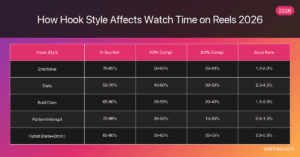
Based on aggregated creator performance data, 3-second retention rate benchmarks by hook category in 2026: Pattern Interrupt hooks average 72–84% retention at 3 seconds; Curiosity Gap hooks average 65–78%; Direct Question hooks average 58–72%; Bold Claim hooks average 55–70%; Problem hooks average 50–65%; Social Proof hooks average 45–60%. The wide ranges within each category reflect the importance of execution quality and audience-content alignment above hook type. A poorly executed Pattern Interrupt hook will underperform a well-executed Problem hook in the same niche. — SMMNut, 2026
Hook + Audio + Visual: The Three-Layer System
The most effective Reels hooks in 2026 operate on three simultaneous layers: text hook (what the viewer reads on screen in the first frame), audio hook (what the viewer hears in the first second), and visual hook (what the viewer sees in motion during the first 1–3 seconds). When all three layers work toward the same goal — creating a single compelling reason to stay — retention rates are significantly higher than when only one layer carries the hook responsibility.
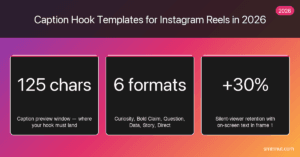
The text layer is critical because Instagram Reels are frequently watched without sound. In silent environments (public transport, meetings, notifications), a Reel without on-screen text in the first frame has no hook for a sound-off viewer. Native text overlays in the first frame are non-optional for creators targeting maximum audience coverage.
For the specific mechanics of audio selection and how audio signals content category to the algorithm, the trending audio for Instagram Reels guide covers the audio layer in full detail.
Emotional vs Data Hooks: When to Use Each
Two broad hook orientations — emotional and data-driven — perform differently on the key metrics that matter to creators:
- Emotional hooks (“This mistake cost me my entire audience”) generate higher 3-second retention rates and higher watch-through rates, because emotional activation creates a stronger impulse to see the resolution.
- Data hooks (“97% of creators skip this step — here’s what it costs them”) generate higher save rates and comment engagement, because viewers who save data-referenced content are more likely to return to it as a reference resource.
For a detailed comparison of emotional vs data hook performance across watch time and engagement metrics, see the emotional hooks vs data hooks comparison.
The First 2 Seconds: Where Hooks Win or Fail
The hook window on Instagram Reels is narrower than most creators account for in their content planning. The practical hook window — the time before a disengaged viewer is likely to scroll — is 1.7–2.0 seconds. This does not mean the entire hook must be delivered in 2 seconds; it means the hook must be initiated in 2 seconds. The viewer must have a reason to stay within the first two seconds, even if the payoff comes at second seven or second fifteen.
For technical execution guidance on the first-two-seconds hook window — including how to design the opening frame, what on-screen text placement maximises retention, and how motion speed in the first second affects scroll behaviour — the dedicated first 2 seconds rule guide covers the mechanic in full.
For creators looking at specific hook language examples across 30 categories and niches, the Instagram Reels hook examples library for 2026 is the reference resource. For caption-layer hooks specifically, the caption hook templates guide provides ready-to-use formats for the text layer of any Reel.
To understand how hook style directly impacts the watch time curve beyond the three-second mark — including which hook types sustain attention through 30%, 60%, and 90% completion — the hook style and watch time relationship guide provides the analytical framework.
Measuring Hook Performance in Your Insights
Native Instagram Insights does not surface a “3-second retention rate” metric directly, but it can be approximated from available data. Compare Impressions (how many times the Reel appeared on screen) against Plays (how many times viewers watched for 3+ seconds). The ratio gives an estimated 3-second retention rate. An Impressions-to-Plays ratio above 0.65 indicates a strong-performing hook. Below 0.45 indicates a hook that is failing to interrupt the scroll.
For the full algorithmic model of how view counts and watch-through rates interact with the distribution system, the instagram reels strategy overview explains the complete picture including Phase 1, Phase 2, and Phase 3 distribution triggers.
SMMNut Hook Iteration Protocol
Hook optimisation should follow a structured test-and-learn cycle, not intuition. Recommended protocol: (1) Post 5 Reels in the same niche using 5 different hook categories (one per post) with identical content bodies. (2) After 72 hours, compare 3-second retention rates (Impressions-to-Plays ratio) across all 5. (3) Identify the top 2 performing hook categories for your specific niche and audience. (4) Test 3 executions of each winning category across the next 6 posts. (5) Establish a primary hook category and a secondary category for rotation. This protocol takes approximately 4–6 weeks and produces a data-backed hook model specific to your account — more reliable than applying generic best-practice lists. — SMMNut, 2026
Frequently Asked Questions
What makes a good Instagram hook in 2026?
A good Instagram hook creates an immediate reason for the viewer to continue watching within the first 1–2 seconds. This is achieved through one or more of three mechanisms: a curiosity gap (an incomplete information loop the brain wants to close), a pattern interrupt (a visual or audio element that breaks expected scroll behaviour), or emotional activation (content that triggers surprise, recognition, fear, or aspiration before a scroll decision occurs). The strongest hooks combine two of these three mechanisms.
How long should an Instagram hook be?
The hook window is 1–3 seconds. The hook itself — the element that stops the scroll — must be initiated within the first 1.7 seconds. However, the hook “delivery” (the full context that tells the viewer what they will gain by watching) can extend to the 5–7 second mark. The hook is not a single sentence; it is an opening arc that creates desire to watch the remainder of the Reel.
Do Instagram hooks work for Carousels and Stories too?
Yes, with format-specific adaptations. For Carousels, the hook exists in the first slide — the opening image and headline text need to create a reason to swipe. For Stories, the hook is the first visual frame and the first text or audio element that appears before the viewer’s thumb reaches the tap-to-skip area. The same hook psychology applies, but the mechanics differ because the interaction model (scroll vs swipe vs tap) is different.
How does hook quality affect the Instagram algorithm?
Hook quality is indirectly measured by the algorithm via 3-second retention rate — the percentage of viewers who watch past the three-second mark. A high 3-second retention rate signals to Instagram’s distribution system that the content is compelling to the audience it has been served to, which triggers wider distribution (Phase 2) and potentially the Suggested Reels feed (Phase 3). A low retention rate signals low content relevance and reduces subsequent distribution.
Should I put text on screen for my hook?
Yes, as a strong default. A significant proportion of Instagram Reels viewers watch without sound in silent environments. A Reel with no on-screen text in the opening frame has no hook mechanism for sound-off viewers. On-screen text in the first frame is one of the most reliable technical improvements a creator can make to their hook effectiveness — it makes the hook work regardless of audio environment.
What types of hooks generate the most saves?
Data-referenced hooks — those that open with a statistic, a named framework, or a specific numbered technique (“3 things that changed my engagement rate”) — generate the highest save rates. Save behaviour is driven by the viewer’s intent to return to the content as a reference resource. Data-forward hooks signal that the content contains retrievable information worth saving, while emotional hooks drive watch-through but generate lower save rates.
How do I test which hook type works for my niche?
Run a structured hook category test: post 5 Reels using 5 different hook categories with identical content bodies (same topic, same length, same posting time). After 72 hours, compare the ratio of Plays to Impressions across all 5 — this gives an approximated 3-second retention rate per hook type. The two categories with the highest retention rates are your account’s primary hook types. Repeat the test every 60–90 days as audience composition and algorithm treatment of hook types evolves.