Official Facebook Monetization Requirements in 2026
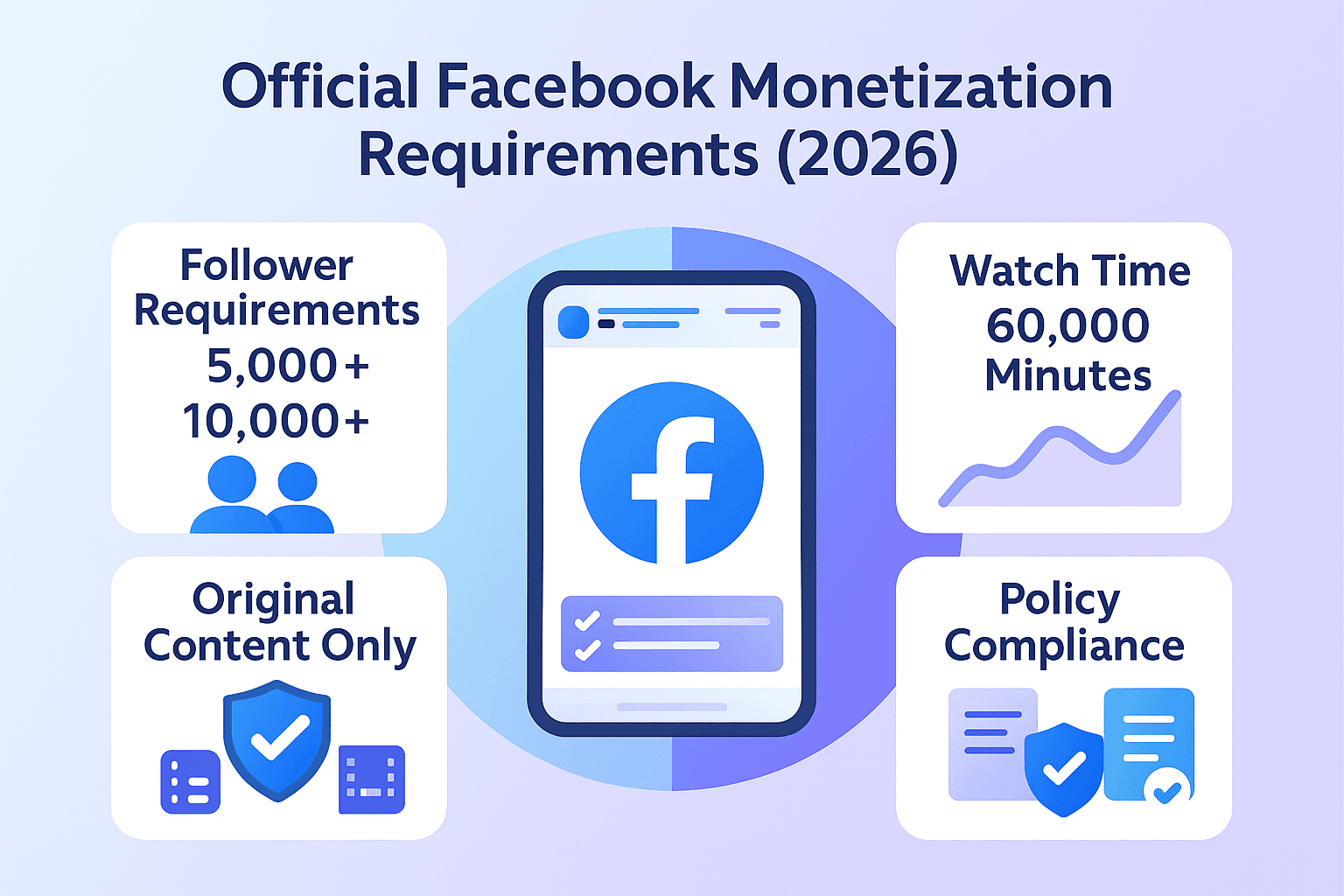
The official Facebook monetization requirements in 2026 represent the baseline structure that determines whether your Page or Professional Mode profile is even eligible to earn money. These rules are published publicly by Facebook, but most creators dramatically underestimate how strict they are and how they interact with underlying algorithm signals.
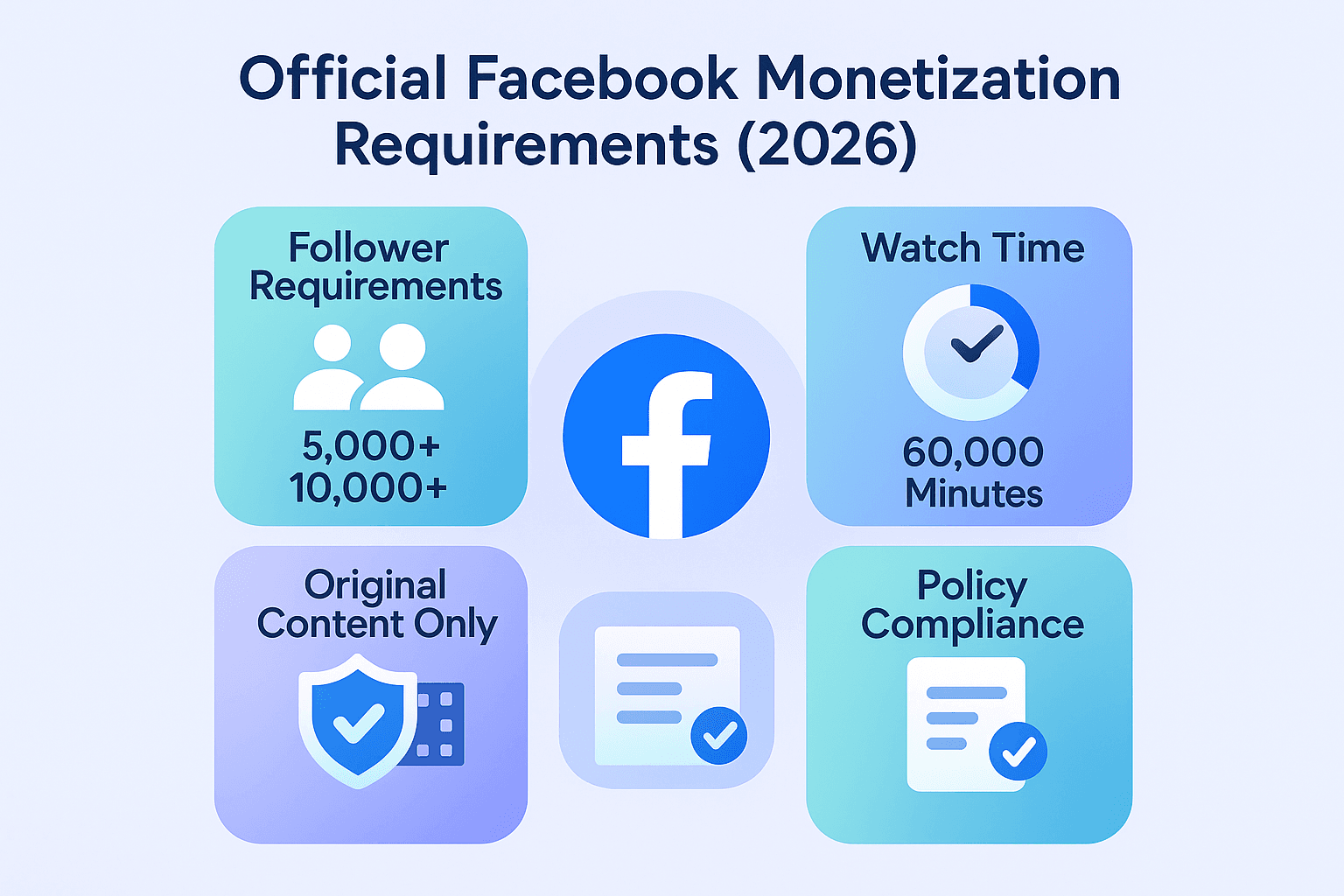
For creators, meeting the official requirements used to be enough. In earlier years, checking the boxes—having the follower count, the watch time, and a clean policy record—almost always resulted in monetization approval. In 2026, however, Facebook has evolved beyond this “numbers-only” approach and integrated multi-layer detection systems that evaluate creator trust, authenticity, engagement quality, and algorithmic confidence.
Still, the official requirements form the first and simplest layer. Below is an ultra-detailed breakdown of each part of the public monetization system.
Follower Requirements
(Pages & Professional Mode)
Facebook still publicly lists follower thresholds, and these numbers haven’t changed significantly in recent years. What has changed is how deeply Facebook analyzes your follower base. In the 2026 system, followers act more like a trust measurement than a simple qualification requirement.
Here are the current public thresholds:
- 5,000 followers: Minimum requirement for basic monetization entry.
- 10,000 followers: Required for in-stream ads and most revenue features.
- 20,000+ followers: Strong threshold that improves approval probability.
But what Facebook doesn’t publicly explain is that a creator with 10,000 low-quality followers will be rejected, while a creator with 8,000 high-quality followers may still be approved because their engagement signals are stronger. The days of “just hit 10k” are long gone—Facebook requires depth, not just quantity.
Facebook’s 2026 follower evaluation system includes:
- Follower authenticity: Are the followers active, real, and behavior-consistent?
- GEO relevance: Do your followers match your content language?
- Engagement ratio: Do your posts generate proportional reactions and comments?
- Growth pattern: Was the follower growth natural or sudden?
Facebook does not care about big numbers alone. If you have 20,000 followers but weak interactions, you will likely fail monetization review. On the other hand, if you have 6,000–9,000 highly active followers, you may be fast-tracked because the algorithm sees your community as “high intent.”
Watch Time Requirements
(60,000 Minutes, But Deeper)
Watch time is a cornerstone of Facebook monetization. Facebook publicly states that creators need at least 60,000 minutes watched in the last 60 days to qualify for in-stream ads. This is correct, but it is only the surface rule.
Behind the scenes, Facebook evaluates:
- Average watch duration: How long users watch before leaving.
- Retention curve shape: The pattern of drop-off in the first 3–10 seconds.
- View source distribution: Percentage from followers vs non-followers.
- Repeat viewer ratio: How many viewers return to your content.
- Long-form vs short-form balance: Whether minutes come from meaningful content.
This means that a creator who posts 30-second clips may reach 60,000 minutes but still fail monetization because their content does not demonstrate deep consumption or advertiser value. Facebook’s advertising partners pay for stable viewing windows—not for low-retention content that causes viewers to scroll.
The key in 2026 is watch-time depth. Even a smaller account with strong retention can outperform a large account with weak engagement. The algorithm rewards content that keeps people watching.
Original Content Requirement (Extremely Strict in 2026)
The “Originality First” update introduced in 2025 matured fully in 2026. Facebook now uses highly advanced media fingerprinting tools to detect whether a video was:
- downloaded from TikTok (even after watermark removal)
- taken from another Facebook Page
- trimmed or slightly edited from YouTube Shorts
- compiled from trending videos
- edited with AI voiceover but not truly transformed
This fingerprinting technology compares your audio, visual structure, timestamp patterns, and metadata to known reused videos across social platforms. Even if your video appears visually unique, the algorithm can detect reused elements within seconds.
Facebook’s originality algorithm breaks content down into:
- Visual components (frames, object patterns, motion sequences)
- Audio patterns (pitch analysis, waveform detection)
- Structural patterns (timing, pacing, segment rhythm)
- Metadata similarity (file structure, encoding artifacts)
If any one of these shows a high similarity score to existing content, your monetization eligibility is immediately downgraded—even if the follower and watch time numbers are perfect.
Policy & Safety Requirements
(The Four Pillars)
Facebook uses four major policy categories to determine whether a creator is monetization-safe. Violating any of these results in immediate failure:
- Partner Monetization Policies (PMP) – Governs who is allowed to earn.
- Content Monetization Policies (CMP) – Governs what content is eligible.
- Community Standards – Governs general safety, behavior, and usage.
- Advertiser-Friendly Guidelines – Determines if brands can run ads on your videos.
Many creators fail monetization because of small infractions they didn’t even know were counted. For example:
- past meme posts with borderline language
- old videos containing copyrighted background music
- political posts shared from other sources
- old Page admins with previous violations
Facebook’s approval system is unforgiving. Even content from years ago can influence your eligibility today.
Professional Mode Monetization Requirements (Profiles)
Professional Mode has become one of the most popular ways for creators to monetize Facebook because it removes the need for a Page. With a single toggle, any profile can turn into a monetized creator account. But because Professional Mode blurs the line between personal and professional usage, Facebook enforces stricter algorithmic scrutiny on these accounts.
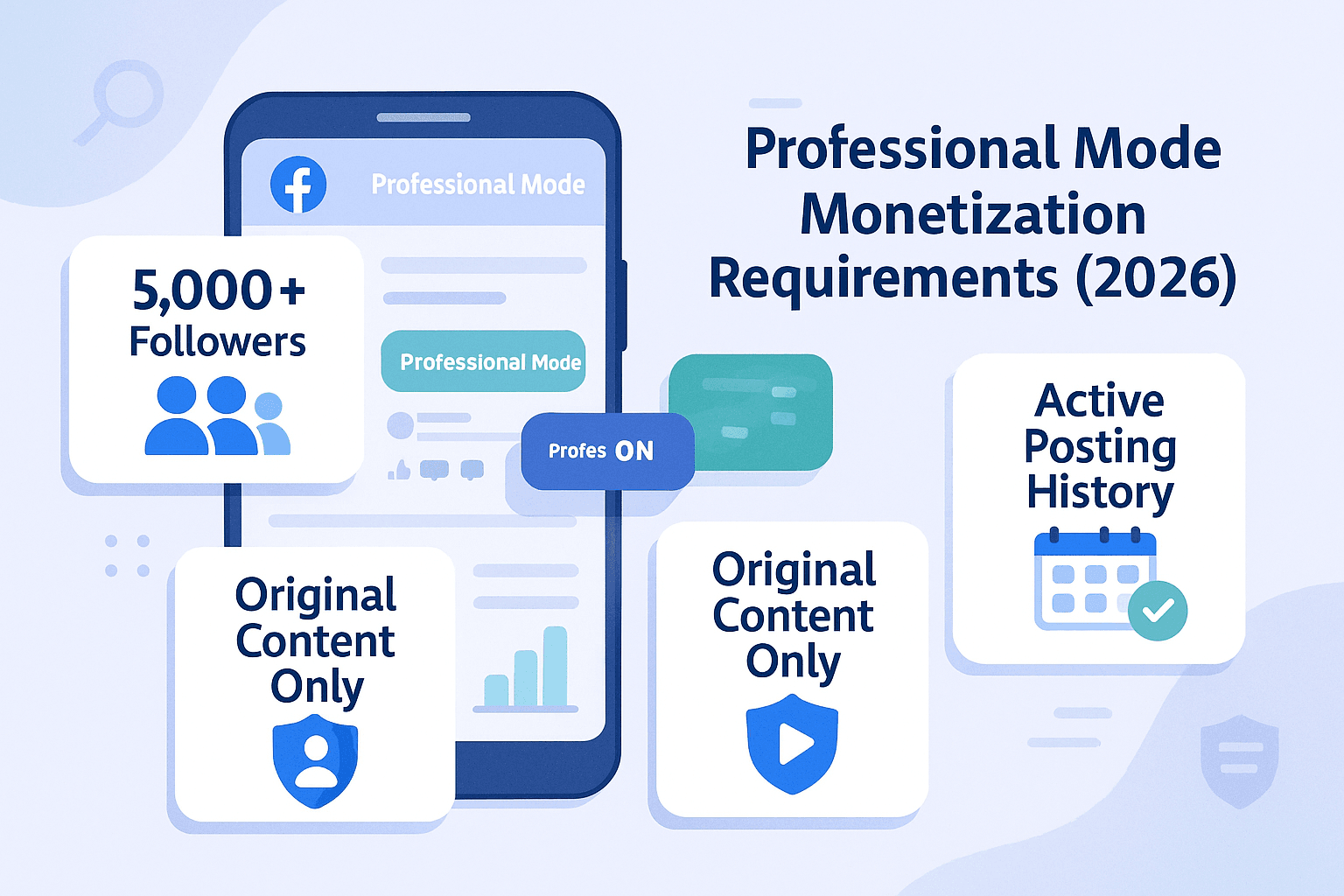
In 2026, Professional Mode follows a review system that analyzes far more than just your follower count:
- your personal posting history
- your behavior patterns since the creation of your profile
- your identity-verification consistency
- your content’s originality score
- your watch-time and engagement depth
Below is a complete breakdown of the Professional Mode monetization requirements.
Eligibility Checklist
(Updated for 2026)
To qualify for monetization via Professional Mode, you must meet all of the following:
- 5,000+ real followers with normal engagement patterns
- A consistent content niche (mixed niches reduce trust score)
- No reuse of external content (strictly enforced)
- An active posting history (algorithm prefers stability)
- No previous restrictions (content or behavior)
- Long-form or high-retention short-form content
Missing even one of these often results in monetization rejection or long review delays.
Why Facebook Applies Stricter Rules to Professional Mode
The primary issue Facebook faces with Professional Mode is content reuse. Users often download content from TikTok or Instagram and repost it on Facebook Reels. To prevent this, Facebook assigns a significantly higher weight to originality detection for Professional Mode profiles.
The platform also expects Profiles to represent real people. That means the algorithm studies your:
- identity consistency (name, region, activity patterns)
- posting personality (authenticity score)
- long-term engagement patterns
- overall behavioral stability
If your account appears repurposed, suspicious, or unusually optimized, you may be flagged. Facebook refers to these flags as “attention markers,” which temporarily reduce monetization priority.
Common Reasons Profiles Fail Monetization Review
Professional Mode profiles fail monetization at a higher rate than Pages. The most common reasons include:
- Hyper-fast follower growth (spike patterns trigger suspicion)
- Unnatural engagement patterns (e.g., many likes but few comments)
- Reused video content
- AI-generated slideshow content with low retention
- Mixed niche posting (confuses relevance signals)
- Old policy violations from years ago
Facebook wants Professional Mode creators to be stable, authentic, and niche-consistent. Anything that reduces algorithmic “comfort” results in delayed approval.
Facebook Page Monetization Requirements in 2026
(Deep Analysis)
While Professional Mode is rapidly growing, Facebook Pages remain the most reliable and stable monetization pathway in 2026. Pages behave like business entities, which means Facebook uses stricter evaluation standards compared to Profiles — but also offers Pages higher monetization priority, stronger revenue potential, and more robust ad placements.
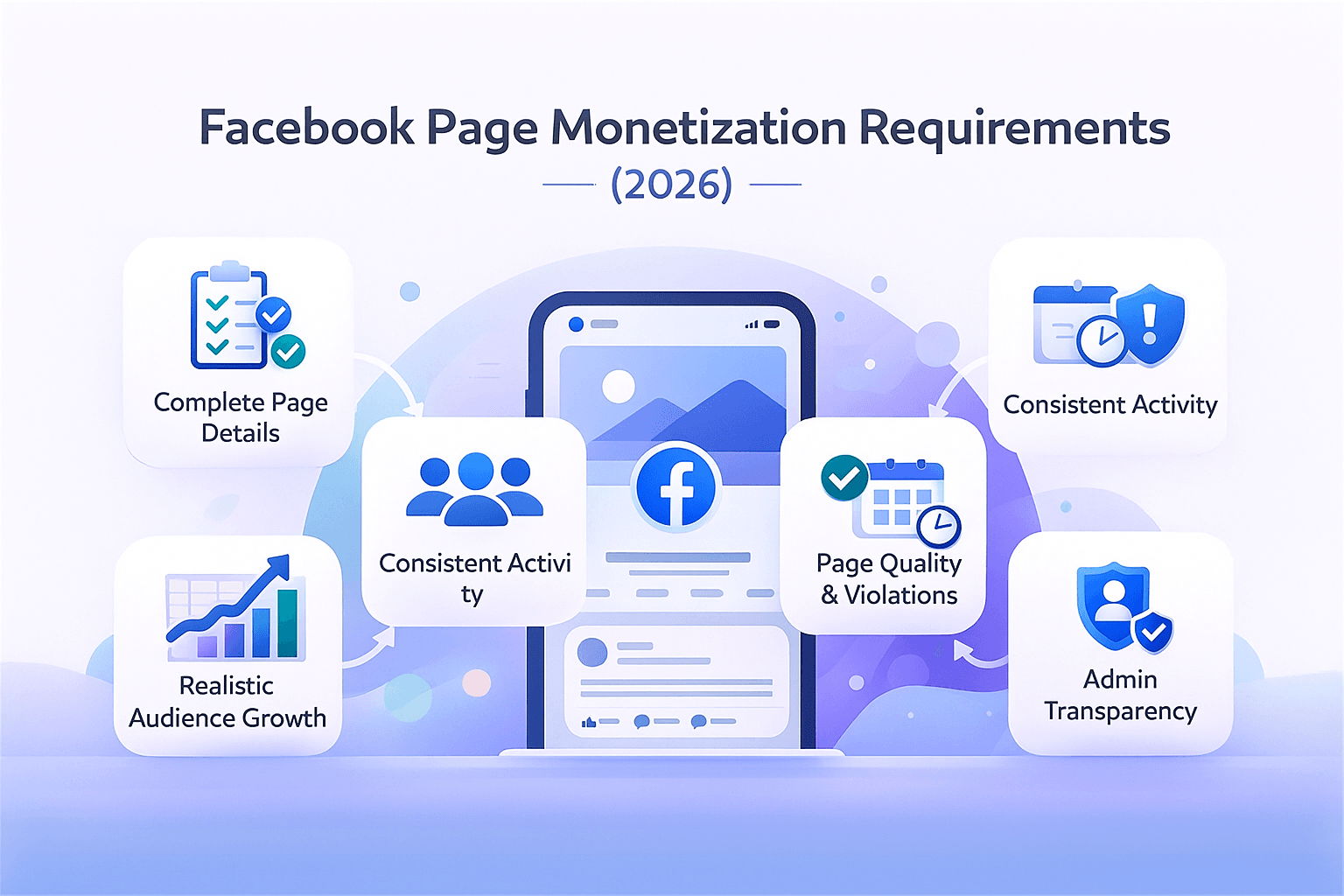
Many creators mistakenly assume that Pages simply require a follower count and watch time. In reality, the 2026 monetization system evaluates a Page on more than 70+ trust signals including its history, admin behavior, niche consistency, content type diversity, and audience growth patterns.
Below is the complete ultra-expanded list of Page monetization requirements for 2026.
Page Structure Requirements
(The Foundation Layer)
A Facebook Page must first meet all structural and setup standards before Facebook even considers it for monetization. These standards prove that the Page is a real entity, has clear purpose, and is presentable to advertisers.
- Complete About Section: Category, description, location, and basic info must be filled.
- Profile Picture: Must be relevant (no blank or meme images).
- Cover Photo: A professional banner increases trust signals.
- Contact Information: Website, email, or business contact increases legitimacy.
- Page Category Accuracy: Must match your niche. Misaligned categories reduce approval odds.
- Admin Transparency: Admin profiles must be verified or stable accounts without violations.
Facebook’s algorithm analyzes Page completeness as part of its “Entity Quality Score” — a behind-the-scenes metric that determines whether your Page resembles a real brand or a low-quality Page.
Page Activity Requirements
(Consistency Signals)
Pages with inconsistent posting, sudden returns after inactivity, or erratic engagement patterns are flagged as unstable. For Facebook to approve monetization, your Page must demonstrate:
- Regular posting history over the past 90 days.
- Consistent niche focus (not switching categories suddenly).
- Interaction consistency — a stable engagement baseline.
- Video content history — Pages must post video content regularly.
- Retention stability — your videos must maintain consistent retention patterns.
Pages that frequently disappear for weeks, or Pages that post in multiple wildly unrelated niches, often fail monetization review because Facebook cannot identify a stable audience for advertisers.
Page Restrictions and Violations
(Automatic Disqualification)
Facebook is extremely sensitive to Page history. Even old violations from years ago can trigger monetization failure today. Here are the main triggers:
- Recent name changes (indicates rebranding or niche flip).
- Page merges (Facebook sees this as “identity instability”).
- Admin changes (adding admins with past violations hurts eligibility).
- Old copyright strikes (Facebook remembers them).
- Reused content history (especially viral clip reposts).
- Past distribution restrictions on the Page.
- Link-out spam (external links that violated community rules).
Facebook sees Pages as businesses. A business with an unstable identity or admin history is considered unsafe for monetization.
Hidden Monetization Requirements Facebook Doesn’t Publicly Disclose
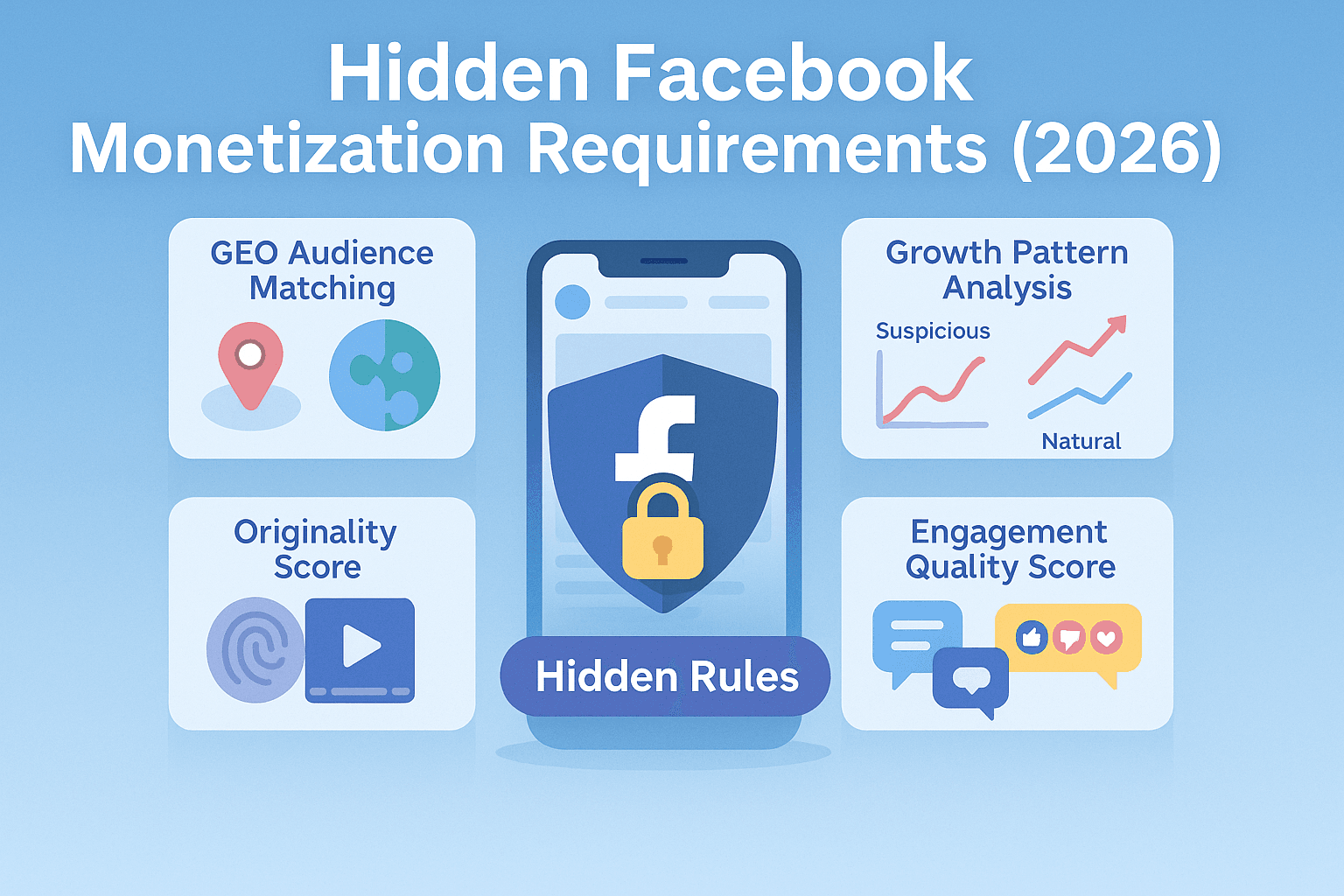
Facebook’s published requirements only represent the surface. The real monetization approval process is driven by dozens of algorithmic hidden rules that analyze your account’s originality, behavior, audience quality, posting patterns, and trust signals.
These hidden rules are what cause most creators to fail monetization even if they meet the public requirements. Below is an ultra-expanded explanation of every hidden requirement that affects your monetization approval in 2026.
GEO Distribution and Audience Quality
(Critical Hidden Metric)
Facebook evaluates whether your followers come from logical regions based on your:
- language
- accents
- cultural references
- posting location
- niche relevance
For example, if you are an English-speaking creator but 85% of your followers are from non-English regions, Facebook flags your account for:
- low advertiser value
- audience mismatch
- inauthentic follower growth
These mismatches cause:
- delayed monetization review
- lower monetization priority
- lower likelihood of approval
Facebook wants your followers to match your expected audience demographics. If they don’t, monetization is often rejected regardless of follower count.
Growth Pattern Analysis
(Facebook’s Stability Algorithm)
Facebook analyzes follower growth curves to evaluate authenticity. This is a hidden metric creators rarely think about. Facebook flags:
- Sudden follower spikes (e.g., +5,000 in one day)
- Irregular curves (huge jumps followed by flat lines)
- Follower gaps (loss of thousands in a short period)
- Repeated follower surges at suspicious hours
Facebook’s system labels these as “unstable growth patterns,” which cause punishments such as:
- lower monetization review priority
- extended review times (up to 90 days)
- automatic review denial
Creators with smooth, gradual growth curves are often approved much faster because the algorithm perceives their audience as real and stable.
Originality Score and Reuse Detection
(Advanced 2026 Algorithm)
Facebook calculates an “Originality Score” for every creator. This score is based on extremely advanced detection models that examine:
- audio waveform similarity
- clip structure similarity
- background noise fingerprints
- color curve matching
- caption metadata patterns
- motion vector analysis
These tools allow Facebook to detect reused content even if it is:
- cropped
- re-timed
- overlaid with text
- revoiced with AI
- slowed down or sped up
If your originality score is low, monetization is automatically blocked. This is one of the most common hidden reasons creators fail in 2026.
Engagement Quality Score
(Not Engagement Quantity)
Facebook does not reward accounts with high numbers of likes and views alone. Instead, Facebook ranks engagement based on depth and authenticity:
- Long comments (meaningful interactions)
- Retention-based engagement (commenting after watching)
- Diverse reactions (not just likes)
- Shares (high-value signals)
- Conversation threads in comments
- Return engagement (users interacting across multiple posts)
An account with 50 comments of “nice video” is lower quality than an account with 10 comments that start discussions. Facebook uses AI comment interpretation to judge comment depth.
Behavior History, Identity Stability & Admin Reputation
Facebook evaluates your entire account history when reviewing monetization eligibility. This includes:
- old community guideline violations
- behavior warnings from years ago
- past restricted posts
- admin actions (for Pages)
- identity verification attempts
- posting behavior trends
If your account has a history of:
- spam-like posts
- controversial content
- copyright violations
- political content
- distribution limitations
…your monetization review will likely be slowed or denied.
Content Requirements for Monetization in 2026
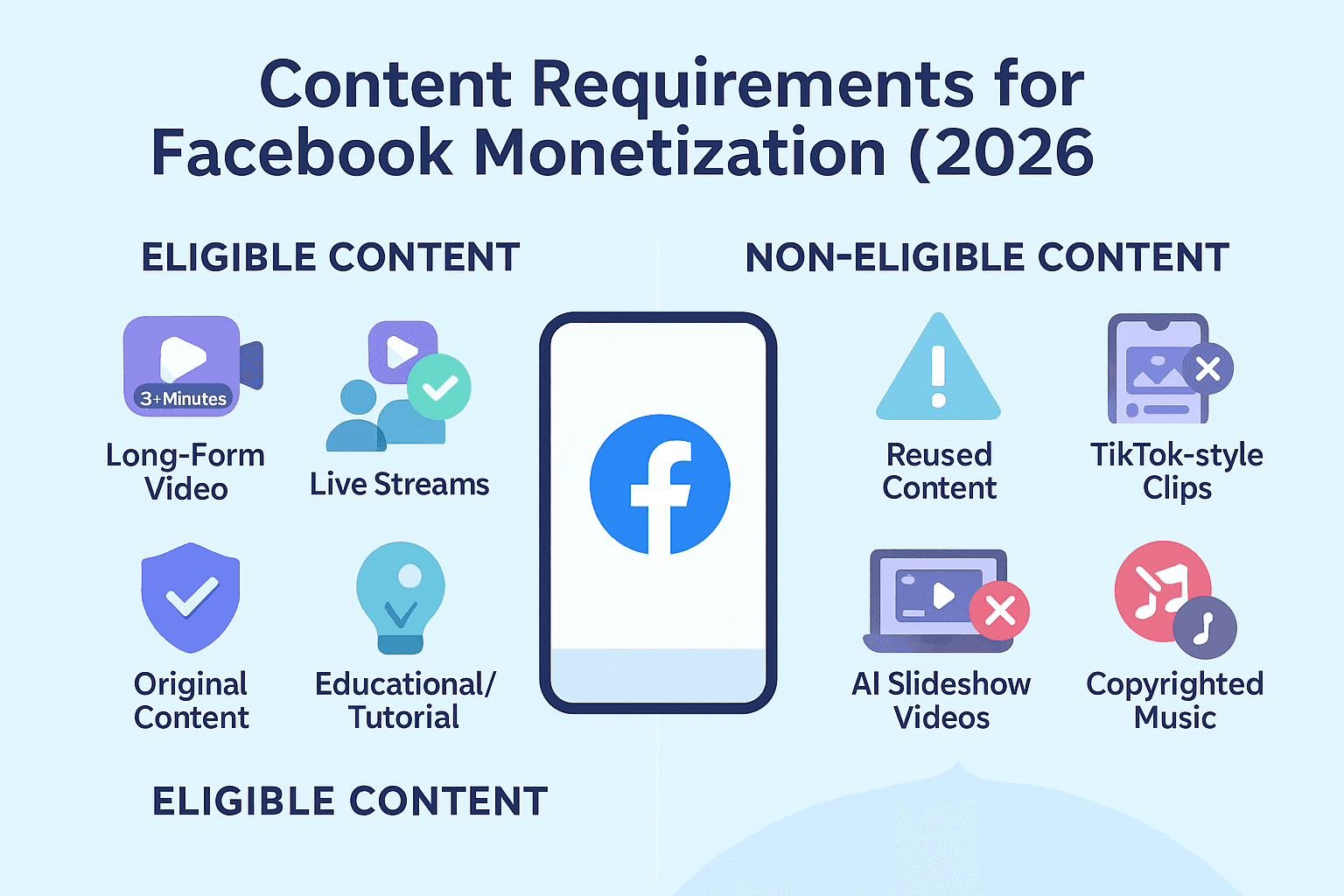
Facebook has significantly expanded its content evaluation systems in 2026. The goal is to identify creators who produce original, advertiser-safe, high-retention, niche-focused content. To understand how to pass monetization, creators must understand the difference between eligible, partially eligible, and non-eligible content types.
Eligible Content Types
(Strong Monetization Signals)
Eligible content includes:
- Long-form video (3 minutes or longer)
- Original commentary with storytelling
- Tutorials and educational content
- Community discussions using text or images
- Live streams (high retention + strong engagement)
- First-person content with unique angles
Facebook’s system favors:
- deep retention
- valuable content
- repeat-watch potential
- topic consistency
Non-Eligible Content
(Automatic Rejection)
Certain content types immediately disqualify you from monetization:
- Reposted TikToks (even without watermark)
- AI slideshow videos with stock images and AI voices
- Video compilations or reaction-less reuse
- Low-effort clips with poor retention
- Memes pulled from other platforms
- Copied news content
These content types score extremely low on Facebook’s “Member Value Score,” which measures how much value your content brings to the platform.
Advertiser-Friendly Content Guidelines
(Vital for Approval)
Even if your content is original and high-retention, it may fail monetization if it is not advertiser-friendly. Facebook measures advertiser suitability using:
- AI-based content scanners
- audio transcription analysis
- visual risk detection
- topic sensitivity scoring
Facebook automatically downranks videos that discuss:
- violence
- adult content
- political or controversial topics
- drug usage
- misleading health info
- copyrighted music
Many creators unknowingly fail monetization because their old content contains copyrighted background music or mild profanity. Facebook’s detection systems are extremely advanced — they can detect background audio even if covered by narration or sound effects.
Engagement Requirements Before Applying for Monetization
Engagement has become one of the strongest ranking and monetization signals in Facebook’s 2026 system. Unlike older years where creators could rely on follower count and watch time alone, today’s algorithm evaluates how deeply your audience interacts with your content.
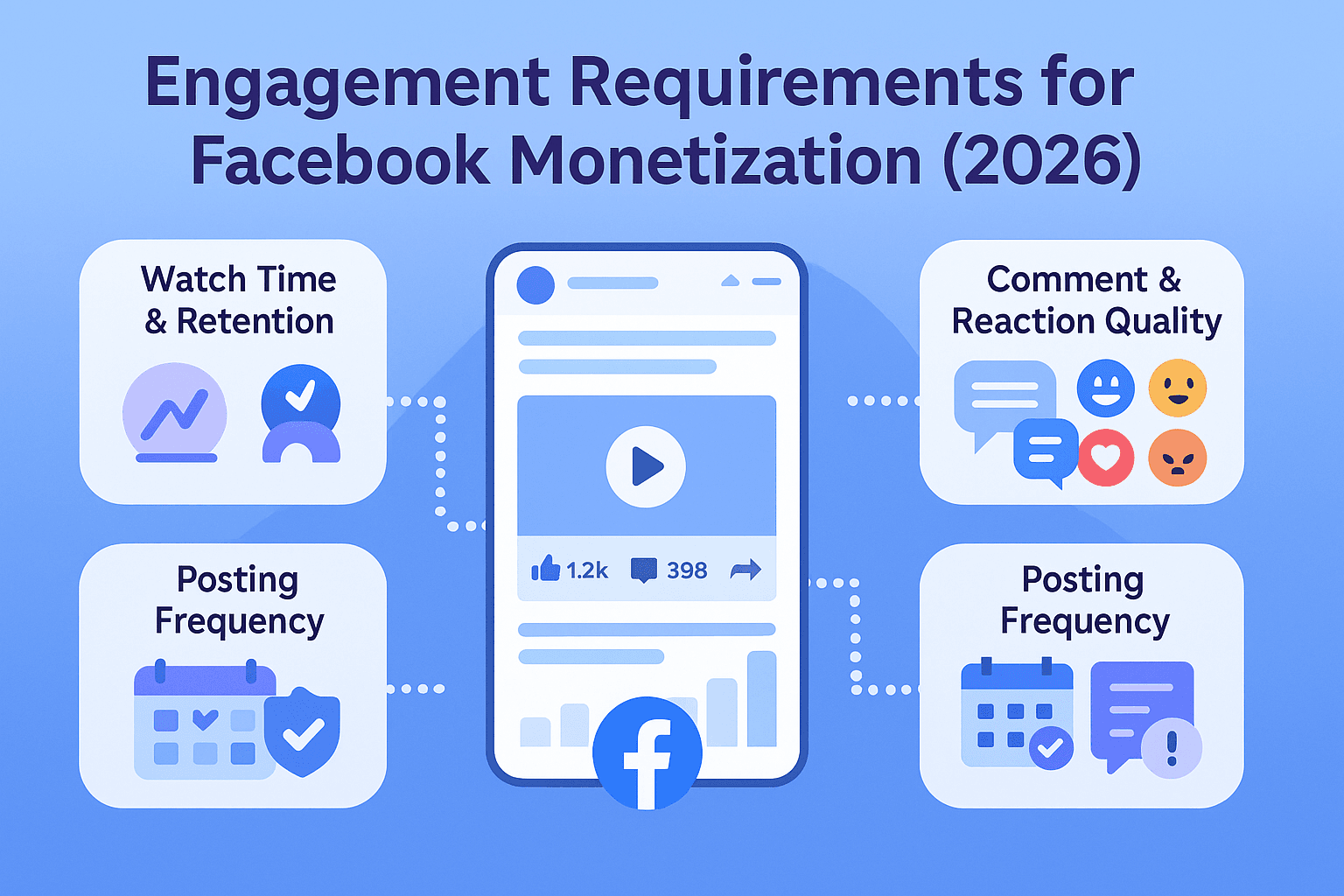
Facebook uses machine learning to analyze your audience behavior across three major categories:
- Engagement Quality — Are followers engaged in meaningful interactions?
- Engagement Consistency — Does your content produce reliable activity?
- Engagement Distribution — What percentage of followers vs non-followers interact?
These categories form the core of Facebook’s internal “Engagement Authenticity Score,” a private metric used to determine monetization approval priority.
Watch Time & Viewer Retention
(Most Important Signal in 2026)
Watch time is not only an eligibility requirement — it is one of the strongest trust signals in Facebook’s system. The platform’s machine learning models distinguish high-retention videos from ones that viewers skip or scroll past.
Facebook evaluates your watch time based on:
- 3-second retention – Key indicator of hook quality.
- 10-second retention – Used to separate low-value clips from real content.
- 30-second retention – Strong signal that content is worth monetizing.
- 1-minute retention – For long-form videos, this is crucial.
- Completion rate – Indicates viewer satisfaction.
- Return viewers – Facebook heavily rewards repeat audiences.
The quality of your watch time is more important than the raw number. For example:
- Account A: 60,000 minutes watched with 3% retention → low approval chance
- Account B: 40,000 minutes watched with 35% retention → high approval chance
Facebook wants monetized creators who keep viewers on the platform longer — because longer viewing increases ad impressions and advertiser satisfaction.
Comment & Reaction Quality
(Facebook’s Behavioral AI Filter)
Facebook evaluates two types of engagement:
- Surface-level engagement — likes, quick reactions, short comments.
- Deep engagement — detailed comments, replies, emotion-driven reactions, shares.
In 2026, Facebook’s algorithm is trained to detect “empty engagement” such as:
- “Nice video” spam comments
- emoji-only comments
- likes from inactive profiles
- reactions that don’t match content context
The system then scores each comment thread using:
- Sentiment analysis → positive, neutral, negative
- Comment depth → long-form vs spam
- Reply chain length → discussions indicate authenticity
- Diversity of reactions → not just “likes”
- Viewer type → follower vs non-follower
High comment depth and diverse reaction profiles significantly increase monetization approval chances.
Posting Frequency & Content Cadence
(Stability Signals)
Facebook prioritizes creators with consistent posting behavior. Sporadic posting or sudden activity bursts trigger a “stability penalty” which lowers your monetization approval priority.
The ideal posting frequency for monetization approval is:
- 1 post per day (best)
- 3–5 posts per week (safe)
- 1–2 posts per week (weak but acceptable)
Pages or Profiles that disappear for weeks and then suddenly upload 20 videos often trigger authenticity checks. Facebook interprets this as “content dumping,” which is a negative trust signal.
Top Reasons Facebook Rejects Monetization Applications in 2026
Most monetization rejections occur because creators fail to meet hidden requirements rather than official ones. The meta-level algorithm evaluates dozens of behavioral and quality signals that the public documentation does not mention.
Below are the most common AND the most important reasons creators fail monetization review in 2026.
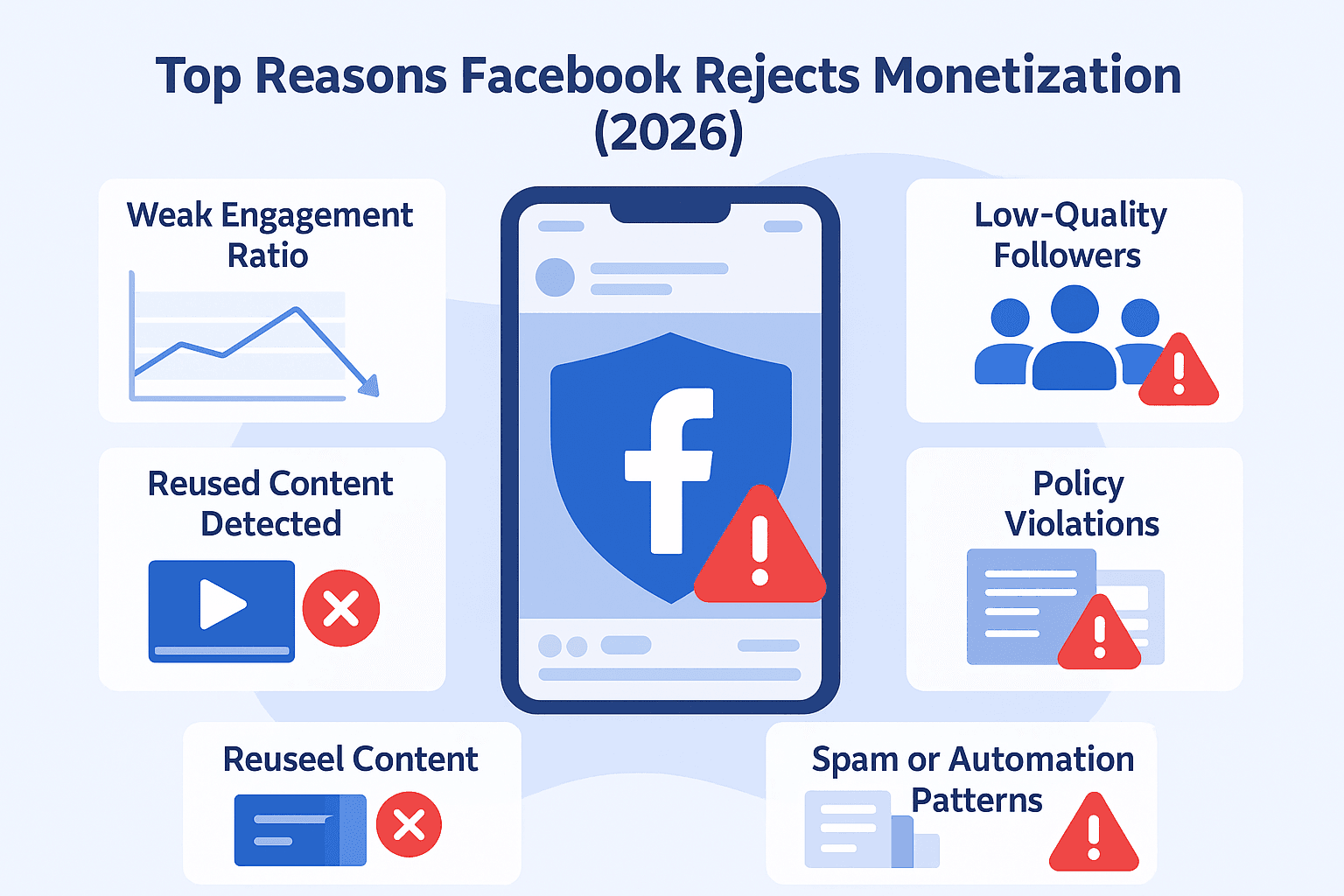
Weak Engagement-to-Follower Ratio
Facebook automatically compares your engagement metrics to the size of your following. If your engagement is disproportionately low, the system flags your audience as:
- inactive
- misaligned
- suspected low-quality
- potentially not acquired naturally
For example:
- 10,000 followers but only 40–50 likes per post → red flag
- 3,000 followers but 200+ likes per post → green flag
Low-Quality or Mismatched Followers
If a large percentage of your followers come from unexpected GEOs or inactive profiles, Facebook assumes your audience is not valuable to advertisers. This is one of the most common rejection triggers.
Reused Content or Low Originality Score
Even if you meet all official requirements, reused content immediately disqualifies you. Facebook’s fingerprinting is extremely advanced and can detect:
- TikTok reposts
- YouTube Shorts reuploads
- viral clip compilations
- stock slideshow content
A History of Policy Violations or Page Restrictions
Facebook considers all past activity — even from years ago. Violations, copyright flags, or Page restrictions create negative trust indicators.
Spam-Like Behavior or Automation Patterns
Facebook evaluates how “human” your posting and engagement behavior looks. Spam patterns include:
- posting too frequently with identical formats
- using engagement bait
- using clickbait captions
- copy-pasted comments
How to Pass Facebook Monetization Review Faster in 2026
Getting monetized quickly on Facebook requires preparation. The algorithm rewards creators who build trust signals BEFORE applying. Below is the complete blueprint for accelerating monetization approval.
Boost Engagement Quality Before Applying
Comment and reaction signals are extremely important. To strengthen engagement before applying:
- Ask open-ended questions
- Create multi-part series to keep viewers returning
- Use pinned comments strategically
- Host weekly Facebook Live sessions
You can also stabilize engagement using:
- Contextual Facebook Comments
- Diverse Facebook Reactions
- High-retention Facebook Views
Fix GEO Irregularities
(Critical Hidden Step)
If your audience location does not match your content language or region, stabilize your follower growth by focusing on a single target GEO.
Improve Originality Score
(The Most Important Metric)
To raise your originality score:
- Record your own footage
- Avoid downloaded or stitched videos
- Use original voiceovers
- Create higher-value long-form content
Build Algorithmic Trust Signals
Facebook approves accounts that demonstrate:
- steady follower growth
- active comments
- returning viewers
- niche consistency
Clean Up Your History Before Applying
Delete or hide:
- old copyrighted videos
- political content
- reposted memes
- controversial posts
These can reduce your monetization approval chances significantly.
Monetization in 2026 Requires Quality, Stability & Authenticity
Facebook monetization in 2026 is no longer about hitting simple numbers. You must build:
- high-quality followers
- high-retention videos
- deep audience engagement
- consistent, original content
- trust signals from stable behavior
Creators who understand the hidden rules, optimize their engagement patterns, and keep their content original and meaningful will pass monetization review faster and earn more sustainably.
The key principle of 2026 is:
Facebook rewards creators who keep people on the platform longer, and who maintain stable, authentic communities.