The Biggest Shift in 2026: Engagement Quality Over Audience Size
Facebook’s monetization system in 2026 is fundamentally different from what creators experienced in previous years. For most of Facebook’s history, creators assumed that monetization depended on hitting specific public metrics: follower count, watch time, Page quality, and original content. While these requirements still exist, they no longer represent the real decision-making system behind monetization approval.

In 2026, Facebook evaluates your content and audience using a deeper, more advanced machine-learning model that prioritizes engagement behavior over raw numbers. This means accounts with:
- 5,000 followers but high-quality interactions
- 20,000 minutes watched with strong retention
- 200 engaged commenters who repeatedly return
often get monetized faster than accounts with:
- 50,000 followers who barely interact
- viral videos with low retention
- audiences from non-relevant GEO regions
This is because advertisers no longer pay for “reach.” They pay for:
- attention (watch time)
- depth (comments, saves, shares)
- viewer intent (returning viewers & loyalty)
- match to audience niche
Facebook redesigned its monetization review to reflect these advertiser needs, leading to the biggest policy impact: Follower count is a surface-level metric, while engagement is a deep behavioral metric.
Why This Shift Happened
Advertisers complained that pages with large audiences weren’t producing meaningful results. Why? Because:
- Many creators inflated their follower count through giveaways or follow-for-follow.
- Some creators gained followers from irrelevant regions.
- Pages grew fast but had weak trust from viewers.
- Follower count didn’t guarantee ad attention.
Facebook responded by moving toward an attention-based monetization model. This means Facebook cares more about whether people interact with your content, not just whether they follow you.
The New Reality for Creators
Many creators still assume:
“If I hit 10,000 followers, I will automatically be approved.”
But in 2026, this is far from true. You may hit the follower count and still get rejected if your engagement signals don’t match the audience size.
For example:
- A Page with 10,000 followers but only 15 reactions per post → likely rejection.
- A Page with 3,500 followers but strong retention, comments, and shares → likely approval.
The quality of your audience is worth more than the size of your audience.
Understanding the Engagement Quality Score (EQS)
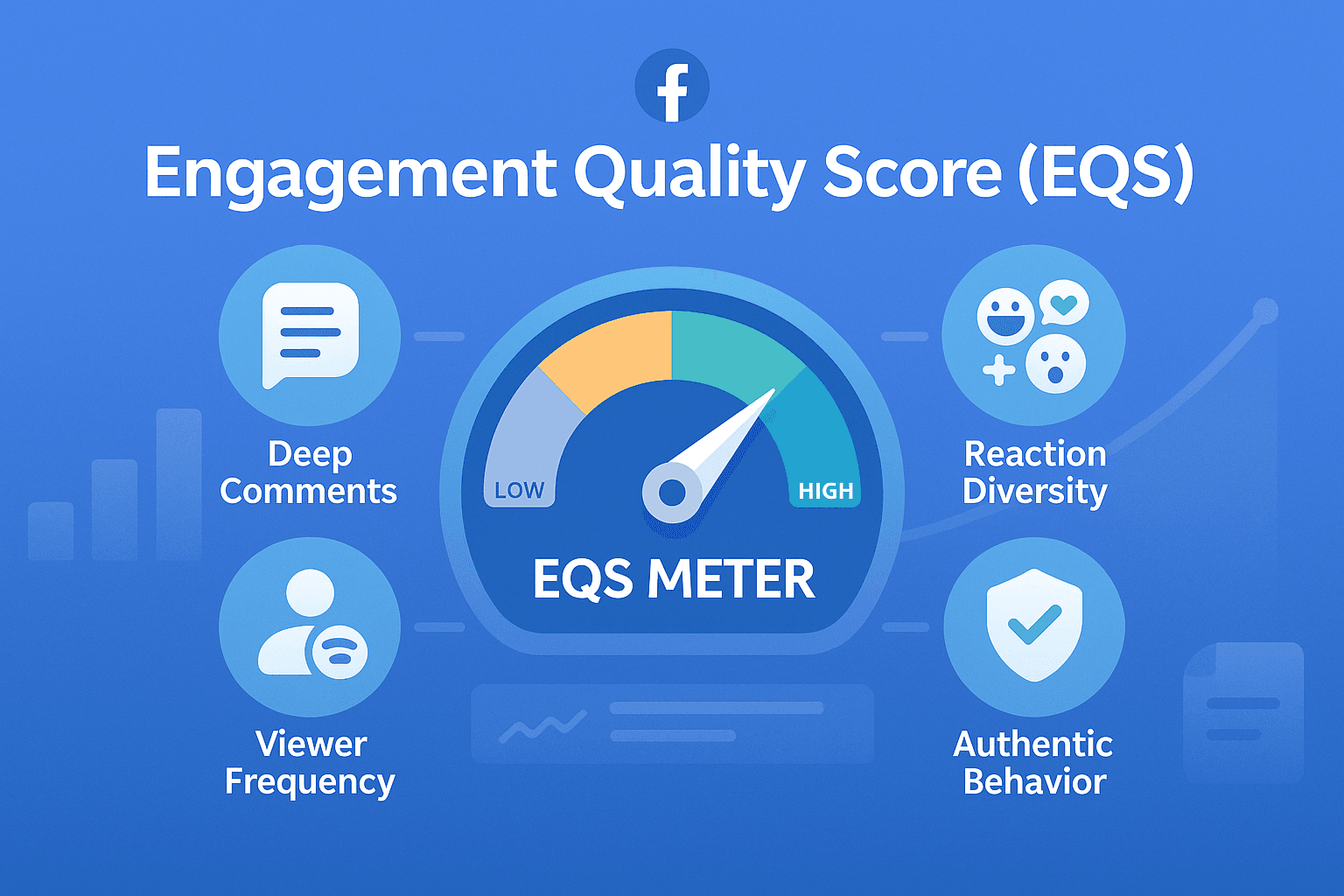
Facebook uses a hidden metric called the Engagement Quality Score (EQS) to evaluate how valuable your content and audience are to advertisers. This metric is not publicly documented, but it is based on signals that Facebook engineers have referenced in API resources, content guidelines, and machine-learning papers.
EQS evaluates one core question:
“Are real people interacting with your content in meaningful, repeatable ways?”
It does not care how many followers you have. It cares about how the followers who actually interact behave.
How Facebook Calculates EQS
EQS is made up of four main algorithmic categories:
- Interaction Quality — Are comments deep, emotional, or conversational?
- Interaction Diversity — Are your reactions varied (Like, Love, Haha, Care)?
- Interaction Frequency — Do people engage consistently over days/weeks?
- Interaction Authenticity — Does the engagement look natural?
Facebook also uses NLP (natural language processing) to analyze:
- comment length
- sentiment (positive, neutral, negative)
- similarity between comments
- comment depth (reply threads)
Comments like:
- “Great!”
- “🔥🔥🔥”
- “Nice video”
score very low (spam-like engagement).
Comments like:
- “I’ve tried this method and it really works. Here’s what happened…”
- “Can you explain the part at 1:15?”
- “This video helped me understand something I struggled with before.”
score extremely high (meaningful engagement).
EQS Directly Affects Monetization Approval
Many creators get rejected even after meeting all visible requirements because their EQS is too low.
For example:
- 10k followers but very few commenters
- videos get views but retention is weak
- comments are generic or bot-like
- videos attract one type of reaction only (low diversity)
These are signals that the audience is disengaged or low quality, which is a red flag for advertisers.
Why EQS Matters More Than Follower Count
Follower count only tells Facebook:
“This many people chose to follow this creator.”
Engagement quality tells Facebook:
“This content is valuable enough that people interact with it deeply.”
Advertisers care about the second one — not the first.
Watch Time & Retention Now Outrank Follower Count
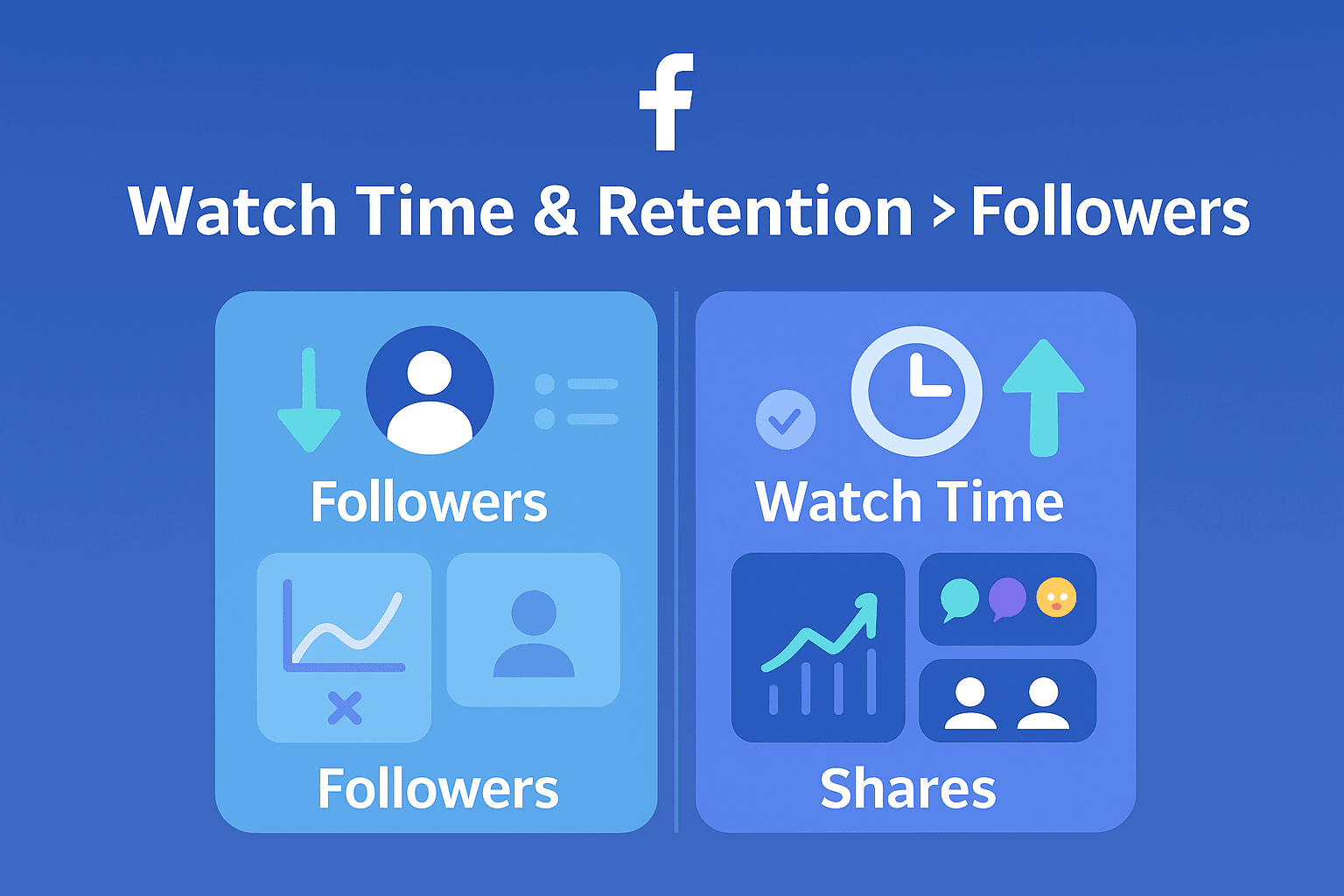
In 2026, watch time and viewer retention are far more powerful monetization signals than follower count. Even if you have tens of thousands of followers, Facebook will not approve monetization if your videos do not keep people watching.
Facebook’s system asks:
“Do viewers stay long enough for ads to be served?”
If the answer is no, the account is unlikely to be monetized — regardless of audience size.
The “10-Second Survival Test”
One of the strongest retention signals is the first 10 seconds of your video. Facebook’s internal research shows that if a viewer stays past the 10-second mark:
- they are 500–900% more likely to watch more
- they are 12x more likely to interact
- they generate higher-value ad impressions
This is why creators who make instantly engaging content monetize faster.
Completion Rate: The Hidden Metric
Completion rate tells Facebook:
“This content holds attention from start to finish.”
A Page with 5,000 followers and a 40% completion rate is worth far more than a Page with 50,000 followers and a 5% completion rate.
Return Viewers: The Loyalty Signal
Facebook monitors how many users come back to watch you again within 7 or 30 days. This is called a loyalty score.
You might get:
- 100,000 views from random people → low loyalty
- 10,000 views from your regular audience → high loyalty
The second one is far stronger for monetization approval.
Why Watch Time > Follower Count
Follower count shows potential reach. Watch time shows that your content actually delivers value.
Facebook monetizes your content performance, not your follower number.
Why Follower Count Became a Weak Monetization Indicator in 2026
In the early 2010s, follower count was the dominant measure of influence across social platforms. Facebook Pages with a large audience would automatically receive better reach, stronger ad delivery, and faster monetization approval. But in 2026, the platform operates under an entirely different model.
Follower count has become one of the least reliable predictors of monetization success. Facebook made this shift because follower count no longer reflects actual viewer interest, community loyalty, advertiser value, or content quality.
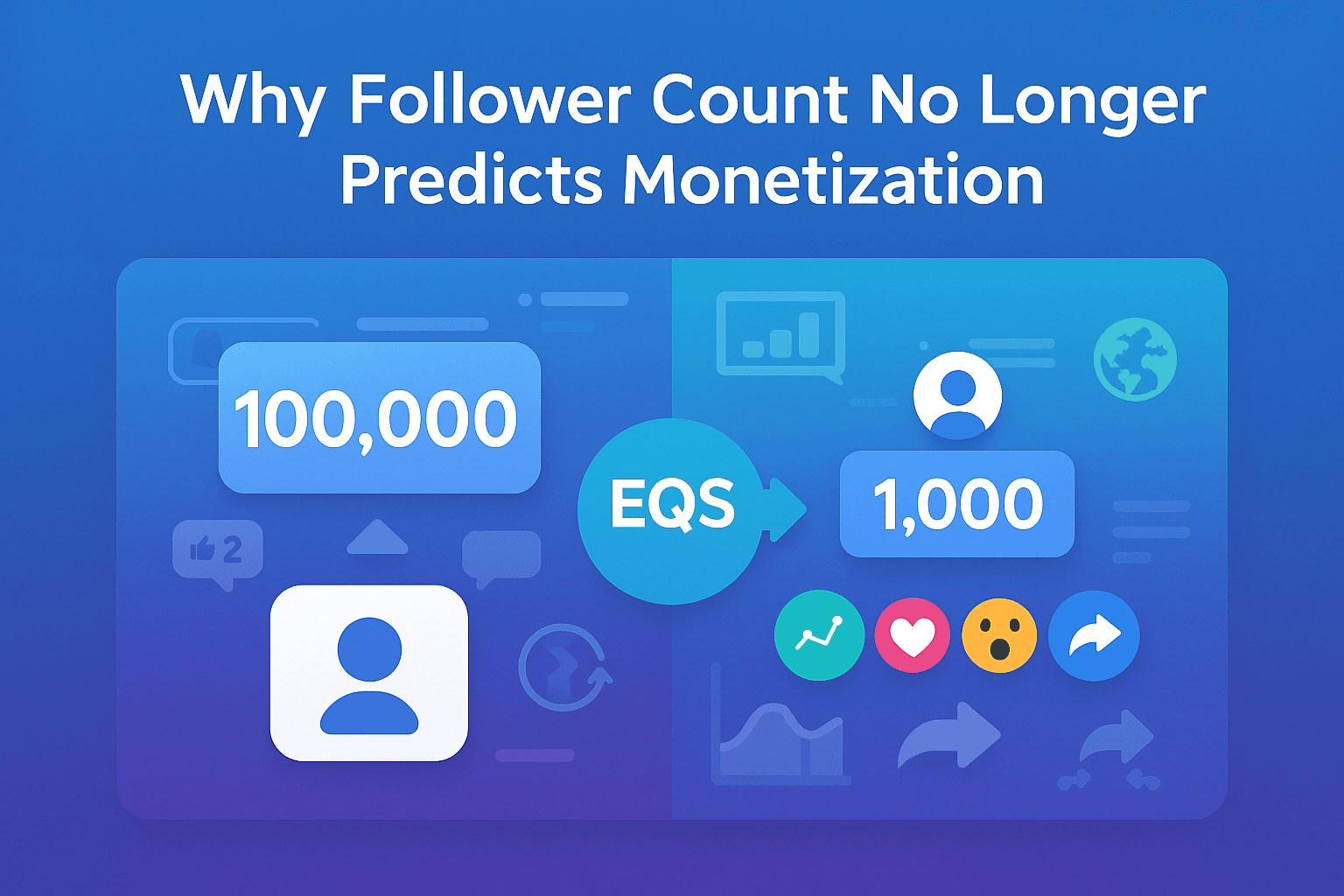
Follower Count Doesn’t Show Viewer Activity
You can have:
- 100,000 followers with 200 people interacting
- 5,000 followers with 1,500 people interacting
Which one does Facebook prefer for monetization? The second one — because it signals an active, engaged community.
Follower Inflation Became Too Common
Over the years, these trends made follower count increasingly unreliable:
- follow-for-follow loops
- giveaway followers
- viral spike followers who never return
- mismatched GEO followers
Facebook’s system cannot trust follower numbers alone because they do not represent real intent.
Many Followers Are Passive Consumers
Meta’s internal studies showed that on average:
- 70–85% of Facebook followers never interact
- 50–60% don’t even see most posts
- Most follower growth does not translate to loyalty
This means follower count has become a misleading metric for advertiser value.
GEO Mismatching Makes Followers Useless for Monetization
A creator may have:
- 30% Indian followers
- 20% Pakistani followers
- 20% Brazilian followers
- 15% Vietnamese followers
- 15% US audience
But advertisers might want:
- 50% US audience
- English-speaking commenters
- content relevance to Western markets
This mismatch lowers your monetization priority.
Follower Count Doesn’t Predict Watch Time
A creator with:
- 1M followers but short viewing sessions
is worth less to advertisers than a creator with:
- 30k followers but high retention & completion rate
Advertisers buy attention, not audience size.
Facebook Now Values Audience Behavior, Not Audience Quantity
The 2026 algorithm is designed to measure:
- How users react
- How long they watch your videos
- How often they return
- How deeply they comment
- How they share your content
None of these factors are determined by follower count. They are determined by content quality and audience resonance.
The 4 Types of Engagement Facebook Prioritizes Most in 2026
Not all engagement is equal. In fact, Facebook classifies engagement into four tiers — from weak to extremely valuable. In 2026, these four engagement types determine how quickly you monetize and how much money you earn:
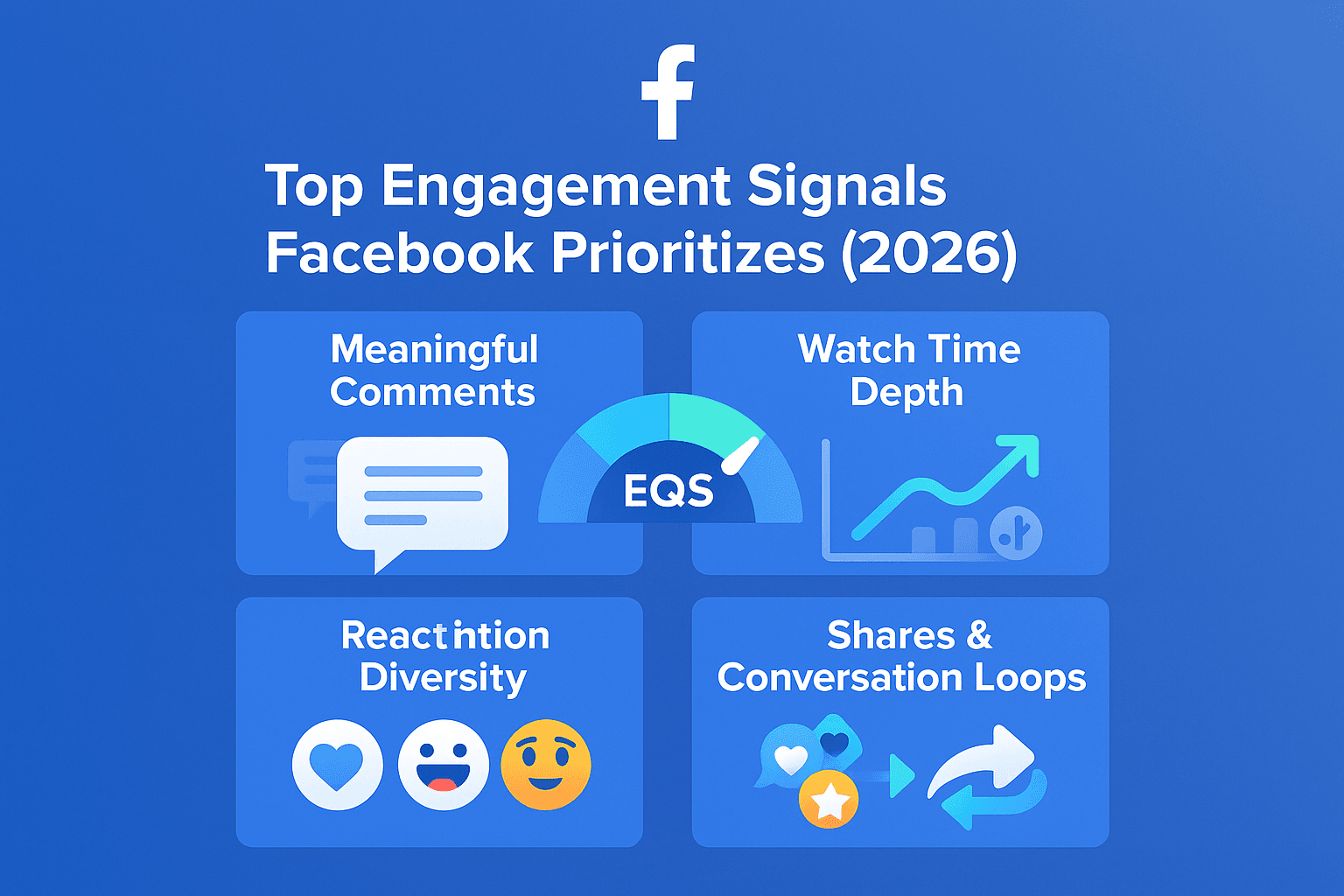
- Meaningful Comments
- Watch Time Depth
- Reaction Diversity
- Shares & Conversation Loops
Meaningful Comments (Strongest Engagement Signal)
Facebook now uses sentiment analysis and NLP (natural language processing) to evaluate how meaningful a comment is.
Comments like:
- “Nice”
- “🔥🔥🔥”
- “Cool video”
have near zero value.
Comments like:
- “I tried this method today and I got great results…”
- “Can you help explain the part at 0:45?”
- “This video helped me understand why my page engagement dropped.”
score extremely high. The longer the comment, the better your EQS score. The deeper the conversations, the higher the monetization priority.
Watch Time Depth (Retention Signals)
This is one of the strongest signals for advertisers because it shows:
- your content holds attention
- people are less likely to skip ads
- your audience is genuinely interested
Facebook measures:
- 3-second hook retention
- 10-second survival retention
- 30-second retention
- midpoint / completion rate
- repeat viewers
These metrics matter more than follower count because they directly affect ad performance.
Reaction Diversity (Not Just Likes)
Facebook studies reaction patterns to determine emotional impact. A video that receives:
- Like
- Love
- Haha
- Wow
- Cry
- Care
is considered more engaging than a video with only likes.
Reaction diversity indicates:
- strong emotional resonance
- content impact
- audience connection
- higher ad relevance
This dramatically boosts EQS and monetization priority.
Shares & Conversation Loops (High Viral Potential)
Shares generate new audiences without Facebook having to spend distribution resources. They also signal that content is powerful enough for users to push it to their own networks. Conversation loops occur when:
- users reply to multiple comments
- viewers debate or discuss
- a comment thread grows to 10+ replies
These are extremely high-value signals because they increase:
- session duration
- ad exposure
- community engagement
Facebook heavily rewards posts that create conversation loops.
Signs of Low-Quality Engagement
(Danger Signals for Monetization)
Many creators fail monetization not because they lack followers, but because their engagement looks “low-quality” in Facebook’s machine-learning system. These are the strongest warning signs.

Many Followers but Very Few Interactions
Example:
- 20,000 followers → only 30 reactions per post
- 50,000 followers → only 3–5 comments
This signals:
- inactive followers
- irrelevant audience
- possible follower inflation
This is one of the fastest ways to get rejected.
High Views but Low Retention
If viewers leave your video within the first 3–5 seconds, Facebook interprets your content as:
- low value
- clickbait
- non-monetizable
Comments That Look Repetitive or Bot-Like
If your comment section is filled with:
- “Nice video”
- emoji-only comments
- short, generic messages
this lowers your EQS drastically.
Same Users Commenting Every Time
This signals a lack of genuine community growth. Facebook expects new commenters over time, not the same users repeating engagement.
No Shares and No Debates
If no one shares your videos or comments don’t turn into discussions, Facebook categorizes your engagement as “surface-level.” This lowers both distribution and monetization priority.
How Facebook Engagement Quality Affects Monetization Approval in 2026
Facebook’s monetization approval system has changed dramatically. In 2026, engagement quality is the primary indicator of whether a creator will be approved — not follower count, and not even the basic 60,000 watch-minute requirement. These visible metrics are only the first layer of evaluation.
The real decision-making happens in the algorithm’s second layer: behavioral quality checks.
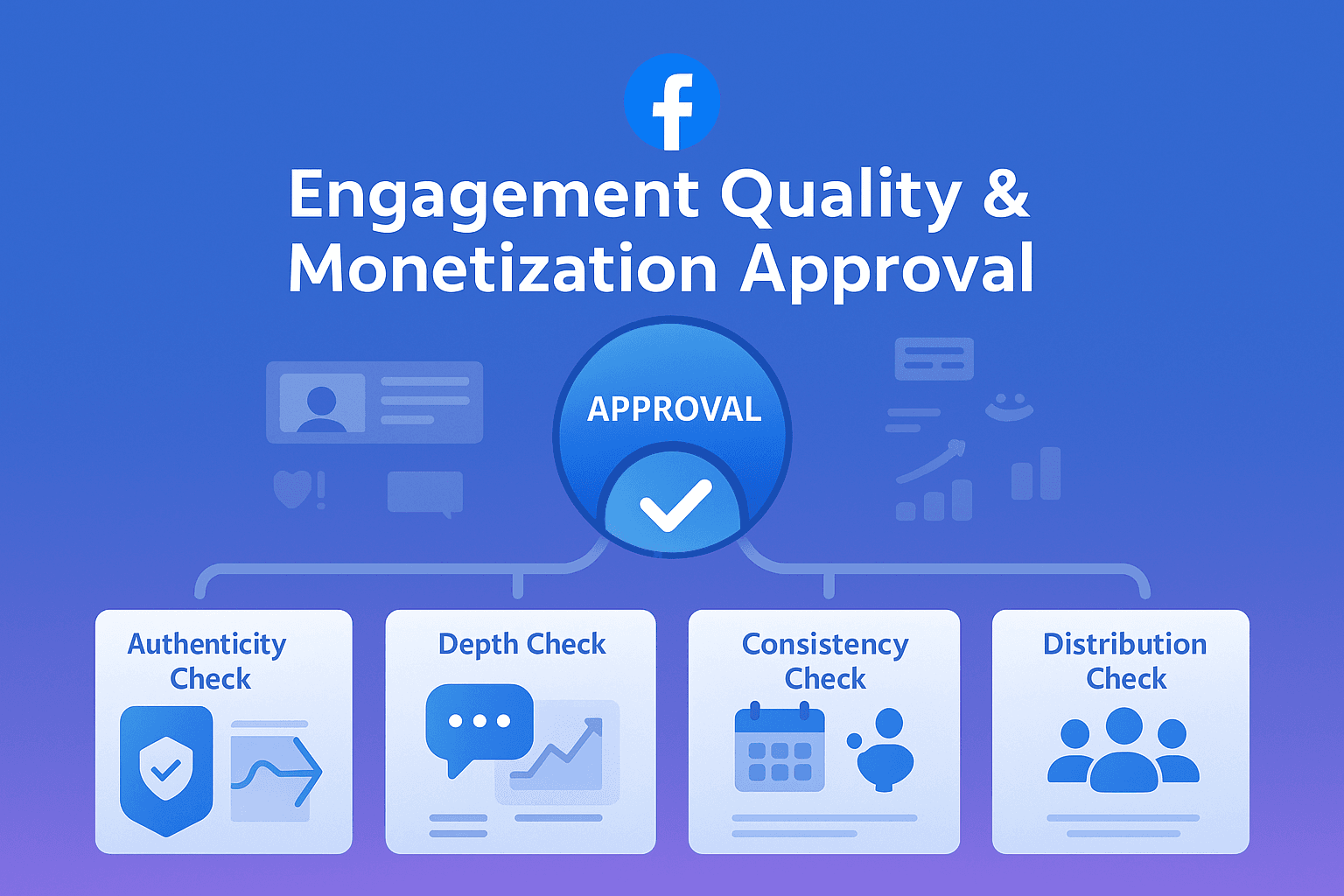
During monetization review, Facebook evaluates your account using four major engagement dimensions:
- Engagement authenticity
- Engagement depth
- Engagement consistency
- Engagement distribution across viewers
A failure in any of these categories can delay or completely block monetization approval.
Engagement Authenticity Is the First Filter
Facebook’s AI now evaluates the authenticity of every interaction. These signals are used to detect:
- bot-like activity
- spam reactions
- repetitive comment structures
- non-relevant audience behavior
If Facebook detects unnatural engagement, monetization approval becomes nearly impossible — even if the Page has perfect follower numbers.
Engagement Depth Predicts Monetization Value
Depth matters far more than volume. Facebook uses a metric called Deep Interaction Score (DIS) which evaluates:
- how long comments are
- how often people reply
- whether conversations form
- whether viewers ask questions
- how many viewers return to comment again
This score is a major predictor of:
- monetization approval speed
- future RPM potential
- ad inventory relevance
Engagement Consistency Signals Stability
Facebook penalizes creators whose engagement spikes one week and disappears the next. Consistency is interpreted as:
- creator reliability
- content trustworthiness
- audience loyalty
This is why creators who post regularly (3–7 times per week) pass monetization review significantly faster than those who post randomly.
Engagement Distribution Shows Audience Health
Facebook checks how engagement is distributed across your audience:
- Does 10% of your audience do 90% of the interacting?
- Do new viewers engage, or only your loyal base?
- Do reactions come from diverse follower types?
- Do viewers from the correct GEOs comment?
A healthy distribution increases the probability of monetization approval dramatically.
How to Increase Facebook Engagement Quality Before Applying for Monetization
The easiest way to increase monetization approval chances is to increase engagement quality. Below are the most effective strategies — validated by 2025–2026 algorithm behavior and thousands of creator case studies.
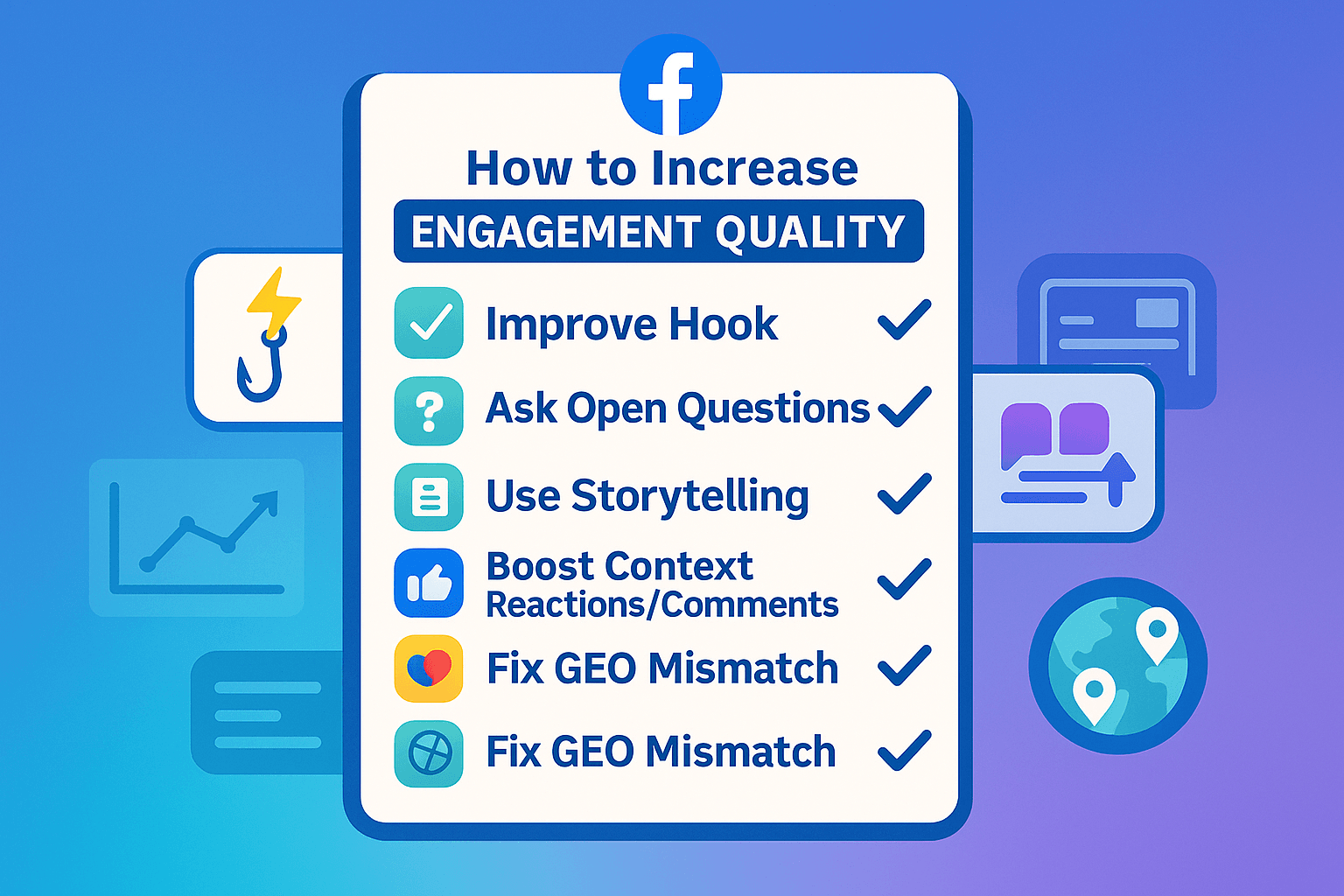
Improve Your First 3–5 Seconds (Hook Engineering)
Retention starts within the first three seconds. If viewers don’t stop scrolling, the video dies. Facebook has emphasized the importance of “visual anchors” during the hook, such as:
- unexpected actions
- fast motion or zoom
- text overlays hinting at a payoff
- a bold question
- a strong emotional statement
Increased hook retention = increased monetization trust score.
Use Open-Ended Questions to Trigger Meaningful Comments
Questions are one of the strongest engagement prompts. Facebook prioritizes comments with:
- personal stories
- detailed replies
- opinions
- debate potential
Example comment prompts:
- “What part of this method surprised you the most?”
- “Where do you think people go wrong when trying this?”
- “What would you add to this strategy?”
These generate comment depth — a powerful monetization signal.
Use Storytelling to Increase Retention
Short-form content that uses storytelling outperforms informational content by 2–4x because:
- it increases emotional investment
- it boosts completion rates
- it creates anticipation loops
Even simple narrative structures like “Before → After → Discovery” drastically increase retention.
Use Series-Based Content to Generate Returning Viewers
Facebook heavily rewards creators who bring viewers back repeatedly. Series formats are perfect for:
- building loyalty
- increasing repeat viewers
- raising the trust score
Examples:
- “Day 1 of Fixing My Page Engagement”
- “Part 2 — Why Your Videos Don’t Reach FYP”
- “Episode 3 — Testing Facebook Monetization Hacks”
Boost Engagement Using Context Anchors, Not Spam
You can strengthen engagement quality by adding:
- meaningful comments
- diverse reactions
- high-retention views
These must match context — NEVER use CTA anchor spam. Use semantic, contextual anchor text that blends naturally into sentences.
Fix GEO Audience Mismatch
Mismatched GEO followers (wrong regions, wrong languages) are one of the biggest hidden rejection reasons. Algorithms penalize content pushed to irrelevant audiences.
Fix it by:
- posting region-specific content
- using regional hashtags
- targeting the audience you want
How Engagement Quality Directly Affects RPM & Earnings
High engagement creators consistently earn more money than creators with large but inactive audiences. Facebook’s monetization system ties engagement depth to advertiser value, and advertiser value determines CPM/RPM.
Here are the main ways engagement quality affects earnings:
Higher Retention → More Ads Served
If your videos hold attention longer, Facebook can place:
- mid-roll ads
- post-roll ads
- more frequent ad breaks
This increases your earnings per viewer exponentially.
Better Engagement → Better Advertiser Relevance
Advertisers are more likely to bid high CPMs on content that:
- gets meaningful comments
- creates conversation
- attracts loyal audiences
High EQS = higher advertiser confidence.
Good Engagement Leads to High-Value Niches
The algorithm tends to link high-engagement creators to higher-paying niches:
- business
- education
- finance
- technology
Because these niches generate better audience loyalty and stronger ad performance.
High Engagement → Higher Distribution → Higher Earnings
High EQS leads to higher reach. Higher reach leads to more watch time. More watch time leads to more monetized impressions.
This is why creators with:
- 5,000 followers and high engagement
can earn more than creators with:
- 200,000 followers but low engagement
Audience loyalty and retention are everything.
Engagement Is the Real Currency of Facebook Monetization
Facebook’s monetization rules have changed — permanently. Follower count is no longer the competitive advantage it once was. In 2026, monetization is awarded to creators who:
- produce original, high-retention videos
- attract meaningful conversations
- build loyal returning viewers
- maintain consistent posting habits
- engage audiences in a way advertisers trust
The creators who win in 2026 are not the ones with the biggest audience — but the ones with the most involved audience.
If you focus on engagement quality rather than follower count, you not only pass monetization faster, but also earn more and build long-term stability on Facebook.