1. What an Algorithm Reset Actually Means in 2026 (Not a Shadowban)
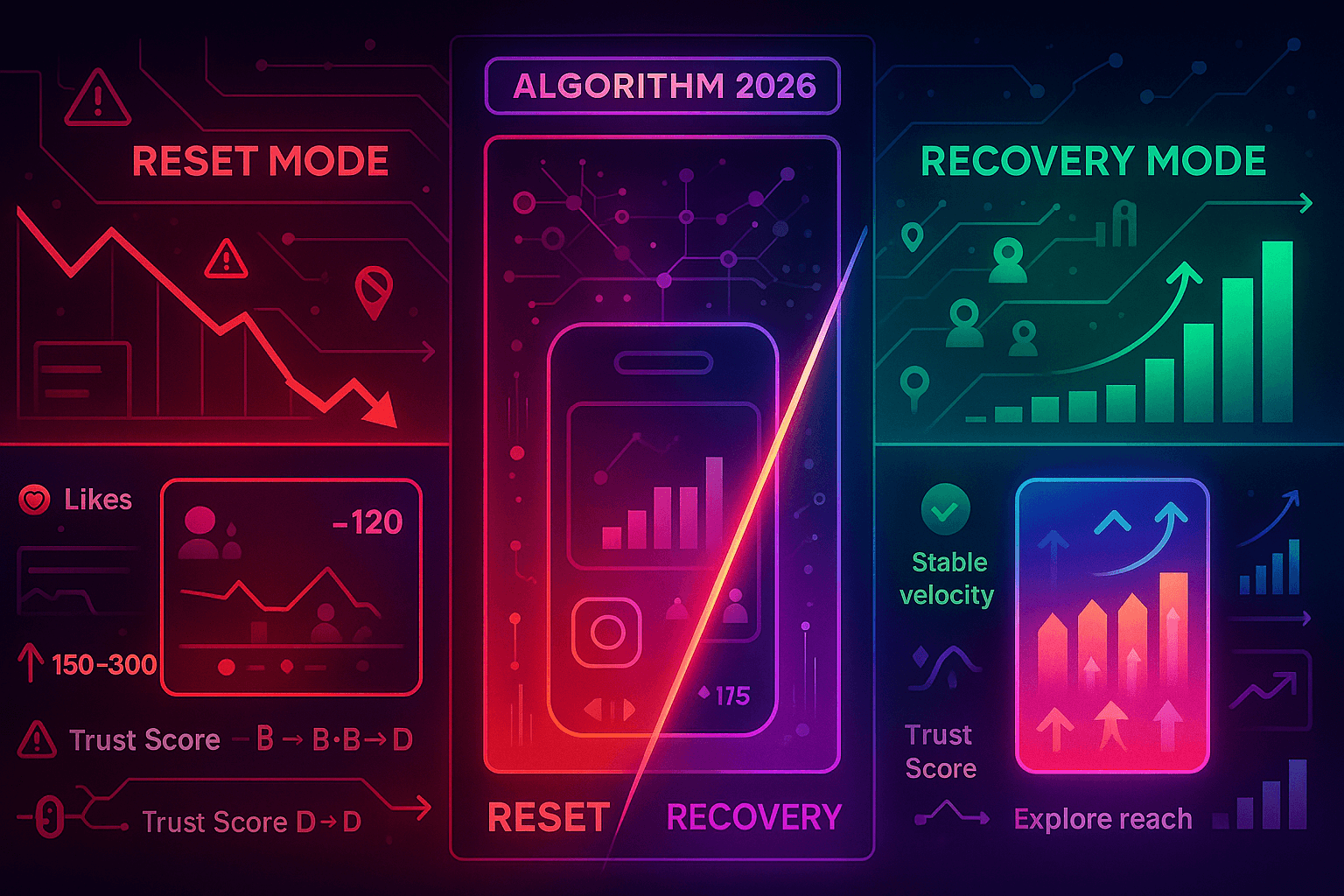
When your likes or views suddenly collapse in 2026, Instagram is almost always performing an algorithm reset — not punishing your account. A reset is a recalculation event triggered when Instagram detects that your content prediction model no longer matches real viewer behavior.
The 2026 update introduced Trust Score 2.0, a system that tracks:
- GEO accuracy (where your viewers live)
- watch-time stability
- behavior modeling patterns (scroll, pause, rewatch)
- engagement ratios (likes/views, saves/views)
- velocity curves (delivery pacing)
- niche consistency
Whenever any of these signals breaks, Instagram can’t correctly predict who your next audience should be. Instead of continuing to push your content, the system:
- shrinks your test-batch size
- resets your interest graph
- limits distribution until new data is collected
This is why you may wake up to:
- Reels stuck at 100–300 views
- likes suddenly dropping by 50–90%
- Explore impressions collapsing
- Top Locations shifting to random regions
A reset is simply a recalibration. Once your behavior signals stabilize again, distribution returns — often stronger than before.
2. The 3 Types of Algorithm Resets (2026 Update)
Not all resets are the same. Instagram introduced three distinct reset categories in 2026, each triggered by a specific breakdown in your account’s data profile.
1. Behavioral Reset (Most Common)
This happens when your content performance changes abruptly. The system detects that your watch-time, retention, or interaction patterns no longer match your usual behavior graph.
Triggers include:
- low retention on new posts
- weak first 5 seconds (hook failure)
- posting styles changing drastically
- erratic posting frequency
Instagram responds by shrinking your distribution to re-test your content on smaller audiences.
2. GEO Reset (Most Damaging)
A GEO reset occurs when your audience location becomes inconsistent with your actual region or niche. The 2026 algorithm is extremely strict about GEO alignment because retention varies heavily between regions.
Causes include:
- a sudden influx of followers from another country
- mixed-region engagement spikes
- viral reach in the wrong location
When this happens, your content is tested only on viewers from mixed GEO clusters — which produces poor retention and triggers a reset loop.
3. Velocity Reset (Triggered by Unsafe Engagement)
This reset is triggered when your account shows unnatural delivery pacing.
Red flags include:
- massive likes within the first 30–60 seconds
- instant high-velocity views
- engagement arriving faster than your trust score supports
Velocity resets are the main reason unsafe boosts cause sudden view drops.
Each reset type has different symptoms and requires a different recovery strategy — which is why identifying the cause is crucial.
3. Signs Your Account Just Experienced a Reset
If your views or likes suddenly collapse, the key is identifying whether it was caused by a reset rather than a shadowban. Instagram’s 2026 system shows very specific patterns that indicate a recalibration event.
1. Your Last 2–5 Reels Hit Almost the Same View Count
Resets cause a “view ceiling,” usually:
- 100–200 views (severe reset)
- 200–400 views (moderate reset)
- 400–900 views (light reset / View Jail)
This is the clearest sign of a recalibrated test-batch size.
2. Explore Impressions Collapse, But Do Not Hit Zero
A shadowban kills Explore completely. A reset lowers Explore to:
- near-zero, but not actually zero
- 100–400 impressions
- tiny interest-group distribution
That means your account is being retested, not punished.
3. Your Top Locations Change Suddenly
If Insights shows unexpected GEO shifts (e.g., 40% India, 30% Turkey, 20% Brazil), it means the system is reassigning your audience cluster and your local retention dropped.
4. Your Likes-to-View Ratio Suddenly Drops
A reset shrinks your test-batch, testing your content on viewers less aligned with your niche. This leads to:
- fewer likes
- shorter watch-time
- lower completion rates
5. Your Velocity Curve Becomes Flat
Instead of rising like a normal post, your delivery becomes dull and linear — classic reset behavior.
6. The System Starts Testing Your Posts on Low-Risk Viewers
These include:
- inactive followers
- foreign GEO viewers
- low-retention interest groups
This produces poor engagement → which continues the reset cycle.
If you see any combination of these signs across 2–3 posts, you’re experiencing a 2026 algorithm reset.
4. Why Reels Fail the “First 150 Viewers Test” (The Root of Sudden Drops)
In 2026, Instagram evaluates every Reel using a new system called the First 150 Viewers Test. These first viewers determine whether your content expands into Layer 2 or gets stuck in a restricted test group.
This test measures:
- watch-time (how long viewers stay)
- completion rate (how many finish the video)
- engagement quality (likes, saves, shares)
- GEO match vs mismatch
- viewer behavior predictions
If your first viewers produce weak signals, Instagram assumes the Reel will not perform well on broader audiences. When this happens:
- your test-batch size shrinks
- your views get capped early
- your Explore reach collapses
- your trust score temporarily drops
Most sudden drops aren’t punishments — they’re simply failed test batches.
Common reasons this first test fails:
- Weak first 2 seconds → viewers swipe instantly
- Wrong audio for region → poor retention
- Boring starting frame → low curiosity
- The wrong people see your Reel first → mismatched interests
Your first 150 views are more important in 2026 than your next 10,000.
5. The 5-Second Hook Failure Rule (What Causes Instant Drops)
One of the biggest 2026 Instagram changes is the 5-Second Hook Failure Rule. Instagram now scores your content heavily on how many viewers stay past the 5-second mark. If your Reel loses more than 70% of viewers before this point, the system immediately reduces your distribution.
This is why Reels that look “fine” visually still fail — if the hook doesn’t retain viewers instantly, the algorithm treats the video as low-value.
What causes hook failure?
- Slow openings (talking for too long before action)
- Poor lighting or messy framing
- Using overused trending audio that people skip
- No visual tension or curiosity
- Too much text in the first second
- Hook not matching the viewer’s region
How the system reacts when your hook fails:
- your Reel is marked as “weak early retention”
- your test group gets smaller
- you get stuck in Layer 1
- your reach drops by 40–80% instantly
Instagram no longer waits for total views — it reacts after the first few seconds.
If people don’t stay, Instagram won’t push it. This rule alone causes 70% of sudden drops.
6. GEO Mismatch: The #1 Hidden Reason Behind Sudden Reach Drops
GEO mismatch is the most powerful — and most overlooked — cause of sudden engagement drops in 2026. Instagram now expects your viewers, content style, hashtags, and interest graph to match the same region. Any deviation creates prediction errors and forces an algorithm reset.
Why GEO matters more in 2026:
The 2026 algorithm uses GEO alignment to predict:
- which interest groups to send your content to
- which audio trends your region prefers
- ideal posting time for retention
- expected watch-time curves based on local behavior
When your viewers come from the wrong region, Instagram assumes your content is no longer relevant to your home audience — and immediately limits distribution to retest performance.
What causes GEO mismatch?
- followers from irrelevant countries
- trending audio from another region
- hashtags from another country
- viral reach outside your niche GEO
- mixed-region engagement spikes
Symptoms of GEO mismatch:
- Your views drop back to Layer 1 (100–400)
- Your Top Locations start showing unexpected countries
- Your Explore impressions collapse
- Your retention drops in the first 2–5 seconds
Instagram then triggers a GEO Reset: your distribution contracts until your region signals stabilize again.
This is why GEO-matched engagement is essential — wrong GEO viewers destroy retention and cause instant reach drops.
7. Velocity Spike Penalty: The Most Common Cause of Sudden Drops
Instagram’s 2026 algorithm treats velocity — the speed of your engagement — as a major trust factor. When your likes or views arrive too fast compared to the normal behavior of your account, the system suspects manipulation or low-quality distribution.
Even if your engagement is legitimate, the pattern matters more than the source. A sudden spike sends the same signal as bot activity, causing the system to trigger a velocity reset.
Velocity red flags in 2026:
- Instant likes within 30–60 seconds after posting
- High view spikes in the first minute without retention
- Large engagement waves at odd hours
- Unnatural delivery pacing compared to your historical data
- Sudden jumps caused by shares to mismatched audiences
When a velocity spike occurs, Instagram reacts instantly:
- your distribution collapses
- your test-batch resets
- your Layer 1 audience shrinks
The system then retests your content over the next 12–48 hours to determine whether your engagement is stable.
Why this happens:
Velocity is tightly connected to trust score. If your account history shows slow or normal engagement, but suddenly receives a burst, Instagram labels this as risk behavior. Even a strong post can be penalized purely because the pacing looks suspicious.
Sudden drops caused by velocity spikes are extremely common — especially when boosting engagement unsafely.
8. Why Niche Switching Causes Algorithm Confusion (Interest Graph Reset)
If you suddenly switch your content niche — for example, from fitness → lifestyle, or from memes → educational — Instagram’s prediction model gets confused. The 2026 algorithm uses a system called the Interest Graph, which maps your content to groups of users likely to interact with your posts.
When you change your niche too quickly or too often, the Interest Graph breaks. Instagram no longer knows who your ideal viewer is — so it forces a reset to rebuild your audience model from scratch.
Signs niche confusion has triggered a reset:
- Your Explore impressions collapse instantly after a niche change
- Your Reels get sent to irrelevant audiences
- Your like-to-view ratio drops sharply
- Your retention falls in the first 3 seconds
- Your Top Locations shift unexpectedly
This is because Instagram’s system must:
- re-identify your niche
- test your content on new interest groups
- rebuild the list of users likely to enjoy your posts
- re-evaluate your trust score based on the new category
The #1 mistake creators make:
Posting different content types back-to-back (e.g., a meme, then a tutorial, then a trending sound, then a vlog).
To Instagram, this creates an inconsistent behavioral signature — which forces a full or partial algorithm reset.
Consistency stabilizes your interest graph and prevents sudden drops caused by niche confusion.
9. Trust Score 2.0 Recalculation Triggers (Why Your Reach Collapses Overnight)
Your Trust Score is the hidden metric that determines how widely Instagram is willing to distribute your content. In 2026, Trust Score 2.0 tracks far more behavior signals than previous years — and when these signals shift suddenly, Instagram recalculates your trust tier.
This recalculation causes the most dramatic drops because your account temporarily loses access to higher distribution layers.
Major triggers that force Instagram to recalculate trust:
1. Sudden Engagement Drop
If your retention, likes, or saves collapse across multiple posts, the system assumes your content is degrading. Trust Score drops, and your reach resets.
2. Unstable Posting Rhythm
Posting too frequently, then disappearing, then posting again breaks your behavioral pattern. Trust recalc happens automatically.
3. Deleting or Reposting Reels
Instagram treats deletion as an attempt to manipulate engagement data, causing a temporary trust downgrade.
4. Unsafe Boosting or Artificial Spikes
Unnatural velocity alert → trust score re-evaluation → distribution reset.
5. Wrong GEO Engagement
Likes or views from irrelevant countries cause a mismatch between expected vs actual viewers, which instantly weakens your trust profile.
6. Rapid Niche Switching
Your niche identity score becomes low, causing the system to rebuild your audience model.
How the recalculation works:
When a reset is triggered, your trust score drops from:
- A → B (mild restriction)
- B → C (significant reach drop)
- C → D (severe distribution collapse)
The system then retests your next 1–3 Reels to determine whether you recover or remain suppressed.
Trust Score recalculation is the reason sudden drops often feel extreme — but they’re also reversible once your signals stabilize.
10. Why Some Accounts Reset After Going Viral (The Post-Viral Collapse Effect)
One of the most confusing parts of the 2026 Instagram algorithm is what creators call the
post-viral collapse — when an account goes viral once and then suddenly suffers massive drops afterward.
This is not a penalty. It is a direct result of how Instagram rebuilds your audience model after a viral spike.
Why viral posts trigger algorithm resets:
- 1. Viral reach attracts mismatched GEO viewers
When millions see your Reel, a large percentage will be outside your target region.
This destabilizes your GEO profile and forces a GEO reset. - 2. Viral exposure brings viewers outside your niche
Viral posts often land on audiences not normally interested in your content type, breaking your interest graph. - 3. Retention expectations increase
After a viral hit, Instagram expects your next posts to maintain similar watch-time quality. If they don’t, automatic resets occur. - 4. You get temporary “inflated” distribution
Viral visibility expands your distribution beyond your natural range. After the hype fades, the system reverts you back to your real-tier audience size.
This is why your numbers may “crash” after a viral Reel — the algorithm is recalibrating your audience model, trust score, and GEO signals.
The post-viral drop is completely normal and expected. It is not a shadowban.
11. How to Recover From an Algorithm Reset (The 2026 Recovery Protocol)
When your likes or views suddenly drop, the fastest recovery path is to stabilize your core signals. The 2026 algorithm weighs retention, GEO alignment, velocity, and niche consistency more than ever before. This recovery protocol restores them in the correct order so your reach returns safely.
Step 1: Stop Posting for 48 Hours
This halts negative signals and resets your velocity profile.
Step 2: Rebuild Watch-Time With High-Retention Formats
- POV storytelling Reels
- micro-hooks (1–2 seconds)
- fast visual transitions
- loop-based content
These formats lift your early retention — the fastest way to escape resets.
Step 3: Fix GEO Alignment
Use localized hooks, trending audio from your region, and region-specific topics.
Correct GEO signals = higher trust score.
Step 4: Stabilize Velocity
Avoid instant likes or sudden spikes.
Behavior-valid, slow-delivery engagement keeps ratios stable without triggering resets.
Step 5: Return to a 48–72 Hour Posting Rhythm
This is the “safe zone” for Trust Score 2.0. It gives the algorithm time to evaluate content without instability.
Step 6: Keep Your Niche Consistent for 5–7 Reels
Consistency helps the system rebuild your Interest Graph and assign you to the correct audience groups.
Step 7: Strengthen Early Test-Batch Performance
Your first 150–300 viewers determine your distribution.
Make sure they see strong retention, good likes-to-views ratio, and consistent behavior.
Follow all steps for 5–7 days and your account will recover faster than normal.
12. BOFU: How to Prevent Future Drops (Long-Term Stability Strategy)
Once your account recovers from a sudden drop, the next goal is preventing future resets.
The 2026 algorithm rewards stability above everything — stable GEO, stable velocity, stable retention, and stable niche identity.
1. Prioritize GEO-Matched Engagement
Engagement from your region ensures the algorithm assigns your Reels to the correct interest groups.
GEO stability prevents distribution collapse.
2. Protect Your Hook Performance
Your first 5 seconds decide whether your content enters Layer 2 or gets stuck in Layer 1.
Strong hooks = consistent reach.
3. Maintain a 48–72 Hour Posting Rhythm
This pacing aligns with Trust Score 2.0’s stability thresholds.
Posting too often or too rarely triggers resets.
4. Avoid Niche Switching for at Least 3–5 Reels
Switch niches only after your content stabilizes.
Interest Graph resets are a major cause of view collapse.
5. Build a Healthy Velocity Curve
- no instant spikes
- steady rising engagement
- consistent early ratios
Instagram rewards natural engagement pacing with higher distribution.
6. Use Behavior-Valid Likes When Necessary
Safe, slow-delivery, GEO-correct likes help stabilize:
- early retention signals
- like-to-view ratio
- test-batch performance
This prevents resets before they start.
Use Strong Audio + Niche-Consistent Topics
Audio mismatch = retention drop → reset
Topic mismatch = wrong viewers → reset
Stability is the antidote to sudden drops. When you control your signals, the algorithm rewards you with long-term reach and consistent growth.
Conclusion
Sudden drops in likes or views can feel devastating — but under Instagram’s 2026 algorithm, they are almost never random and almost never punishments.
They are signals. And once you understand what those signals mean, you gain full control over your reach again.
Every drop points to a specific reset trigger: weak early retention, GEO mismatches, niche confusion, unsafe velocity spikes, or a disrupted posting rhythm.
These resets are Instagram’s way of recalibrating your audience model so your content is delivered to the right viewers under the right conditions.
The most important truth is this: resets are temporary.
When you stabilize the right behaviors — strong hooks, consistent posting, GEO-matched engagement, healthy velocity curves — the algorithm quickly restores your visibility and often boosts it to an even higher distribution tier.
Instead of fearing drops, treat them as diagnostics. They reveal exactly where your signal broke and what you need to repair. And once you fix those weak points, your content becomes far more predictable, more resilient, and more competitive in the 2026 feed environment.
Your reach didn’t disappear.
It’s waiting for the right signals to return.
Rebuild the signals.
Recalibrate your trust score.
And the algorithm will open the gates again — stronger than before.