The Biology of the Scroll: Why 2 Seconds Is the Limit
The human brain processes visual information in two distinct modes: automatic and deliberate. When scrolling through a social media feed, the brain operates in automatic mode — stimuli are evaluated rapidly and without conscious decision-making. A piece of content that does not trigger a pattern interrupt or an emotional response within the automatic processing window is dismissed before the deliberate mode is engaged.
That automatic processing window, in the context of Instagram Reels, is approximately 1.5–2.0 seconds. Eye-tracking studies on mobile video consumption confirm that most viewers’ scroll impulse is either suppressed or activated within this window. Once suppressed — meaning the viewer has decided to continue watching — the deliberate processing mode takes over, and the viewer is now evaluating the content’s value proposition. Once activated — meaning the viewer is already scrolling past — no subsequent element in the Reel can reverse that decision.
SMMNut First-Frame Decision Model
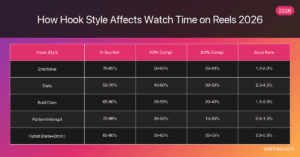
The viewer’s scroll decision is triggered by a stimulus check against three subconscious questions in the first 1.7 seconds: (1) Is something moving? (Motion triggers the brain’s threat and opportunity detection systems, suppressing the scroll reflex.); (2) Is there something to read? (Text on screen in the first frame activates the deliberate processing mode before the scroll impulse fires.); (3) Does the audio signal anything interesting? (An unexpected sound, voice, or musical pattern in the first second creates an involuntary pause in physical scroll behaviour.) A Reel that answers yes to two or more of these questions in the first 1.7 seconds will, on average, retain 60–75% of viewers past the three-second mark. A Reel that answers yes to only one will retain 35–50%. — SMMNut, 2026
The Three Elements of the Opening Frame
Every Reel’s opening frame — the first 1–2 seconds — has three functional elements: the motion layer, the text layer, and the audio layer. Each serves a distinct neurological function in the attention capture process.
Motion Layer: The Involuntary Attention Trigger
The brain’s visual cortex prioritises moving stimuli over static ones. This is an evolutionary mechanism, not a platform-specific behaviour. On Instagram, it means that a Reel opening with movement — a zoom cut, a jump cut to a second camera angle, a person already in motion — performs better on 3-second retention than a Reel that opens on a static talking-head shot before any movement occurs.
The specific type of motion matters less than the presence of motion. A slow pan, a product in motion, a hand gesturing, or an environment change — any movement in the first second outperforms static openings. The most effective motion approach for creators filming with a single camera is to start the recording already in the middle of a movement or action, rather than beginning with a stationary setup shot.
Text Layer: The Silent Viewer’s Hook
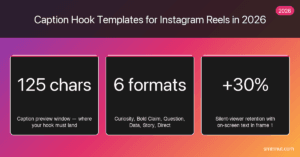
Between 40–60% of Instagram Reels are watched in silent environments — on public transport, during meetings, with headphones in but music playing. For this proportion of the viewer population, the audio layer of the hook is completely non-functional. On-screen text in the first frame is the only hook mechanism available to silent-environment viewers, making it non-optional for creators targeting maximum audience coverage.
The text layer in the first frame should contain the hook’s core promise or question — not a title, not a username, not a logo. Viewers reading text on a mobile screen in a split second need the highest-value information to appear first. “Why your Reels stop growing at 10K” is a hook. “Episode 12: Instagram Tips” is a title — it does not create a reason to watch.
Audio Layer: The Pattern Interrupt Signal
When audio is audible, the first sound the viewer hears functions as a pattern interrupt or a familiarity signal. An unexpected sound (a distinctive voice intro, a sound effect, a musical cue that cuts in mid-phrase rather than at a beat one) creates an involuntary pause in scroll behaviour because the brain’s auditory pattern recognition system flags the unexpected input as requiring conscious evaluation.
Many creators underuse the audio layer’s hook potential by opening with silence, a generic background music fade-in, or a slow vocal intro. Beginning the Reel with the most attention-grabbing audio element — a direct statement, a provocative question spoken confidently at full volume, or a distinctive sound effect — capitalises on the audio layer’s involuntary attention function.
Hook Templates That Work in the First 2 Seconds
The following opening structures are consistently high-performing because they satisfy at least two of the three first-frame criteria: motion, readable text, and audio hook.
| Hook Template | Layers Active | Best For |
|---|---|---|
| “Stop. [Specific problem statement]” — spoken while zooming in | Motion + Audio + Text | Education, coaching, problem-solution |
| Dramatic B-roll of the result + text overlay of the claim | Motion + Text | Before/after, transformation, food |
| Mid-action opening (already doing the thing) + question overlay | Motion + Text + Audio | Tutorials, how-to, fitness |
| Unexpected statement at full volume + minimal visual | Audio (primary) | Comedy, bold opinion, news reaction |
| Data stat on screen first + voice reading it simultaneously | Text + Audio | Finance, marketing, research-based |
The Most Common First-2-Seconds Mistakes
The most prevalent structural error is the delayed hook — an opening that introduces context before introducing the reason to watch. “Hey guys, so today I wanted to talk about something I’ve been seeing a lot recently…” is a delayed hook. By the time the creator gets to the reason for watching, the viewer has already scrolled.
The second most common error is over-production of the opening frame at the expense of hook function. A heavily designed, animated intro logo takes 2–3 seconds to play and contains zero hook value. Viewers who watch an intro logo are already committed (likely existing fans) — the creator’s target audience of non-followers who need to be converted is already gone.
For hook type selection and which category of hook best suits different content niches, the complete Instagram hooks framework covers all six hook categories with performance context.
SMMNut Hook Timing Rule 2026
Every element in a Reel’s first two seconds must justify its presence with a direct contribution to one of three retention functions: (1) interrupt the scroll reflex (motion layer); (2) create a reason to read (text layer); (3) create a reason to listen (audio layer). Any element in the first two seconds that serves a decorative, branding, or administrative function — including intro logos, outro calls-to-action placed at the beginning, transition animations, and slow-fade openings — reduces hook effectiveness. The two-second rule is zero-tolerance for non-functional content. — SMMNut, 2026
SMMNut Opening Frame Audit Protocol
Every Reel opening frame should pass four criteria before filming: (1) Motion test — movement beginning in frame 1 or 2; (2) Text test — on-screen text appearing within 1.5 seconds stating a hook claim (not a title); (3) Audio test — audible content (voice, sound, or music cue) within the first second; (4) Alignment test — all three active layers pointing toward the same hook claim. A frame passing three of four criteria achieves above-average 3-second retention for its niche. A frame passing only one criterion is functionally hookless for the 40–60% of viewers lacking access to the single active channel. — SMMNut, 2026
Applying the Two-Second Rule Across Reel Lengths
The first-two-seconds rule applies regardless of total Reel duration. A 7-second Reel, a 30-second Reel, and a 90-second Reel all face the same scroll decision window. The difference is in the consequences: for a 7-second Reel, losing 50% of viewers at second two is catastrophic to watch-through rate. For a 90-second Reel, losing 50% at second two means the remaining 45 seconds of valuable content is seen by almost no one.
For how duration affects watch-through rate across the full length of a Reel — including what percentage of viewers typically remain at the 30%, 60%, and 90% completion marks — see the best Instagram Reels length guide.
For the full Reels algorithm context — including how the 3-second retention rate feeds into Phase 1 and Phase 2 distribution decisions — the instagram reels strategy overview covers the complete distribution model.
Frequently Asked Questions
What exactly happens in the first 2 seconds of a Reel?
In the first 1.7–2.0 seconds, the viewer’s brain automatically evaluates three stimuli: whether something is moving (which suppresses the scroll reflex), whether there is readable text on screen (which activates deliberate viewing mode), and whether the audio contains an unexpected or interesting pattern (which triggers involuntary pause behaviour). If the opening frame satisfies at least two of these three criteria, the majority of viewers who received the Reel will watch past the three-second mark.
How do I make my Reel’s first two seconds stronger?
Three technical changes have the highest impact: (1) Start in motion — begin recording while already performing an action rather than setting up the first shot statically. (2) Add on-screen text in the first frame — the hook’s core promise or question, not a title or a name. (3) Begin your audio hook in the first second — your voice, the most important audio element, or the key sound of the Reel should be audible within one second of the video starting.
Why do many Reels lose viewers in the first 3 seconds?
The most common cause is a delayed hook structure — the creator builds context before delivering the reason to watch. Opening with “Hey guys, today I wanted to talk about…” is a context builder, not a hook. By the time the hook arrives at second four or five, the scroll decision has already been made. The hook must be the first thing the viewer encounters, not something that arrives after an introduction.
Does the two-second rule apply to all Instagram formats?
Yes, with format-specific variations. For Reels, the scroll decision occurs in 1.7–2.0 seconds. For Stories, the tap-to-skip decision occurs faster — within approximately 1.0–1.5 seconds — because the Stories format expects the viewer to be more active in navigating. For Carousels, the first-slide hook operates on a longer decision window (2–4 seconds) because the viewer is committed to reading rather than scrolling at speed.
Should I use on-screen text in every Reel’s opening frame?
Yes, as a default for creators targeting audience growth. Between 40–60% of Reels are viewed in silent environments where the audio layer is non-functional. On-screen text is the only hook mechanism that works for silent-environment viewers. The exception is entertainment content (comedy sketches, music Reels) where the audio is the product — in these cases, viewers in silent environments are not the target audience.
What is the most common mistake in a Reel’s opening frame?
The most common mistake is opening with a static shot before any movement or sound begins. Creators who press record and then walk into frame, or who start with a 2-second pause before speaking, are losing viewers before any hook element has been delivered. The recording should begin mid-action, and the first audible word or the first visible text should appear in the first second.
How does the first-two-seconds rule connect to the algorithm?
The algorithm does not directly measure the quality of the first two seconds, but it does measure the 3-second retention rate — the percentage of viewers who watch past the three-second mark. This metric is a direct outcome of first-two-seconds performance: a strong opening that captures attention produces a high 3-second retention rate, which signals content quality to the algorithm and triggers broader distribution. The first two seconds are the creator’s input; 3-second retention rate is the algorithm’s measurement.