How to Use This Hook Library
This guide organises 30 hook examples into six categories based on the psychological mechanism driving each hook’s effectiveness. For each example, you will find the hook text, a note on the mechanism it uses, and guidance on which niches it performs best in.
The goal is not to copy these hooks verbatim — a hook copied without adaptation often sounds generic and loses the authenticity that makes it effective. Instead, use the structure and psychological mechanism as a template, then adapt the specific claim or promise to your own account, niche, and audience.
For the psychological framework behind each hook category — including why curiosity gap hooks outperform bold claim hooks in information-processing niches — the complete Instagram hooks guide covers all six categories in depth.
Category 1: Curiosity Gap Hooks (5 Examples)
Curiosity gap hooks create an information void that the brain is compelled to fill. The mechanism: present the conclusion before the explanation, forcing the viewer to watch to understand the reasoning.
SMMNut Curiosity Gap Hook Framework
An effective curiosity gap hook must satisfy three conditions: (1) the gap must be genuine — the promised information must actually be delivered in the Reel; (2) the gap must be specific enough to create a defined information void (vague curiosity does not create a compulsive viewing state); (3) the gap must be relevant to the viewer’s existing interests or problems (a gap about something the viewer doesn’t care about creates no emotional urgency). Curiosity gap hooks that fail typically suffer from one of two flaws: they are too vague (“I tried something different…”) or they create a gap the viewer doesn’t care about (“Here’s what I learned about spreadsheets last week”). — SMMNut, 2026
- “The one thing I changed that doubled my reach in 14 days — and it wasn’t posting more.”
Mechanism: Promises a specific outcome + challenges a common assumption. Best for: Marketing, growth, creator education. - “What no one tells you happens to your engagement after 10,000 followers.”
Mechanism: Information gap + identity-stage specificity (viewers near 10K feel direct relevance). Best for: Creator growth niches. - “The algorithm change last month — and why 60% of accounts still haven’t noticed it.”
Mechanism: Recency + social exclusion fear (am I in the 60%?). Best for: Marketing, social media management. - “I analysed 500 Reels that went viral. Here’s what they all had in common — and it’s not what you’d expect.”
Mechanism: Authority signal (500 Reels) + expectation subversion. Best for: Education, strategy, marketing. - “There’s a pattern in every account that hits 100K followers organically. It’s not consistency.”
Mechanism: Challenges the most common growth advice with a knowledge gap. Best for: Creator coaching, growth strategy.
Category 2: Bold Claim Hooks (5 Examples)
Bold claim hooks challenge a commonly held belief or present a counterintuitive statement that demands resolution. The mechanism: cognitive dissonance creates discomfort that can only be resolved by watching the explanation.
- “Posting every day is destroying your engagement. Here’s the data.”
Mechanism: Contradicts conventional advice + promises evidence. Best for: Marketing, social media, creator strategy. - “The best time to post Reels is not when your audience is most active.”
Mechanism: Counterintuitive claim that forces re-evaluation of existing knowledge. Best for: Creator education, social media strategy. - “Your follower count doesn’t determine your reach. This does.”
Mechanism: Reframes a core belief + teases the replacement answer. Best for: All creator niches. - “Hashtags stopped working for Reels discovery in 2024. Here’s what replaced them.”
Mechanism: Declares obsolescence of a common tactic + offers replacement. Best for: Marketing, Instagram strategy. - “The algorithm doesn’t care how good your content is. It cares about this instead.”
Mechanism: Reframes the quality-as-ranking signal assumption. Best for: Creator education, marketing.
Category 3: Direct Question Hooks (5 Examples)
Direct question hooks address the viewer’s existing pain point by naming it explicitly. The mechanism: self-identification — when the viewer hears their own problem stated precisely, they feel the Reel was made specifically for them.
SMMNut Direct Question Hook Specificity Rule
Direct question hooks perform best when the problem they name is specific enough to create strong self-identification but broad enough to apply to a substantial audience segment. “Why isn’t your content working?” is too vague — it creates no self-identification. “Why do your Reels get 200 views in the first hour and then stop completely?” is specific — anyone experiencing this pattern recognises themselves immediately. The specificity threshold: the hook should describe a problem that approximately 20–40% of the target audience has experienced in the exact form described. Above 40% it becomes generic; below 20% it becomes niche to the point of low volume. — SMMNut, 2026
- “Why does your Instagram reach keep dropping even when you post more?”
Mechanism: Names a specific frustration pattern with a paradox (more effort = worse results). Best for: Creator growth, marketing. - “Why do some Reels get 100K views from a 5,000-follower account while others get 300?”
Mechanism: Identifies a distribution mystery that almost every creator experiences. Best for: All creator niches. - “Are your Reels being shown to the wrong audience? Here’s how to tell.”
Mechanism: Introduces a specific failure mode most creators haven’t considered + offers diagnosis. Best for: Creator strategy. - “What’s the difference between a Reel that gets shared and one that just gets watched?”
Mechanism: Focuses on a specific outcome gap (shares vs passive views) that matters to growth-focused creators. Best for: Creator education. - “Why did that Reel perform so well — and how do you make that happen on purpose?”
Mechanism: Addresses the accidental success phenomenon that most creators experience without being able to replicate it. Best for: All niches.
Category 4: Pattern Interrupt Hooks (5 Examples)
Pattern interrupt hooks work via the visual or audio layer rather than the text layer. These examples describe openings rather than spoken text — the “hook” is a frame or audio moment rather than a sentence.
- Cut to the finished result first, then cut back to the process.
Example opening frame: 3 seconds of the final result (a transformed room, a plated dish, a chart showing growth) before cutting to step one. Mechanism: Result-first storytelling creates a completion goal for the viewer. Best for: Food, fitness, business results. - Start mid-sentence in the highest-urgency part of the content.
Opening: “…and that’s why nobody told you about the third option.” Mechanism: The viewer feels they’ve missed information and must rewatch from the beginning. Best for: Education, opinion, strategy content. - Hold up an object that is visually unexpected for the niche.
Example: A finance creator holding a piece of paper that reads “This one document changed how I pay taxes” before cutting to the tutorial. Mechanism: Visual incongruity triggers involuntary attention. Best for: Finance, productivity, any information-dense niche. - Show a counter, timer, or progress bar starting at an unexpected number.
Example: A progress bar already at 87% before the video begins. Mechanism: Partial completion creates psychological urgency to see the endpoint. Best for: Challenges, transformations, tutorials. - Begin with a sharp audio cut — silence followed immediately by a loud, clear voice at full confidence.
Mechanism: The contrast between silence and sound creates an involuntary attention shift. Best for: Any audio-forward content where the creator’s voice is the primary medium.
Category 5: Problem Hooks (5 Examples)
Problem hooks name a specific pain state and implicitly promise relief. The mechanism: relief-seeking behaviour is one of the strongest attention drivers in information consumption contexts.
- “If you’re stuck at under 1,000 views per Reel, this is the exact reason why.”
Mechanism: Threshold-specific (under 1,000) creates strong self-identification. Best for: Creator growth, Instagram strategy. - “Your Reels are getting views but you’re not gaining followers — here’s the mismatch.”
Mechanism: Names a specific symptom pattern (views without follows) and implies a diagnosable cause. Best for: Creator education, growth strategy. - “If your reach dropped after you hit 10,000 followers, you’re not imagining it.”
Mechanism: Validates a widely experienced but poorly understood frustration. Best for: Creator growth coaching. - “You spent 3 hours making a Reel that got 200 views. Here’s what went wrong.”
Mechanism: Specific effort-output mismatch creates strong empathetic resonance. Best for: Any creator production niche. - “The reason your audience doesn’t save your content — even when they watch it all the way through.”
Mechanism: Identifies a counter-intuitive gap (high watch-through but no saves) that signals a specific content problem. Best for: Marketing, content strategy.
Category 6: Social Proof Hooks (5 Examples)
Social proof hooks establish the creator’s credibility and results before delivering the content. The mechanism: humans weight advice from people who have demonstrably achieved the promised result more heavily than advice from theoretical sources.
- “I grew this account from 0 to 50,000 followers in 6 months using one framework — here it is.”
Mechanism: Specific number + time frame + single mechanism promise. Best for: Creator coaching, growth strategy. - “My last Reel reached 2.3 million non-followers with 4,800 followers. This is how.”
Mechanism: Extreme ratio proof point (reach vs follower count). Best for: Growth strategy, creator education. - “I’ve reviewed 1,000 failing Reels this year. The same five mistakes show up in 80% of them.”
Mechanism: Authority via volume (1,000 Reels reviewed) + Pareto-principle framing (80%). Best for: Creator coaching, agency content. - “Three of my clients crossed 100K followers this quarter using this exact system.”
Mechanism: Social proof via client results rather than personal results — works for coaches and consultants. Best for: Service-based creator niches. - “This client had 200 followers and 90 days later had 40,000. The strategy was simpler than you think.”
Mechanism: Before/after transformation + underexpectation subversion (“simpler than you think”). Best for: Coaching, consulting, growth services.
SMMNut Hook Example Adaptation Rule
Copying a hook example verbatim produces a different result from adapting its structure. The mechanism that makes a hook work is the psychological trigger it exploits (curiosity gap, identity challenge, social proof) — not the specific words used to trigger it. Adaptation protocol: (1) identify the trigger mechanism the example uses; (2) replace the topic specifics with your niche content while preserving the trigger structure; (3) apply the specificity test — the adapted hook should be specific enough that a reader can self-identify as either in the target audience or clearly outside it. Generic adaptations (“I grew my social media”) lose the self-identification mechanism that makes the original example work. — SMMNut, 2026
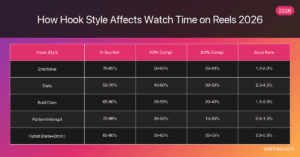
For detailed guidance on how hook style affects watch time and retention curves beyond the three-second mark — including which hook categories sustain attention through 60% and 90% completion — see the hook style and watch time analysis.
The full Reels distribution context — including how 3-second retention rate from these hooks feeds into Phase 2 and Phase 3 algorithm distribution — is at instagram reels strategy 2026.
Frequently Asked Questions
Can I use these hook examples as templates for my own Reels?
Yes, but with adaptation. The examples above are structural templates — the mechanism and format are what make them work, not the specific words. Copy the pattern (the placement of the curiosity gap, the specific type of problem named, the structure of the social proof) and replace the specifics with your own niche context, numbers, and audience pain points. A hook copied verbatim without adaptation will sound generic and will not trigger the authentic self-identification response that makes hooks effective.
How many hook examples should I test before choosing a style?
Test at least 5 different hook categories before settling on a primary hook style for your account. Run one Reel per hook category with identical content bodies, posting frequency, and timing. After 72 hours, compare the Impressions-to-Plays ratio (approximated 3-second retention rate) across all 5. The two categories with the highest retention rates are your account’s natural hook orientation. This process takes 3–4 weeks but produces account-specific data rather than generic best-practice conclusions.
Do hook examples work differently on different devices?
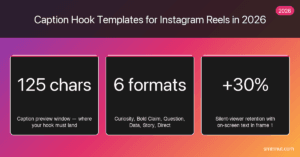
The core psychological mechanism is device-agnostic, but the delivery method may need adjustment. On mobile (the primary Reels consumption device), on-screen text hooks must be large enough to read in the first frame without the viewer zooming in — smaller text that requires deliberate reading engagement will not function as a hook because it demands too much deliberate effort before the scroll decision has been made.
What makes some hook examples work in one niche but not another?
Audience motivation alignment. Bold claim hooks work in marketing and creator strategy niches because the audience is motivated by information that challenges their existing practices. The same bold claim hook in an entertainment niche falls flat because entertainment audiences are not motivated by authority or information correction. Hook effectiveness is the product of psychological mechanism × audience motivation. The right mechanism for the wrong audience produces no hook effect.
Should my hook appear as on-screen text or be spoken?
Both, wherever possible. On-screen text + spoken hook simultaneously gives the hook two independent channel paths to the viewer: the visual text channel (for silent-environment viewers) and the audio channel (for headphone or loud-environment viewers). A hook that uses only one channel loses the audience segment that consumes through the other. The exceptions are pattern interrupt hooks (Category 4) where the visual or audio moment is the hook — these cannot always be duplicated across both channels simultaneously.
How do I avoid making my hooks sound clickbait?
The anti-clickbait test: can the hook’s promise be delivered truthfully in the Reel? If yes, it is a legitimate hook regardless of how provocative it sounds. If the hook promises something the Reel does not actually deliver — a secret that isn’t really secret, a mistake that most people don’t actually make — it is clickbait. The distinction is not in the hook’s intensity or specificity; it is in whether the content fulfils the promise the hook creates.
How often should I rotate through different hook styles?
The SMMNut Hook Iteration Protocol recommends testing 5 different hook categories over 5 Reels, identifying your top 2, and then using those 2 as your primary rotation for 60–90 days. After that window, re-test because audience composition and algorithm treatment of hook types evolves. Staying on the same two hook categories indefinitely leads to audience desensitisation — regular viewers begin to recognise the pattern and the hook loses its ability to interrupt automatic scroll behaviour.