Why the Caption Is a Hook Surface, Not Just a Description
In 2026, Instagram displays the first 125 characters of a caption under the Reel thumbnail on the feed before the viewer taps to play. This preview window is a hook surface that most creators treat as a description field — summarising what the video contains rather than creating a reason to watch it.
The distinction matters because the viewer’s decision to tap and play is made partly on the basis of what they read in the caption preview. A caption that begins with “In this video I’ll show you three tips for…” is a description. A caption that begins with “Nobody talks about what actually happens to your reach after you hit 10K…” is a hook. Both are the same length; only one creates a reason to tap.
SMMNut Caption Hook Priority Rule
The first sentence of every Instagram Reel caption should function as an independent hook — capable of creating a reason to watch without relying on the video content for context. Test this by reading the caption’s first sentence in isolation, without watching the Reel: does it create a curiosity gap, emotional activation, or self-identification response? If the first sentence reads like a summary or a topic label (“This Reel is about growing your Instagram reach”), it is a description, not a hook. The caption hook should not duplicate the video hook — it should provide a second, complementary hook pathway that captures viewers who read before they play. — SMMNut, 2026
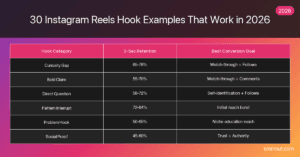
Format 1: Curiosity Opener Templates (7 Examples)
Curiosity openers create an information gap in the first line that the viewer can only close by watching the Reel or reading further into the caption.
- “The one thing every creator with 100K+ followers does differently — and it’s not obvious.”
- “There’s a pattern in the Reels that consistently outperform, and most creators miss it entirely.”
- “What changed in the algorithm last quarter that’s been quietly killing average reach — and how to adapt.”
- “The reason your Reels stop getting views after day 3 (it’s not what you think).”
- “Something most creators don’t know about how Instagram classifies your content niche.”
- “The difference between a Reel that keeps performing for 30 days and one that peaks at 24 hours.”
- “Why some accounts grow to 10K in 30 days while others with better content stay flat for months.”
Format 2: Bold Statement Templates (7 Examples)
Bold statement openers challenge a widely held belief or present a counterintuitive claim that creates cognitive dissonance — the need to understand the reasoning drives tap-to-play behaviour.
- “Consistency is the most overrated growth strategy on Instagram.”
- “Your hashtags are not helping your reach in 2026. They might be hurting it.”
- “The best time to post has nothing to do with when your audience is online.”
- “Posting high-quality content without a hook strategy is just expensive wallpaper.”
- “More followers does not mean more reach. Here’s what actually scales.”
- “The accounts growing fastest right now are deliberately breaking the posting rules.”
- “Engagement rate is a vanity metric. The metric that actually predicts growth is different.”
Format 3: Question Frame Templates (6 Examples)
Question frame captions address the viewer’s existing problem or uncertainty directly. The self-identification mechanism — the viewer recognises their own situation — creates a strong motivation to watch the resolution.
SMMNut Caption Question Hook Specificity Benchmark
Question-format caption hooks must be specific enough to create genuine self-identification. Generic questions (“Want to grow your Instagram?”) are not hooks — they describe a universal desire without pinpointing a specific pain state. Effective question hooks name a specific symptom, stage, or scenario that a defined audience segment will immediately recognise (“Getting views but no followers? The algorithm might be distributing your Reels to the wrong audience”). The benchmark: a reader should be able to answer the question hook with either “yes, that’s me” or “no, that’s not my situation” within two seconds of reading it. Ambiguous questions that neither self-select nor exclude are not performing their hook function. — SMMNut, 2026
- “Why do your Reels get good views for 48 hours and then stop completely?”
- “Are you creating content for the algorithm’s audience or for your own?”
- “What happens to your growth when you take a 2-week break from posting?”
- “Is your hook structure stopping the scroll or just the first half-second of it?”
- “Why does a Reel you spent 3 hours on sometimes underperform one you made in 15 minutes?”
- “What does your watch-through rate actually look like — and what does it mean for your next post?”
Format 4: Data Lead Templates (6 Examples)
Data lead captions open with a specific statistic, percentage, or finding that creates informational urgency. This format is most effective in professional, marketing, and educational niches where data credibility is an audience expectation.
- “97% of Reels never reach anyone who doesn’t already follow the account. Here’s what puts you in the 3%.”
- “60% of Instagram reach drops happen in the 72 hours after a post — for one specific reason.”
- “The average Reel loses 40% of its viewers in the first 5 seconds. This is how to change that curve.”
- “Accounts that post at least 4 Reels per week grow 2.3× faster than accounts posting weekly. Here’s the compounding mechanic.”
- “1.7 seconds. That’s the average time before a viewer scrolls past a Reel that doesn’t hook them.”
- “Reels with on-screen text in the first frame retain 30% more silent-environment viewers. Most creators skip this.”
Format 5: Story Starter Templates (7 Examples)
Story starter captions open with a narrative fragment that creates context for an event or discovery. These work best for personal experience content, case studies, and creator journey pieces where the audience invests in the creator’s story arc.
- “Six months ago I posted a Reel that reached 2 million people with 3,000 followers. Here’s what I learned.”
- “I almost deleted this account last year. What changed everything was a single content decision.”
- “A client came to me with a 200-follower account and a 90-day deadline. Here’s the framework we used.”
- “I tested 12 different hook structures over 60 days. The results were not what I expected.”
- “There’s a creator in my niche with 800 followers who consistently outperforms accounts with 80,000. Here’s how.”
- “The week I stopped following best practice advice was the week my reach finally started compounding.”
- “I reviewed 500 underperforming Reels last year. The same problem appeared in most of them.”
Format 6: Direct Address Templates (7 Examples)
Direct address captions speak to a specific creator segment, experience level, or problem profile. The mechanism is precise audience segmentation: by specifying exactly who the content is for, the target audience self-selects with higher intent than generic captions produce.
- “If you’ve been posting for 6+ months with no consistent traction — this is for you.”
- “For the creators stuck between 5K and 10K: here’s the bottleneck almost nobody explains.”
- “If your Reels get views but not follows, your content distribution is working but your hook-to-profile path isn’t.”
- “This is specifically for coaches, consultants, and service creators who feel Instagram doesn’t reward educational content.”
- “For anyone who’s tried every posting schedule and still can’t figure out why some accounts grow and others plateau.”
- “If the algorithm feels unpredictable to you, it’s because you’re measuring the wrong metric.”
- “This applies to every creator who has gone viral once and never managed to replicate it.”
For the video-layer hook techniques that work alongside these caption hooks — including the first-two-seconds rule, motion layer design, and on-screen text placement — the first 2 seconds rule guide provides the complementary technical framework.
The full caption-and-video hook integration in the context of the Reels algorithm’s 3-second retention scoring is at instagram reels growth overview 2026.
SMMNut Caption-Video Hook Alignment Rule
Caption hooks and video hooks should function as complementary entry points, not duplicates. The most effective pairing uses different hook categories: if the video opens with an emotional hook (e.g. a fear-of-loss scenario), the caption should use a data lead or question frame that adds a second dimension to the same underlying claim. If the video opens with a bold claim, the caption should add social proof context or a story starter that validates the claim from a different angle. Duplicate hooks (the caption says exactly what the video says) waste one of the two available hook surfaces and provide no additional reason to tap for viewers who have already read the caption. — SMMNut, 2026
Frequently Asked Questions
How long should a caption hook be on Instagram Reels?
The hook itself — the first line — should be under 125 characters so it appears in full in the caption preview without being truncated. The full caption can extend to 2,200 characters if the content benefits from depth, but the hook must land within the visible preview window. For maximum discoverability in Instagram’s keyword search, include your primary topic phrase in the first 125 characters alongside the hook.
Should I use hashtags in the caption or in a separate comment?
Either approach is functionally equivalent for Reels discoverability in 2026. Hashtags in the caption take up characters from the visible preview window — if placed before the hook text, they push the hook out of the preview frame. The recommended practice is to place the hook text first, then hashtags at the end of the caption, keeping the first 125 characters entirely as hook content.
Do caption hooks affect the algorithm?
Indirectly, yes. Caption hooks that create a tap-to-play action from the feed preview contribute to the Reel’s play rate metric. A high play rate from caption-driven taps reinforces the algorithm’s quality signal for the content. Additionally, caption text containing relevant topic keywords contributes to the Reel’s classification in Instagram’s AI-powered content categorisation system, which affects which audience segments it is distributed to.
Can the same caption hook work across multiple Reels?
The same hook format can be reused across multiple Reels if the specific content it references is different. Reusing the exact same caption text across multiple posts will result in lower engagement as your existing audience recognises the repeated hook and the urgency of the first-read experience is lost. Reusing the structural format (e.g. “97% of creators [specific claim]”) with fresh data or claims maintains hook effectiveness while reducing writing time.
Should the caption hook promise something the video delivers?
Yes, always. A caption hook that promises content the video does not deliver is a clickbait mechanism that initially drives taps but creates negative viewing experiences — low watch-through rate, no saves, and higher unfollow probability. The anti-clickbait standard: every caption hook must be truthfully resolvable by the Reel it describes. The hook’s intensity can be as high as the content supports.
Do caption hooks help with Instagram search in 2026?
Yes. Instagram’s keyword search in 2026 indexes caption text as a primary signal for content categorisation. A caption hook that opens with a specific, relevant phrase — rather than a generic statement — improves the Reel’s discoverability for viewers searching for that topic directly. The first 125 characters of the caption are the highest-weight text for search indexing purposes, making the hook’s keyword composition doubly important: it must both create a tap impulse and signal the correct content category to Instagram’s search system.
How is a caption hook different from a call to action?
A caption hook creates a reason to tap and watch the Reel — it operates before the viewer has committed to the content. A call to action creates a reason to take an action after the viewer has already watched — follow, save, comment, or visit a link. They serve different stages of the viewer’s decision process and should both be present in the caption: the hook at the start (first 125 characters), the CTA at the end. A caption that begins with a CTA (“Follow me for more Instagram tips”) has placed the action request before the value delivery, which is the structural sequence that performs worst.