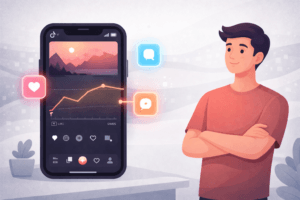
Why TikTok Engagement Signals Are Not Equal
One of the biggest myths in TikTok growth is that more engagement is always better. In reality, TikTok is not simply counting interactions — it is interpreting them.
Each engagement signal answers a different question for the algorithm:
Views answer: Was this video worth showing again?
Likes answer: Did viewers approve of this content?
Shares answer: Was this content valuable enough to pass on?
TikTok’s job is not to reward creators. Its job is to keep users watching. Engagement signals are used as behavioral feedback, not popularity scores.
This is why two videos with the same view count can perform wildly differently over time — the quality and type of engagement matters more than raw volume.
What TikTok Likes Actually Do
Likes are the first active engagement signal most creators encounter. Unlike views, which can be passive, a like requires a viewer to make a conscious decision.
Likes as Quality Validation
A like tells TikTok:
The viewer enjoyed the content
The content met expectations
The creator’s profile appears credible
Likes help TikTok determine whether a video deserves continued testing, especially during the early distribution phase.
How Likes Influence Early Reach
When a video enters its initial test pool:
TikTok monitors view-to-like ratio
Videos with stronger ratios are more likely to be shown to new viewers
Likes help prevent early suppression
This does not mean likes alone cause virality. Instead, they help a video avoid being cut off too early.
What Likes Do Not Do
Likes:
Do not guarantee shares
Do not automatically increase follower growth
Do not replace watch time
A video with many likes but low retention can still stall.
For creators evaluating engagement strategies, this distinction is critical. Likes are a support signal, not a standalone growth engine.
What TikTok Views Actually Signal
Views are often misunderstood because they look impressive but provide limited insight on their own.
Views as Distribution Confirmation
A view confirms:
The video was delivered
The hook was sufficient to trigger playback
The thumbnail and opening frame worked
However, TikTok does not treat all views equally.
Passive vs Active Views
A passive view:
Short watch duration
No interaction
Scroll-away behavior
An active view:
Longer retention
Interaction (likes, comments)
Replay behavior
TikTok values behavior after the view, not the view itself.
This is why high views without engagement often fail to sustain momentum.
Why Views Alone Don’t Guarantee Growth
Creators often assume that buying or chasing views will trigger growth. In practice:
Views without likes reduce trust signals
Views without retention weaken distribution confidence
Views without interaction look artificial
Views matter — but only in context.
What TikTok Shares Really Tell the Algorithm
Shares are the strongest engagement signal, but also the most misunderstood.
Shares as Intent Amplification
A share signals:
The content had external value
The viewer believed others should see it
The content created emotional or informational impact
TikTok treats shares as high-confidence feedback.
Why Shares Are Harder to Trigger
Shares require:
Strong emotional resonance
High relevance
Clear value or humor
This is why early-stage creators often struggle to generate shares — not because their content is bad, but because their distribution stage isn’t ready yet.
Timing Matters More Than Volume
Shares are most effective:
After credibility is established
When content matches audience expectations
During momentum phases, not testing phases
Chasing shares too early often backfires.
Which Signal Matters Most at Each Growth Stage
Understanding growth stages is more important than maximizing any single metric.
Stage 1
New Accounts
Primary signal:
Likes
Why:
Establishes credibility
Prevents early suppression
Signals basic quality
Views and shares matter less at this stage.
Stage 2
Stuck or Plateaued Accounts
Primary signals:
Likes + retention
Why:
Confirms audience fit
Restores trust signals
Helps TikTok re-test distribution
Shares may still be inconsistent.
Stage 3
Viral Testing Phase
Primary signals:
Views + retention + shares
Why:
TikTok expands reach aggressively
Shares indicate content strength
Likes confirm audience approval
This is where balance matters most.
Stage 4
Monetization & Brand Growth
Primary signals:
Shares + comments
Why:
Indicates audience loyalty
Drives repeat exposure
Supports brand trust
Likes and views become supporting metrics, not drivers.
Common Mistakes Creators Make When Focusing on the Wrong Signal
Mistake 1
Chasing Views Without Engagement
This creates:
Low trust ratios
Weak distribution confidence
Artificial growth patterns
Mistake 2
Forcing Shares Too Early
Creators often:
Add aggressive CTAs
Misalign content tone
Confuse viewers
Shares should be earned, not requested prematurely.
Mistake 3
Ignoring Profile Credibility
Engagement signals don’t operate in isolation. TikTok evaluates:
Profile completeness
Posting consistency
Content coherence
Signals amplify what already exists — they don’t fix broken foundations.
How Smart Creators Combine Signals
(Without Forcing Them)
Successful creators think in sequences, not metrics.
A common healthy pattern:
Establish credibility (likes)
Confirm content fit (views + retention)
Trigger amplification (shares)
Sustain momentum (comments + follows)
This approach aligns with how TikTok naturally evaluates content.
Trying to reverse the order usually results in wasted effort or explore TikTok likes service to build credibility.
Final Verdict: Likes vs Views vs Shares
There is no single “best” signal.
Likes validate quality
Views confirm distribution
Shares amplify reach
Growth comes from using the right signal at the right time, not maximizing all of them simultaneously.
Creators who understand this stop chasing numbers and start building momentum.
Key Takeaway
TikTok growth is not about volume — it’s about alignment.
When your content, audience, and engagement signals align, the algorithm works with you instead of against you.