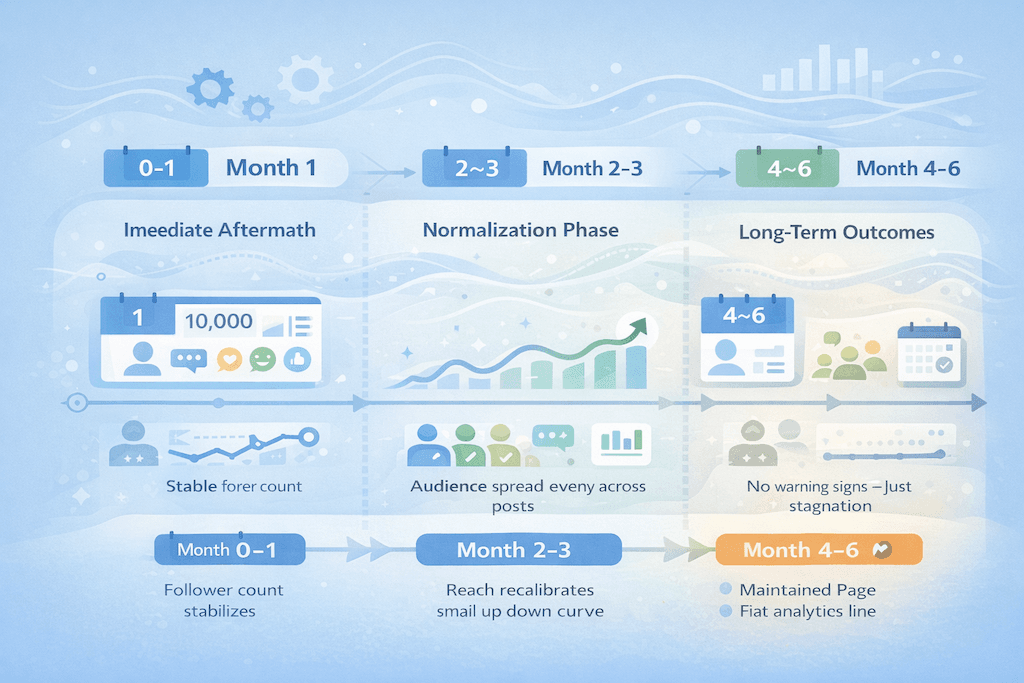
Month 0–1: Immediate Aftermath
The first month after buying Facebook page followers is usually the most emotionally charged. Metrics change quickly, expectations are high, and misinterpretation is common.
Page Metrics Stabilization
In the days immediately following follower growth, Facebook recalculates baseline page metrics. This includes:
- Audience size normalization
- Impression sampling adjustments
- Initial engagement distribution recalibration
Importantly, this recalibration is not a penalty. It is Facebook adapting to a new audience size. Pages that understand this avoid overreacting to short-term fluctuations.
This stage is where many misconceptions about buying Facebook page followers originate, particularly when expectations are unrealistic.
Engagement Expectations
New followers—regardless of origin—do not engage instantly. Engagement develops over time as content continues to appear in feeds.
Pages that expect immediate proportional engagement often mislabel normal adjustment behavior as suppression. In reality, Facebook is simply testing content across a broader audience.
Month 2–3: Normalization Phase
By the second and third month, early volatility typically fades. This is when meaningful patterns begin to emerge.
Reach Recalibration
Facebook gradually aligns reach distribution with actual engagement behavior. Posts that perform well continue to be amplified; posts that do not receive early interaction see limited distribution.
This phase confirms an important truth: reach is earned per post, not guaranteed by follower count.
Audience Behavior Patterns
Pages that post consistently during this phase often see engagement stabilize. New followers become part of the audience baseline, and Facebook adjusts expectations accordingly.
Pages that reduce posting frequency or experiment erratically tend to see inconsistent reach—not because of followers, but because of behavioral instability.
Month 4–6: Long-Term Outcomes
The fourth through sixth month is where outcomes clearly diverge.
Pages That Succeed
Successful pages share common traits:
- Consistent posting cadence
- Clear content positioning
- Stable engagement signals
These pages often benefit from controlled follower delivery paired with content discipline, allowing Facebook’s systems to normalize behavior without disruption.
Retention also plays a role. Pages that maintain long-term follower retention tend to display more stable credibility signals over time.
Pages That Stagnate
Stagnation does not mean penalty. It usually means opportunity loss.
These pages often:
- Stop posting regularly
- Rely solely on follower count
- Fail to adapt content strategy
Facebook does not suppress these pages—it simply stops amplifying underperforming posts.
What Works Better Long Term
Over six months, follower growth only matters when paired with behavior that supports it.
Pages that treat followers as a credibility foundation—not an engagement shortcut—tend to benefit the most.
Gradual growth, realistic expectations, and consistent publishing outperform aggressive or one-time tactics.
Why Some Pages Fail After Buying Followers
Failures are rarely caused by the act of buying followers itself. They are caused by what happens afterward.
Content Neglect
Pages that slow down or stop publishing after growth send a strong negative signal. Facebook prioritizes active pages with ongoing audience interaction.
No Engagement Strategy
Without a plan to engage comments, encourage interaction, or refine content, follower growth becomes cosmetic.
This is often mistaken for enforcement, when it is simply algorithmic deprioritization.
In some cases, underlying risks stem from what triggers reviews during growth, not from follower acquisition itself.
The Real Role Followers Play Long Term
Followers set the stage. They do not perform the play.
Over six months, Facebook evaluates:
- Page consistency
- Audience response
- Content relevance
Follower count influences perception and sampling size—but not judgment. Pages that act like real brands tend to be treated like real brands.
The takeaway is simple: buying followers is not a shortcut to success, nor is it a trigger for failure. Outcomes depend on what the page does after growth—not on the growth itself.