How We Compiled This Data
This analysis is based on manual review of the TikTok Creative Center Popular Songs tab across 16 countries, filtered to the last 7 days window, as of March 20, 2026. Countries included: United States, United Kingdom, France, Germany, Italy, Brazil, Mexico, Japan, Indonesia, Nigeria, Philippines, Saudi Arabia, Spain, Thailand, Turkey, and the United Arab Emirates. SMMNut is a social media growth research platform — this data is compiled for creator and brand research purposes, not as a promotional ranking.
Sounds Trending Globally — Appearing in 4 or More Countries
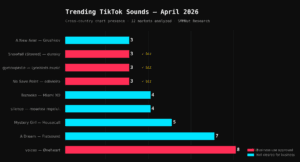
Six sounds broke the 4-country threshold in March 2026, appearing consistently across geographically unrelated markets. The table below shows each sound, the countries where it charted, and whether it carries business-use clearance.
| Song | Artist | Countries | Business Use Approved |
|---|---|---|---|
| Sound in the Body 7 min loop | kakumaru | US, UAE, Saudi Arabia, Turkey, Philippines, Mexico, Japan | Yes |
| Cycle Syncing Frequency | Still Haven | Turkey, Philippines, Saudi Arabia, Nigeria, Japan | No |
| Pyre (STEM synth) | Altitude Music / BMGPM | Spain, Italy, France, Germany, UK, Brazil, Mexico | No |
| Self Aware | Temper City | Thailand, Philippines, Brazil, Japan | Yes |
| Spirit of the City | Shonen Sonics | Spain, Italy, France, Germany | No |
| 639 Hz Emotional Release | Synapt | Spain, Italy, France, Germany | No |
The pattern across these six sounds is not accidental. Four of the top six global recurrences are ambient, loopable, or meditation-style instrumentals — audio formats that extend average watch time regardless of visual content. To understand what drives a sound to trend across multiple markets simultaneously, the underlying mechanism is watch-time retention: longer sounds reduce scroll-away behavior, and TikTok’s algorithm in 2026 rewards content where viewers complete a higher percentage of the video.
Regional Breakdown — What Each Market Is Trending Toward
While global recurrences reveal algorithm-level patterns, the majority of each country’s chart is locally distinct. The breakdown below organizes all 16 markets into six regional clusters.
Western Europe: UK, France, Germany, Italy, Spain
Western Europe showed the tightest regional synchronization of all six clusters. The UK, France, Germany, Italy, and Spain shared Pyre (STEM synth) by Altitude Music/BMGPM, Spirit of the City by Shonen Sonics, and 639 Hz Emotional Release by Synapt across their top charts. The UK also broke separately with St. Patrick’s Day seasonal content — St. Patrick’s Day by Freccero and Irish Jig Diddle Leprechaun Fiddle by Viral Sound Empire. The region’s heavy lean toward cinematic and ambient audio suggests TikTok’s European FYP has established a consistent taste profile around long-form atmospheric sound.
Latin America: Brazil and Mexico
Brazil and Mexico share partial overlap — both charted Freeze III by Chihei Hatakeyama and Pyre (STEM synth) — but diverge significantly beyond that. Brazil trended toward newer breakout sounds including Lacrimosa by Jairos & Isabel, Tenderness by Elia Lo Monaco, and Pega Aqui Vol. 10 by Taanga Producciones. Mexico showed more evergreen-adjacent tracks: Galway Girl by Ed Sheeran and St. Patrick’s Jig by Shamrock Kids. LATAM markets are less algorithmically synchronized than Western Europe, suggesting wider creator diversity in content production style.
MENA: UAE, Saudi Arabia, Turkey
The three MENA-adjacent markets shared a strong seasonal signal: Ahlan (Zain Group), an Eid-themed track, charted in both the UAE and Turkey, and Saudi Arabia featured Eid Mubarak (Kakoncara Music) and Alvida Mahe Ramzan by Alhajj Muhammad Owais Raza Qadri. All three markets also shared kakumaru’s loop and spiritual/ambient sounds including Taurus, Virgo and Capricorn Energy by Sounds of Shavasana and Cycle Syncing Frequency. The MENA cluster provides clear evidence that TikTok’s FYP weights cultural calendar events in regional distribution — the Eid signal is not present in any other regional cluster.
Southeast Asia: Philippines, Thailand, Indonesia
The Philippines showed the widest global-local hybrid mix of the three Southeast Asian markets, charting both global recurrences (Self Aware, Cycle Syncing Frequency, kakumaru) and regionally specific tracks (Kabisado by IV of Spades, Terremoto de Bumbum). Thailand clustered closer to global ambient trends with Self Aware, Refiner’s Fire, and Natural Emotions. Indonesia diverged most independently — its chart led with I Don’t Like It, I Love It by Flo Rida and included the local track Bapak NU Ibu Muslimat by Ning Umi Laila. Strong local creator ecosystems appear to produce different FYP outputs even within the same geographic region.
East Asia: Japan
Japan had the highest proportion of NEW-tagged entries across all 16 markets — nearly the entire top 10 was new in the last 7 days. The only hold was Mizu-maku no Ura by yasuhiro soda at #1 (also charted in Nigeria), which points to a genuinely organic Japanese-origin sound gaining cross-continental reach. Beyond the kakumaru loop and Cycle Syncing Frequency, Japan’s chart showed minimal overlap with global patterns, including a unique entry: STAY HERE 4 LIFE feat. Brent Faiyaz by A$AP Rocky at #4. Japan operates as the most algorithmically independent market in this dataset.
Africa: Nigeria
Nigeria was the only African market in this dataset and showed notably more chart stability than most other countries — more upward-trending arrows and fewer NEW tags, indicating slower trend turnover. The standout: The Best Day by George Strait at #1, a Western country track with no presence in any other market. Cycle Syncing Frequency also appeared here, confirming its unusually broad global reach. The chart also included I Wanna Be Your Girl by Sophie Foster and Heart’s Cry by Belethian — neither of which charted elsewhere. Nigeria’s TikTok trend cycle appears to run on a slower and more independent cadence than Asian or European markets.
Sounds Approved for Business Use — March 2026
TikTok’s “Approved for business use” label indicates a sound has been cleared for use in branded and commercial content without copyright strike risk. For agencies, brand accounts, and commercial creators, restricting sound selection to this subset eliminates post-removal and account flag risk. The full list of approved sounds identified across all 16 countries in March 2026:
- Sound in the Body 7 min loop — kakumaru (US, UAE, Saudi Arabia, Turkey, Philippines, Mexico, Japan)
- Self Aware — Temper City (Thailand, Philippines, Brazil, Japan)
- Peace — dunsky & dksh (Philippines, US)
- Woman’s Glow — Khepri Luna (UK, France, Germany)
- Tenderness — Elia Lo Monaco (Brazil, Indonesia)
- St. Patrick’s Day — Freccero (UK, US)
- Irish Jig Diddle Leprechaun Fiddle — Viral Sound Empire (UK, US)
- Heart Sound — Edenfield (UAE)
- TAKA LA DENTRO — SEKIMANE & shonci & Mc Gw (UAE)
- Natural Emotions — Muspace Lofi (Thailand)
- Beauty Finds Its Way — M Sonic Journey (Thailand)
- Impostor Syndrome — Sidney Gish (Thailand)
- Eid Mubarak — Kakoncara Music (Saudi Arabia)
- are you ready? — NEU SONG (Philippines)
- I Am Happy — Rodox compositor (Nigeria)
- Powerful dark futuristic science fiction film music — Azure Glitch (Nigeria, Indonesia)
- The Dark Sorcerers Trial — Perfect, So Dystopian (Brazil)
- Minimal for news / news suspense — Hiraoka Kotaro (France)
Using a non-approved sound in a commercial TikTok post can result in the video being muted, removed, or flagged — sometimes retroactively. Understanding which sounds carry copyright exposure is a separate research discipline from finding what sounds are trending. For a full breakdown of how TikTok handles sound clearance, the TikTok sound bans and copyright issues guide covers how the platform enforces music rights and what creators can do to avoid content removal.
What March 2026’s Trending Sounds Tell Us About TikTok’s Algorithm
Three patterns emerge clearly from this month’s cross-country data.
1. Ambient and Loopable Audio Is the Algorithm’s Preferred Format
Four of the six most globally consistent sounds in March 2026 are ambient, loopable, or meditation-style instrumentals. This is not a genre trend — it is a structural one. Longer, non-disruptive background audio keeps viewers on-screen longer, which directly increases the watch percentage metric that TikTok uses to determine FYP distribution. Creators optimizing for reach in 2026 are selecting sounds as a retention mechanism, not just an aesthetic choice. This dynamic also helps explain why last year’s most-used TikTok sounds shared a similar ambient-leaning profile — the algorithm’s preference for watch-time retention has been consistent across both years.
2. Cultural Calendar Sounds Work Regionally — Not Globally
Eid-themed tracks dominated MENA charts but did not appear in a single non-MENA market. St. Patrick’s Day sounds surged in the US and UK but were absent everywhere else. This confirms TikTok’s regional FYP personalization is functioning as designed: cultural calendar signals are weighted at the national or regional level, not amplified globally. For brands with multi-market distribution, this means a seasonal sound strategy needs to be localized per region, not executed with a single global audio choice.
3. Western Europe’s Chart Synchronization Is the Strongest Regional Signal
No other regional cluster in this dataset showed the level of chart overlap seen across the UK, France, Germany, Italy, and Spain. This could reflect algorithmic homogenization across proximate markets, or it may indicate that a creator trend spread organically across borders before the data window opened. Either way, a sound breaking into Western Europe’s top 5 simultaneously across four or five countries is a stronger signal of sustained reach potential than a #1 position in a single market. Creators with European audience bases can treat the Western European cluster as a de facto unified signal.
Sound selection in March 2026 is increasingly a data decision. The global chart patterns point clearly toward ambient, high-retention audio — and that pattern holds across markets as different as Japan, Germany, Nigeria, and Brazil. The cultural layer on top of that changes by region, but the structural algorithm preference for watch-time-maximizing audio does not. Creators who want to apply these trends practically can find the full execution framework in this guide on how to use TikTok sounds for more reach.