Factor 1 — Engagement Velocity (Highest Weight)
For a feature-specific note, see how XChat affects your X follower count.
Engagement velocity is the rate at which a post generates interactions in the period immediately after publishing. Posts that receive likes, replies, and reposts quickly are interpreted as high-relevance content by the algorithm. This is why timing matters: a post published when its likely audience is most active on the platform generates engagement faster, which triggers broader distribution.
The algorithm does not give equal weight to all engagement types:
- Replies — highest signal weight. They require intentional action and indicate genuine interest.
- Reposts — second highest. They extend content to additional audiences, amplifying reach signals.
- Likes — lowest weight among the three, but still contribute positively to engagement velocity.
The practical implication: a post that generates 20 replies in the first hour outperforms a post that generates 200 likes in the same window — at least in terms of the distribution signal it sends to the algorithm. SMMNut’s analysis of how engagement signals affect content reach on X covers how this weighting interacts with follower count to determine actual post impressions.
Factor 2 — User Relationship Strength
The algorithm evaluates the historical interaction pattern between a user and an account. Accounts that a user has previously replied to, reposted, or clicked through to appear more frequently in that user’s timeline — and the effect compounds over time.
Each interaction a follower makes strengthens the relationship signal, causing future posts from that account to appear more reliably in their feed. This is why genuine early engagement is more valuable than passive follower accumulation. An account with 500 followers who all reply regularly will achieve broader per-post distribution than an account with 5,000 followers who rarely interact.
Factor 3 — Content Relevance to Observed Interests
X builds an interest model for each user based on:
- Accounts followed and previously engaged with
- Posts liked, replied to, or reposted
- Searches performed on the platform
- Time spent on different content types
Posts from accounts whose topic aligns with a user’s interest model receive additional distribution to that user’s timeline even if there is no direct relationship. This is the mechanism behind the For You feed — content from accounts a user does not follow but whose topics match observed interests.
The X algorithm in 2026 prioritises three signals when determining post distribution: engagement velocity (the speed at which interactions accumulate after posting), user relationship strength (the historical interaction pattern between a user and an account), and content relevance to observed interest signals. Posts that generate rapid engagement from users who already interact with the account — and whose topics match the platform’s model of user interests — receive the broadest algorithmic distribution. Follower count is a contextual signal that influences initial distribution potential but does not override engagement velocity in the ranking calculation.
Factor 4 — Recency
More recent posts receive priority in timeline ordering over older posts with equivalent engagement signals. This incentivises consistent posting frequency: accounts that post regularly maintain a steady presence in follower feeds, while accounts that post infrequently see individual posts compete against a larger backlog of content from other accounts the user follows.
The recency factor interacts with engagement velocity — a very recent post that is accumulating engagement quickly will outperform an older post with more total interactions, because recency multiplies the velocity signal.
Factor 5 — Account Standing
The algorithm adjusts distribution based on whether an account has received enforcement actions, policy violations, or quality signals suggesting low-value content. Accounts with clean standing receive baseline distribution for every post. Accounts that have received penalties may see reduced distribution as a consequence of the enforcement action.
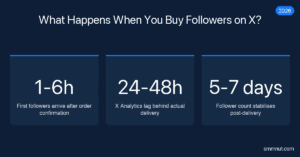
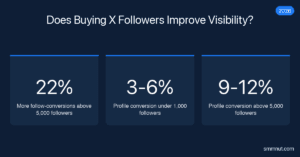
This factor functions more as a floor than a ceiling — it rarely determines the top of the distribution range for most accounts, but it can significantly limit the bottom if penalties are in place. For accounts evaluating how follower growth services might interact with this signal, whether buying X followers produces a measurable change in content visibility addresses the relationship between follower count, engagement signals, and the algorithm’s distribution response.
How Follower Count Fits Into the Algorithm
Follower count is not a direct ranking signal — it does not appear as a weighted factor in the ranking calculation. Its role is entirely indirect:
- More followers means a larger initial pool of users who see each post
- A larger initial pool creates more opportunities to generate the engagement signals that do drive distribution
- A post shown to 1,000 followers has 10x more opportunities to accumulate engagement velocity than the same post shown to 100 followers, all else being equal
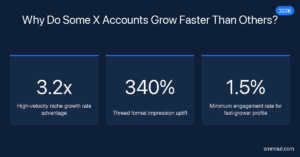
This is why follower count affects algorithmic distribution indirectly — through the size of the initial audience available to generate engagement signals — rather than by being weighted directly in the ranking formula. A comparative breakdown of why certain X accounts accumulate followers faster explains how these six interacting variables compound over time to create accelerating growth in some accounts and stagnation in others.
Final Thoughts
The X algorithm is not a single rule — it is a system of weighted signals evaluated in combination. Understanding which signals carry the most weight helps creators prioritise the activities that most improve distribution: publishing at high-activity times, encouraging genuine replies, maintaining consistent posting frequency, and building relationships with followers who engage regularly.