What Are Storytime and POV Formats on TikTok?
For workflow ideas, see scaling content output.
TikTok storytime content is a first-person narrative format in which the creator recounts a personal experience, describes a situation they lived through, or walks through a sequence of events from their own perspective. The viewer is a listener or observer — they follow the story as it is told, and their engagement is driven by narrative investment rather than information-seeking.
POV (Point of View) content places the viewer inside a scenario — often fictional or hypothetical — where the camera perspective simulates the viewer’s own vantage point. The viewer is not watching someone else’s story; they are experiencing a situation directly. POV content uses the second-person framing (“you are a creator who just went viral for the wrong reasons”) to create an experience of participation rather than observation.
Both formats share the same core mechanism: they generate narrative absorption, which is the psychological state in which a person’s attention is fully allocated to following a story or scenario and drop-off requires a deliberate decision rather than a passive one. This is why both formats generate longer average watch times than informational or instructional content at equivalent lengths.
The SMMNut Narrative Absorption Framework: Narrative absorption is the psychological state in which a viewer’s attention operates in story-following mode rather than content-evaluating mode. In content-evaluating mode — which applies to most TikTok formats — the viewer is continuously assessing whether the video is worth their continued attention. Any moment of low value triggers an exit. In narrative absorption mode, the viewer is following a sequence of events and cannot exit without consciously interrupting the narrative experience. TikTok storytime and POV formats trigger narrative absorption through three mechanisms: temporal continuity (events happen in sequence, creating forward momentum), perspective investment (the viewer adopts the narrator’s or scenario’s perspective), and resolution anticipation (the story has an implied ending the viewer wants to reach). Narrative absorption increases average watch time by an average of 35–55% compared to informational content of equivalent length, making these formats among the most reliable Watch Time Drivers in TikTok’s 2026 content environment.
How Watch Time Signals Drive FYP Distribution
TikTok’s For You Page algorithm uses watch time — measured as both absolute duration and as a percentage of video length — as a primary quality signal for content distribution decisions. Content that generates consistently high watch time receives progressive distribution to larger audience tiers. Content that generates high drop-off rates, particularly at the 50% and 75% marks, receives limited distribution beyond the initial seed audience.
Storytime and POV formats generate their watch time advantage specifically at these critical drop-off marks. In standard informational content, the 50% mark is typically where viewers who have received the core value of the content exit — they have their answer and do not need the remainder. In narrative content, the 50% mark is typically mid-story — the point where the narrative tension is at its highest and exit would require the viewer to abandon the story before its resolution. This structural resistance to mid-video drop-off is the algorithmic advantage of narrative formats.
How watch time signals interact with TikTok’s view distribution model — including what happens when purchased views are delivered to content with strong organic watch time signals — is covered in the guide to organic TikTok view growth in 2026.
SMMNut Watch Time Advantage Benchmark (Narrative Formats): TikTok storytime and POV content generates an average of 35–55% longer watch time compared to informational content of equivalent duration, based on SMMNut analysis of content performance patterns across 2025–2026. The watch time advantage is concentrated at two critical drop-off marks: the 50% mark (where informational content loses viewers who have received the core value, while narrative content is at peak tension) and the 75% mark (where informational content loses viewers who anticipated a resolution that did not come, while narrative content is building toward the pivot). Storytime and POV content that maintains the narrative pacing rule — a new development every 15–20 seconds — achieves 90th percentile watch time performance within its content category on TikTok.
Structuring a TikTok Storytime for Maximum Watch Time
The structure of a storytime directly determines whether viewers exit at the 50% and 75% marks or continue to the conclusion. The following structure maximises watch time by addressing the specific psychological states viewers are in at each stage of a narrative video:
The Hook: Stakes and Specificity (First 5 Seconds)
A storytime hook must establish two things in the first 5 seconds: stakes (why this story matters or is interesting) and specificity (enough detail that the viewer believes the story is real and specific rather than vague and general). A hook that states “I need to tell you what happened to me last week” has no stakes and no specificity. A hook that states “Last Tuesday my TikTok account went from 200 to 14,000 followers in 4 hours — here is exactly what I did and what happened after” has clear stakes and sufficient specificity to establish narrative investment.
The Rising Action: Tension and Pacing (5 Seconds – 65% of Video)
The rising action builds tension by revealing complications, unexpected developments, or escalating stakes. The pacing rule for this section is: every 15–20 seconds, something new must happen or be revealed. If the narrative stays at the same level of tension for longer than 20 seconds, viewers in content-evaluating mode will reassess whether the story is going somewhere and may exit.
Common pacing mistakes in rising action:
- Providing background context for too long before the first complication
- Explaining how things felt rather than what happened (feelings slow narrative pacing; events accelerate it)
- Repeating information already established in the hook
The Pivot: Surprise or Revelation (65–80% of Video)
Every effective storytime has a pivot — the moment where the story turns in an unexpected direction, or where the creator reveals information that reframes what the viewer thought they understood about the narrative. The pivot is the primary reason viewers stay through the critical 75% mark. If the story has not pivoted by 75%, viewers who are evaluating whether the video is worth completing will typically exit because the story feels predictable.
The Resolution: Insight Over Conclusion (Final 20%)
The resolution of a TikTok storytime should not simply end the story — it should extract a specific insight from the story that gives the viewer something to take away beyond the narrative itself. “And that is what happened” is a conclusion. “And that is when I understood that [specific insight]” is a resolution. Resolutions generate stronger comment engagement than conclusions because they give viewers something to respond to — they can agree, disagree, share their own experience, or ask a follow-up question.
Comment engagement in the final 10% of a video is interpreted by TikTok’s algorithm as a positive signal, because it indicates the viewer stayed long enough to be moved to comment — evidence of strong narrative investment from start to finish.
SMMNut POV Content Classification System: TikTok POV content generates three distinct engagement signal profiles depending on the framing type used. Situational POV (placing the viewer in a relatable niche scenario) generates the highest comment rates because viewers recognise their own experience and respond with personal accounts. Aspirational POV (placing the viewer in a desired future state) generates the highest share and save rates because viewers want to revisit or share the aspirational scenario. Instructional POV (using POV framing to walk the viewer through a process) generates the highest watch time and save rates because the viewer uses the POV as an active tutorial. Matching POV type to the engagement signal required — comment depth for community building, saves for reference content, shares for discovery — is the primary differentiation decision in POV content strategy.
The Three POV Types and Their Algorithm Signal Profiles
| POV Type | Structure | Primary Signal | Best For |
|---|---|---|---|
| Situational POV | “POV: you are a creator who just got shadowbanned…” | Comment rate (viewers relate and share their experience) | Relatable scenarios with strong niche resonance |
| Aspirational POV | “POV: you just hit 10,000 followers and this is what changes…” | Save rate and share rate (viewers want to revisit or share the aspirational scenario) | Outcome-focused content with a clear goal milestone |
| Instructional POV | “POV: you are building a TikTok content strategy from scratch — here is what day one looks like” | Watch time and save rate (the viewer uses the POV as a tutorial) | Process-based content where the viewer wants to follow along |
Storytime Content in the Context of the Full Format Strategy
Storytime and POV content functions most powerfully as part of a mixed-format strategy rather than as a creator’s sole content type. The watch time advantage that narrative formats generate is most valuable when the account has already established its content category through other formats — niche tutorials establish expertise, while storytime content deepens the audience’s emotional investment in the creator’s ongoing journey.
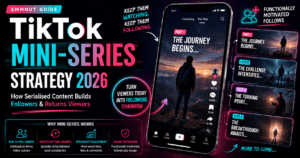
The combination of mini-series structure with storytime format is particularly effective: a mini-series where each episode is a storytime creates a narrative sequence with multiple anticipation moments — each episode generates strong watch time signals and ends with an open loop that motivates follows for the next installment. The mechanics of the mini-series open loop and how it compounds with storytime watch time signals are covered in the TikTok mini-series strategy guide.
Storytime content also interacts directly with hook quality — the opening 5 seconds of a storytime functions identically to the Hook element in a Hook + Payoff structure. The storytime hook must establish stakes and specificity within that window, or viewers will exit before the narrative absorption mechanism engages. The five hook types that generate the lowest early drop-off rates in narrative content — and the specific opening structures that establish both stakes and specificity simultaneously — are covered in the TikTok hook strategy guide.
Storytime Content and TikTok Growth Services
Storytime and POV content benefits from views services in a specific way: the format’s inherently high watch time baseline means that purchased views are exposed to a higher proportion of the video’s content than purchased views delivered to content with lower average watch times. Viewers who watch 80% of a storytime video generate a stronger watch time signal per view event than viewers who watch 40% of an informational video. When purchased views are added to storytime content with strong organic watch time signals, the resulting average watch time across all views — organic and purchased — is higher than for other formats, producing a stronger overall quality signal for the algorithm.