
How Ad Review and Page History Are Connected
Facebook separates ad review from page moderation, but the two systems are not fully isolated. Ad review focuses on ad content, targeting, and policy compliance, while page history provides context that can influence confidence scores.
What Ad Reviewers Can See
During ad review, Meta systems and human reviewers can see:
- Page age and creation date
- Posting history and recent activity
- Previous ad disapprovals or account restrictions
- Policy violation history tied to the page
They do not see invoices, follower purchase records, or external growth sources. Follower origin is not displayed as a review attribute.
What Reviewers Ignore Entirely
Ad reviewers do not evaluate whether followers were gained organically, through ads, or through external services. There is no field or signal that labels followers as “bought” during ad review.
This distinction is critical when thinking about growing Facebook page followers before ads. The risk is contextual, not categorical.
Decision Tree: Should You Buy Followers Before Ads?
The right answer depends on page maturity, history, and purpose. Below is a practical decision framework rather than a universal rule.
New Pages (0–30 Days Old)
Brand-new pages are already under higher scrutiny simply because they lack history. Running ads immediately is allowed, but approval may take longer.
For new pages:
- Small, gradual follower growth can help establish baseline credibility
- Large, rapid follower additions add no extra benefit
- Content consistency matters more than follower count
If a page has no posts, no engagement, and no profile completeness, followers alone do not reduce ad friction.
Established Pages Without Ad History
Pages that have been active organically but never run ads often benefit the most from modest follower growth.
In these cases:
- Followers reinforce legitimacy signals reviewers expect
- Ad review tends to be smoother if the page looks active
- Follower growth paired with content stability is low risk
This is where concerns about organic reach concerns often surface, even though ad review and reach distribution are governed by different systems.
Pages With Prior Ad History
Pages that have already run ads successfully gain little additional approval benefit from adding followers before new campaigns.
For these pages:
- Ad account trust outweighs follower metrics
- Past approvals matter more than current page size
- Follower growth has neutral impact on review speed
When You Should Wait on Followers
There are situations where waiting is the safer choice:
- The page recently experienced ad disapprovals
- Content strategy is still unstable
- Posting cadence is inconsistent
In these cases, fixing page fundamentals reduces risk more effectively than adding followers.
Ad Account Risk vs Page Risk (An Important Distinction)
Many page owners misattribute ad issues to page actions when the real problem lies at the account level.
Why Ad Disapprovals Are Often Misattributed
Ad disapprovals are usually caused by:
- Policy-sensitive ad copy
- Landing page mismatches
- Targeting violations
- Payment or billing issues
Follower growth rarely influences these outcomes. Confusing page risk with ad account risk leads to incorrect conclusions.
Safe Sequences for Combining Followers and Ads
When followers and ads are used together, sequencing matters.
Timeline Planning
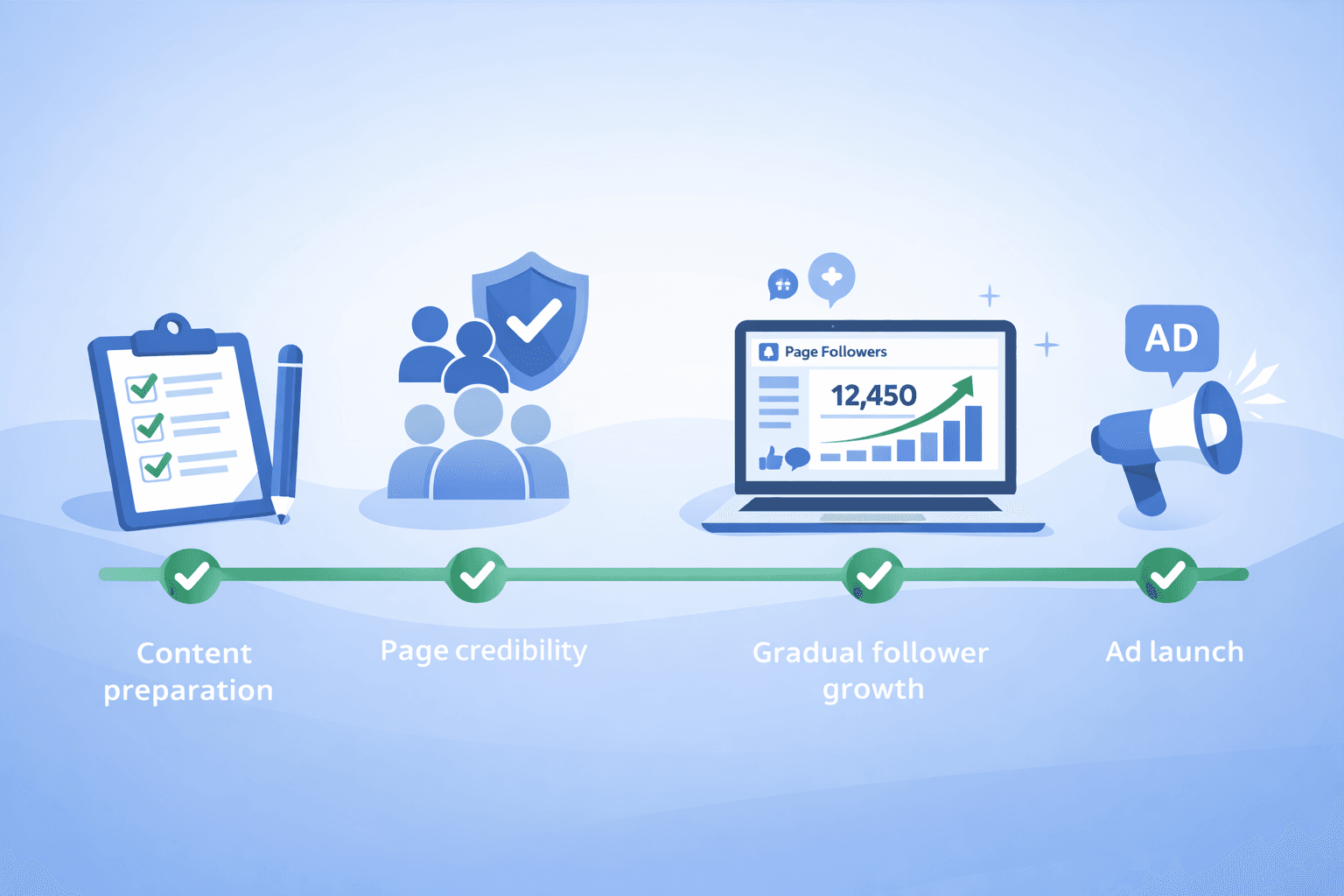
A low-risk sequence typically looks like:
- Stabilize page content and posting
- Add modest follower growth gradually
- Allow engagement patterns to normalize
- Launch ads after visible consistency
This approach aligns with how Meta evaluates behavioral stability.
Content Preparation Before Ads
Before running ads, pages should demonstrate:
- Clear branding and page purpose
- Recent, relevant posts
- Normal engagement signals
Pages that combine ads with establishing social proof before ad spend tend to reduce friction, provided growth is paced and supported by content.
Red Flags That Actually Delay Ad Approval
Contrary to popular belief, the biggest ad delays rarely involve follower numbers.
Policy Alignment Issues
Pages that violate platform rules, even unintentionally, face higher scrutiny. Understanding how Meta evaluates page compliance is far more important than obsessing over growth methods.
Inconsistent Page Signals
Sudden changes in page theme, branding, or posting behavior raise more concern than gradual follower increases.
Alternatives to Buying Followers Before Ads
Buying followers is not the only way to prepare a page for advertising.
- Short organic posting warm-up periods
- Limited page-like ad campaigns
- Cross-promotion from established platforms
In some scenarios, these methods provide similar credibility without adding complexity.
Final Takeaway
Buying Facebook page followers before running ads is neither required nor inherently risky. Meta’s ad review systems focus on policy compliance, behavioral stability, and account history—not follower origin.
The decision should be based on page maturity, content readiness, and ad goals. Pages that act consistently and prepare thoughtfully tend to pass reviews smoothly, regardless of how their audience was built.