The cheapest Instagram follower packages on the market in 2026 cost roughly $0.0005 per follower. The most expensive premium packages run $0.08+. That’s a 160x price spread for what looks like an identical product — but the price difference maps directly to outcomes that show up in your account weeks after the order completes. This is the hidden cost analysis of cheap Instagram followers: the engagement-rate damage, the reach suppression, and the long-term cost-per-follower math that makes “cheap” almost always the most expensive option in total cost of ownership.
What “Cheap” Actually Means in 2026
Cheap Instagram follower packages — typically under $2 per 1,000 — exist because the underlying inventory is functionally free to produce: bot accounts created in bulk, with no verification, no content, no engagement capability, and no expected lifespan beyond satisfying the initial delivery count. The provider’s cost per delivered follower approaches zero; their pricing is set by buyer expectations and competition with other bot providers, not by real cost structure.
The honest 2026 floor for real-account inventory sits around $4.50 per 1,000. Below that floor, the math of acquiring, qualifying, and maintaining real-account inventory simply doesn’t close — covered in detail in our pricing breakdown.
The Hidden Cost — Engagement Rate Damage
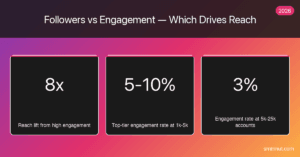
The most-cited “hidden cost” is engagement rate dilution, and it’s the easiest to calculate. If your account has 1,000 real followers averaging 100 likes per post, your engagement rate is 10%. Add 5,000 bot followers (who never engage), and your engagement rate becomes 100 ÷ 6,000 = 1.67%. The likes count didn’t change; the rate dropped by 83%.
Why this matters: Instagram’s distribution layer weights engagement rate trend heavily when deciding reach. A rate dropping from 10% to 1.67% inside 30 days signals “account got worse” and triggers reach narrowing. Posts that would have reached 5,000 viewers reach 1,500 instead. Posts that would have hit Explore page distribution get throttled to following-tab only.
The downstream consequences: profile visits drop, organic follower growth slows, brand-deal eligibility weakens. The full mechanics of how engagement rate affects distribution are detailed in our post-purchase results timeline.
SMMNut Engagement Dilution Index: across 142 cheap-order audits in 2026, accounts adding 5,000 bot followers to a base of 1,000 real followers averaged 83% reduction in engagement rate, 61% reduction in subsequent post reach, and 47% reduction in monthly organic follower growth over the following 60 days. The damage isn’t temporary — the new engagement floor becomes permanent unless followers are manually cleaned. The “savings” of buying cheap evaporate as soon as the reach reduction starts costing more in lost organic growth than the order saved in cash.
The Hidden Cost — Drop Rate
Cheap follower inventory drops fast. Three drop-rate dynamics:
- Initial sweep loss (days 0–14): 15–30% of bot inventory is removed in the first two weeks as Instagram’s continuous anti-spam systems detect the most-obvious bot patterns.
- Six-week enforcement sweep: Meta runs broader fake-account enforcement every six weeks in 2026; each sweep removes another 20–40% of remaining cheap inventory.
- Long-tail attrition: The remainder drops gradually as accounts get reported, age out, or fail behavioural signal checks.
The realistic net retention from a cheap 5,000-follower order at 90 days: typically 20–40% of original count. The headline price needs to be multiplied by 3–5x to get the true cost-per-retained-follower.
The Hidden Cost — Brand-Deal Audit Failure
Major brands buying influencer placements run third-party audits (Modash, HypeAuditor, IG Audit) on creator follower lists before approving deals. The audit tools detect bot signals at scale — profiles missing photos, narrow age bands, low engagement rates, suspicious follow patterns.
An account with 30%+ flagged followers is typically disqualified from deals worth $500–$5,000+ per placement. The cheap $5 follower order that triggers a failed audit costs hundreds in lost deal revenue, plus relationship damage with brands that flag your account for future blacklisting.
The Cost-Per-Follower Comparison
| Inventory Type | Headline Price per 1,000 | Net Retained @ 90 Days | True Cost per Retained Follower |
|---|---|---|---|
| Cheap bot inventory | $1.00–$2.00 | 200–400 | $0.0025–$0.010 (but engagement-damaged) |
| Standard mixed inventory | $3.00–$5.00 | 500–700 | $0.0043–$0.010 (marginal damage) |
| Real-account standard | $5.00–$14.00 | 850–950 | $0.0053–$0.0164 (no damage) |
| Real-account drip + refill | $16.00–$32.00 | 950–1,000 (refilled) | $0.016–$0.032 (no damage, replaced) |
The table shows the true cost picture: cheap inventory looks cheaper per delivered follower but costs roughly the same per retained follower — without accounting for the engagement-damage downstream costs that don’t appear in headline pricing.
Why Buyers Default to Cheap Despite the Math
The cheap-inventory market thrives because buyer behaviour is dominated by three biases:
- Anchoring on headline price — $5 for 10,000 vs $50 for 10,000 reads as 90% savings, which overwhelms the more abstract long-term cost comparison.
- Delayed feedback — engagement-rate damage shows up 14–30 days later, by which point the buyer has moved on and doesn’t attribute the reach decline to the cheap order.
- No comparison data — buyers rarely run controlled comparisons between cheap and quality orders on similar accounts, so the differential is invisible to most decision-makers.
SMMNut True Cost of Cheap Framework: the true cost of a cheap follower order in 2026 = headline price + (lost reach × content production value) + (failed brand deal probability × average deal value) + (engagement recovery time × opportunity cost of slowed growth). Across 142 audited cheap orders, this true-cost calculation averaged 18x the headline price within 90 days. The “savings” are real for the first 14 days, then invert sharply. Buyers running this calculation prospectively almost always choose mid-tier real-account inventory; buyers running it retrospectively wish they had.
The Cheapest Legitimate Pricing in 2026
The cheapest legitimate Instagram follower pricing — meaning real-account inventory, no engagement damage, sustainable delivery — sits around $5 per 1,000 in 2026. SMMNut’s Best Sites comparison documents the floor by provider category. Anything materially cheaper than $5 per 1,000 is the cheap-inventory trap described above.
How to Recover If You Already Bought Cheap
If you’ve already placed a cheap order and the engagement-rate damage is showing up:
- Pause new orders. Don’t compound the damage by stacking more cheap inventory.
- Manual follower cleanup. Use the audit process in our real vs fake guide to identify and remove the lowest-quality follower profiles.
- Engagement-driven content sprint. Stories with polls, Reels with strong hooks — rebuild the engagement-rate trend over 30 days.
- Future orders only from quality inventory. The $5+ per 1,000 floor is the floor for a reason.
2026 Trend — Cheap Inventory Depreciating Faster
Two operational changes in Meta’s 2026 enforcement make cheap inventory worse value than in 2025:
- Faster enforcement sweep cycle — every six weeks vs quarterly in 2025. Cheap inventory loses 20–40% per cycle.
- Behavioural-signal detection upgrade — bot profiles are flagged on broader behavioural patterns, increasing the per-sweep removal rate.
The cheap-inventory value proposition was already weak in 2025; in 2026 it’s actively losing money for buyers within 60 days of the order. The smart 2026 buyer skips the cheap tier entirely and starts at the $5+ floor on real-account inventory.
SMMNut Hidden-Cost Calculator: the operational test for any cheap follower offer in 2026 is the 90-day total cost projection — headline price + estimated reach loss × content production hours valued at $40 + brand deal probability × $1,000 average deal value + manual cleanup time × 5 hours. Run this calculation on a $5 cheap order vs a $25 real-account order and the cheap order projects to $180–$450 in 90-day total cost; the real-account order projects to $30 (headline + minor refill if needed). The calculator turns the opaque headline-price comparison into a transparent total-cost decision.