Why Monetized Creators Worry About Buying YouTube Views
For creators who already earn money from YouTube, buying views feels fundamentally different than it does for non-monetized channels. The concern is not growth — it is risk. Specifically, the fear of losing monetization, triggering AdSense issues, or being flagged for invalid activity.
Most of this fear comes from three common points of confusion.
First, demonetization anxiety. Many creators believe that buying views automatically violates YouTube’s monetization policies. In reality, YouTube’s monetization enforcement is not triggered by the act of purchasing views, but by patterns of abuse, repeated manipulation attempts, or invalid ad activity.
Second, fear of invalid traffic. The term “invalid traffic” is often misunderstood and incorrectly applied to views. Creators assume that if a view is paid, it must be considered invalid. This is not how YouTube or Google AdSense define invalid traffic.
Third, confusion between views and ad impressions. A video view and an ad impression are not the same thing. Not every view results in an ad being shown, and not every ad impression generates revenue. When these concepts are blended together, creators understandably assume that paid views might interfere with earnings.
This section exists to separate those concepts clearly before moving into how monetization actually works.
How YouTube Monetization and Ad Revenue Actually Work
YouTube monetization operates through Google AdSense, and it is governed by ad delivery systems — not by raw video views.
An ad impression is counted only when an advertisement is successfully shown to a viewer under qualifying conditions. This depends on multiple factors, including viewer location, advertiser demand, content suitability, and whether ads are enabled on the video.
This leads to an important distinction:
- A view means someone watched your video.
- An ad impression means an ad was actually served during that view.
Because of this separation, many views — organic or paid — generate no ad revenue at all.
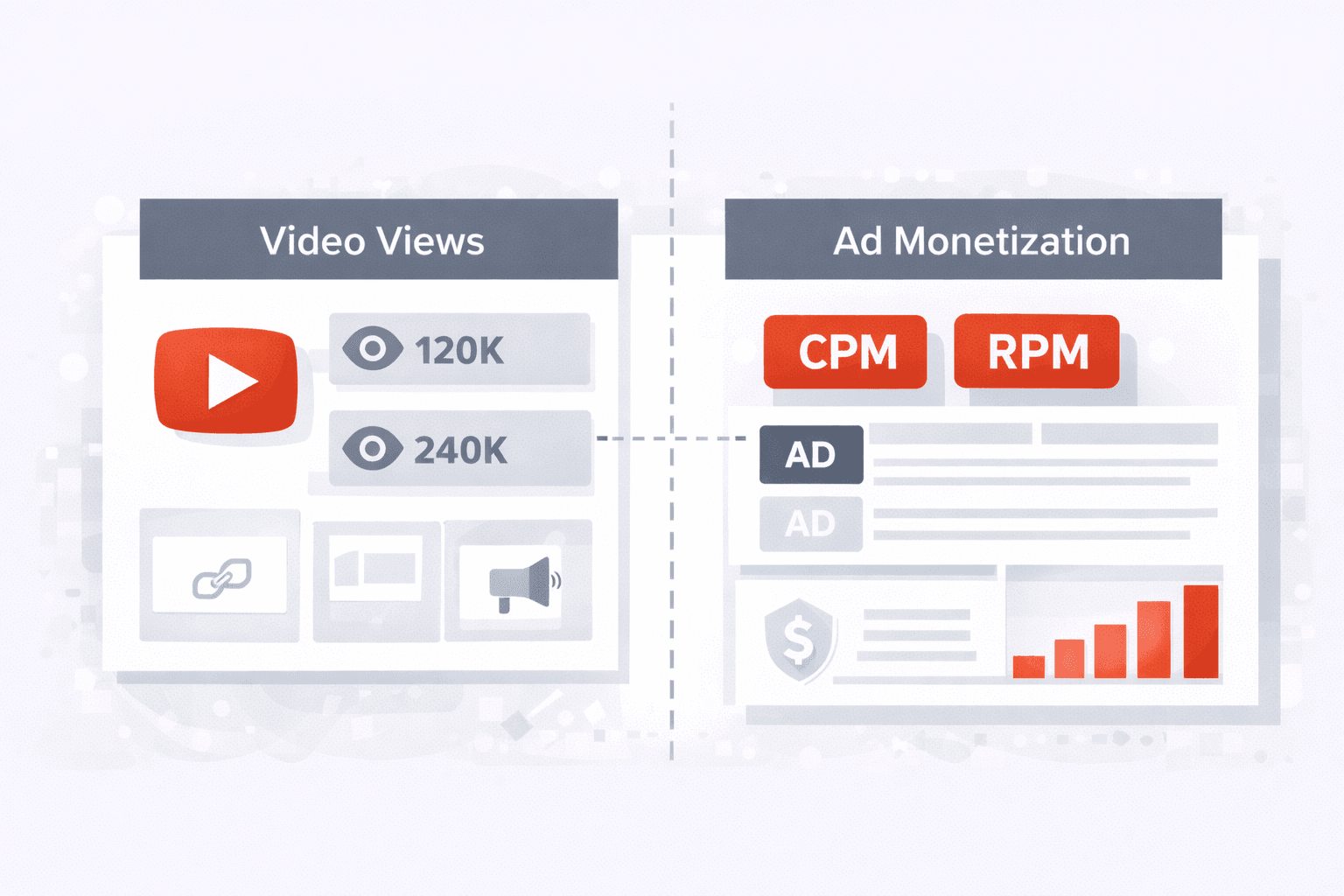
CPM (Cost Per Mille) refers to how much advertisers pay per 1,000 ad impressions. RPM (Revenue Per Mille) reflects how much creators earn per 1,000 total views, after YouTube’s share.
RPM is influenced by CPM, but it is also affected by:
- How many views actually receive ads
- Viewer geography
- Ad formats used
- Viewer behavior (skips, engagement)
This is why two videos with the same number of views can earn very different amounts of money.
Understanding this structure is essential before evaluating whether bought views influence ad revenue.
Does Buying YouTube Views Count Toward Ad Revenue?
The short answer is: usually no — and that is not a problem.
Most bought YouTube views do not generate ad impressions. This happens for several reasons:
- Ads are not shown on every view
- Some traffic sources do not qualify for ads
- YouTube may limit ad delivery on external or non-core traffic
For monetized creators, this separation is actually protective. It means that buying views does not automatically inflate ad metrics or interfere with AdSense calculations.
YouTube validates views and ads through different systems. A view can be counted for visibility purposes without being treated as monetizable traffic.
This is why most creators notice that buying views increases view count but does not increase earnings — and also does not reduce them.
Problems arise only when creators attempt to blur this boundary by intentionally trying to generate ad revenue from paid traffic. That behavior crosses into policy risk territory.
What YouTube Considers “Invalid Traffic”
The term invalid traffic refers specifically to ad interactions, not video views.
From an AdSense perspective, invalid traffic includes:
- Artificial or automated ad clicks
- Repeated clicks intended to inflate earnings
- Traffic designed to manipulate advertiser costs
Invalid traffic is about protecting advertisers — not about punishing creators for growth tactics.
This distinction matters because many creators incorrectly assume that paid views are automatically classified as invalid traffic. They are not.
Common misconceptions include:
- “Paid views are invalid traffic” → false
- “Any paid activity affects AdSense” → false
- “Buying views equals ad fraud” → false
Invalid traffic becomes a concern only when creators attempt to earn from paid interactions or repeatedly create abnormal ad patterns.
When views are used strictly for visibility, delivered gradually, and kept separate from ad optimization strategies, YouTube’s monetization systems continue to function normally.
When Bought Views Can Affect Monetized Accounts
Buying YouTube views does not automatically put a monetized account at risk. However, there are specific edge cases where problems can occur. These situations are not the default outcome — they usually result from repeated misuse or attempts to manipulate ad-related systems.
The most common risk scenarios include the following.
Repeated Abnormal Traffic Patterns
If a channel repeatedly introduces large, unnatural spikes in views that do not align with its historical performance, YouTube may begin to scrutinize overall traffic quality more closely. This does not usually lead to immediate demonetization, but it can trigger reduced trust or closer review.
Attempting to Monetize Paid Traffic
Problems arise when creators intentionally try to generate ad revenue from paid traffic. This includes directing paid viewers toward monetized videos with the expectation of earning from ads. YouTube’s ad systems are designed to detect abnormal ad behavior, not abnormal views.
Combining Views With Fake Engagement
Buying views alone is rarely the issue. Risk increases when views are combined with fake likes, fake comments, or automated engagement designed to simulate advertiser value. This creates patterns that resemble invalid traffic behavior.
Extreme Traffic Inconsistencies
When traffic sources, viewer locations, and engagement metrics fluctuate wildly and repeatedly, YouTube may classify the activity as unreliable. This typically results in reduced ad delivery rather than account penalties.
It is important to emphasize that these scenarios are edge cases. Most monetized creators who use views sparingly and responsibly never encounter monetization issues.
CPM, RPM, and Bought Views: What Really Changes
One of the most confusing aspects for monetized creators is seeing CPM or RPM fluctuate after buying views and assuming something has gone wrong. In most cases, these changes are normal and unrelated to penalties.
Why CPM May Fluctuate Naturally
CPM is driven primarily by advertiser demand, seasonality, viewer geography, and content category. Even without buying views, CPM can rise or fall week to week due to factors completely outside a creator’s control.
Why RPM Can Drop Without Penalties
RPM is calculated using total views, not just monetized views. When you add views that do not generate ads, RPM can decrease mathematically — even though your actual earnings remain the same.
This RPM drop does not indicate a penalty. It simply reflects the formula:
- More total views
- Same number of ad impressions
- Lower average revenue per 1,000 views
Why Bought Views Rarely Affect CPM Directly
CPM is tied to advertisers and ad auctions. Since most bought views do not generate ad impressions, they do not meaningfully influence CPM. YouTube does not lower CPM as punishment for buying views.
Understanding this distinction helps creators avoid misinterpreting normal metric movement as risk.
Why Most Monetized Channels Use Views Safely
Contrary to popular belief, many monetized channels use bought views at some point — especially for launches, brand campaigns, or external promotion support.
The key reason this works safely is mindset.
Views as Visibility, Not Income Tools
Experienced creators treat views as a way to increase exposure, not as a method to earn ad revenue. They do not expect paid views to increase earnings, and they do not attempt to monetize them.
Brand-Focused vs AdSense-Focused Creators
Brand-driven creators often care more about reach, credibility, and awareness than AdSense income. For these channels, views are a visibility metric, not a revenue driver.
AdSense-focused creators tend to be more cautious — and rightfully so — but even they can use views responsibly when they understand the separation between views and ads.
The Reality of External Traffic
YouTube regularly receives traffic from social media, embeds, websites, and paid promotions. Bought views, when delivered gradually, behave similarly to other external traffic sources and are evaluated accordingly.
How to Buy YouTube Views Without Risking Monetization
For monetized creators who choose to buy views, following a disciplined approach minimizes risk.
- Avoid monetized videos (optional): Some creators prefer to use views only on non-monetized or low-ad videos.
- Use gradual delivery: Avoid sudden spikes that distort normal traffic patterns.
- Keep traffic realistic: Scale views in proportion to your channel’s usual performance.
- Monitor AdSense dashboards: Watch for unusual ad impression or click patterns.
- Never try to “earn” from paid views: Treat them strictly as visibility support.
This approach aligns with how YouTube separates growth activity from ad evaluation.
Internal Bridge and Practical Context
For monetized creators, the safest mindset is clarity rather than fear.
When views are used strictly for visibility and delivered gradually, YouTube treats them separately from ad traffic, allowing monetized channels to operate normally. In this context, using YouTube views boost tool as a visibility tool does not interfere with AdSense systems or monetization eligibility.
Summary
- Buying YouTube views does not automatically affect ad revenue
- Views and ad traffic are evaluated separately
- RPM drops can occur without penalties
- Risk comes from misuse, not from buying views itself
- Monetization relies on consistency, trust, and behavior over time
In 2026, monetized creators who understand the difference between visibility and earnings can use YouTube views responsibly — without risking their accounts or their revenue.