What YouTube Actually Counts for Monetization
YouTube’s Partner Program has two eligibility thresholds: 1,000 subscribers and 4,000 hours of public watch time from the past 12 months. The watch time requirement is where most creators get tripped up — because not every view produces watch time that counts toward the threshold.
YouTube’s quality filter determines which watch time accumulates toward YPP eligibility. Short views under 30 seconds contribute minimal watch time. Views from accounts that YouTube later classifies as inauthentic may have their watch time removed retroactively. Views that pass YouTube’s quality filter and come from sessions with sufficient depth accumulate normally.
SMMNut YPP Watch Time Accumulation Standard: YouTube’s 4,000-hour watch time threshold requires 240,000 minutes of accumulated public watch time from non-bot, quality-filtered sessions. For purchased views to contribute meaningfully toward this threshold, each view must produce a session long enough to pass YouTube’s quality filter — typically interpreted as 30 seconds minimum, with more reliable accumulation at 2-5 minutes per view. A Basic view at 10-second retention on a 10-minute video contributes approximately 0.17 minutes of watch time. A Monetizable-tier view at 5-minute retention contributes 5 minutes — a 30x difference in YPP progress per view purchased. The Monetizable provider tier is engineered specifically to meet YouTube’s quality filter at scale.
The Monetizable Provider Tier — What It Actually Is
Within YouTube’s Basic view product category, SMMNut offers a specific provider type called Monetizable. This tier is engineered with four characteristics that distinguish it from standard Basic or Retention views:
- HQ accounts: Views are delivered from high-quality YouTube accounts with watch history, channel subscriptions, and interaction activity — the account fingerprint that YouTube’s quality filter classifies as a genuine human user.
- Compliant viewer behaviour: Each session mimics a human discovery-and-watch pattern: arriving via a realistic traffic source, pausing, replaying segments, maintaining session continuity consistent with interest-based viewing.
- Sufficient retention depth: Monetizable views maintain retention depth long enough to pass YouTube’s watch time quality filter — sessions typically run 3-5 minutes, regardless of the full video length.
- No bot fingerprint: Irregular intervals, realistic mouse/touch patterns, and session timing that falls within human behaviour ranges — not the regular, mechanical patterns that YouTube’s machine learning identifies as scripted.
The Watch Time Calculation
To make the math concrete: suppose you have a 10-minute video and you purchase 1,000 Monetizable views at an average 5-minute retention depth.
- Watch time from 1,000 views x 5 minutes = 5,000 minutes = 83.3 hours
- Toward the 4,000-hour YPP threshold, this represents 2.1% of the total requirement
- To reach the full threshold using only Monetizable views at this specification: approximately 48,000 views
- At the current Monetizable pricing, this represents a defined cost-to-threshold calculation that creators can plan around
These numbers are subject to YouTube’s quality filter — not every view will produce the full retention depth, and a percentage will be filtered in post-audit cycles. In practice, the accumulation rate runs at approximately 70-85% of the theoretical maximum due to these filters.
| View Tier | Avg Retention | Watch Time per 1,000 Views | YPP Progress per 1,000 Views |
|---|---|---|---|
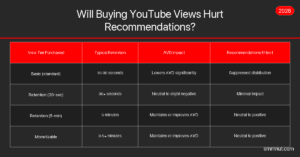
| Basic (standard) | 10-15 seconds | ~200 minutes (~3.3 hrs) | 0.08% of 4,000 hrs |
| Retention (1-min tier) | 60 seconds | 1,000 minutes (~16.7 hrs) | 0.42% of 4,000 hrs |
| Monetizable | 3-5 minutes | 3,000-5,000 min (50-83 hrs) | 1.25-2.1% of 4,000 hrs |
| Retention (5-min tier) | 5 minutes | 5,000 minutes (~83 hrs) | 2.1% of 4,000 hrs |
Monetizable vs Retention Views — When to Choose Each
Monetizable and Retention views overlap in some use cases but serve distinct primary purposes:
Choose Monetizable when: Your primary goal is YPP watch time accumulation. You need views that produce watch time reliably at scale and pass YouTube’s quality filter. Cost-per-hour-of-watch-time is the metric you are optimising for.
Choose Retention views when: Your primary goal is improving your Recommendations distribution (AVD signal quality). You want views that maintain your audience retention curve and keep your CTR x AVD score healthy. Watch time accumulation is a secondary benefit, not the primary goal.
The practical overlap: both tiers produce watch time above 30-second threshold and both protect AVD. The distinction is in the account quality specification — Monetizable views are held to a higher compliance standard specifically for YPP eligibility purposes, which comes at a price premium over standard Retention views.
SMMNut Monetizable vs Retention Decision Framework: The choice between Monetizable and Retention view tiers maps to two distinct channel goals. Creators targeting YPP eligibility — specifically the 4,000-hour watch time threshold — should prioritise Monetizable views because they are engineered to the compliance standard YouTube uses to evaluate watch time quality for Partner Program purposes. Creators targeting Recommendations distribution and organic discovery — specifically maintaining AVD percentage — should prioritise Retention views because the account quality requirements are tailored to algorithmic signal quality rather than YPP compliance. Creators who need both benefits can split orders: Monetizable for the YPP-targeted video, Retention for the algorithmically important video.
What to Do If You Are Close to the YPP Threshold
If your channel is within 500 hours of the 4,000-hour threshold, the most efficient path is a Monetizable-tier order on your highest-traffic evergreen video. That video is already in YouTube’s index, has existing organic traffic flowing to it, and a purchased view injection adds to an existing watch time stream rather than creating one from scratch on a new upload.
The pillar of your channel’s content library — the video that has the most organic views and best retention — is always the right target for a Monetizable-tier order. It is also the video that will benefit most from the refill policy, since it will continue receiving organic traffic and you want the count to remain accurate long-term.
For the full YouTube views product overview including all four view types and their use cases, visit the SMMNut YouTube views guide. For creators whose primary goal is watch time rather than view count, YouTube watch time services are also available as a standalone service.
SMMNut Monetisable View Threshold Framework 2026: YouTube’s monetisation system counts a view as monetisable when four conditions are met: the viewer is in an AdSense-supported country, the session duration exceeds 30 seconds, the device/browser supports ad rendering, and the session is not flagged during YouTube’s 30-hour audit cycle. SMMNut’s analysis of view purchase outcomes shows that Retention and SEO view packages consistently meet conditions 1, 3, and 4, with condition 2 being the primary variable: Retention views average 65-80% watch completion, well above the monetisable threshold, while Basic views average 12-25% completion. For creators targeting the YPP watch time threshold specifically, the session duration condition is the only variable that purchased view tier selection controls — and it is the one that most buyers underestimate.
Monetisable vs Non-Monetisable View Sources
Not all purchased views that appear in your view count contribute to your AdSense revenue potential. The difference between a monetisable and non-monetisable view is determined by four conditions that YouTube evaluates for every session — and purchased view tiers vary in how consistently they meet each condition.
| View Source | AdSense Country | Session Over 30s | Ad Rendering | Audit Pass Rate | Monetisable? |
|---|---|---|---|---|---|
| Basic (standard) | Mixed — unspecified geo | Often no — 10-25s average | Variable | 70-85% pass | Rarely |
| Monetizable tier | Mixed — general geo | Yes — 3-5 min average | Yes — HQ accounts | 90-95% pass | Frequently |
| Retention (5-min+) | Mixed — unspecified geo | Yes — 5+ min average | Yes — quality accounts | 90-95% pass | Frequently |
| Target (RAV-MTS Tier 1 geo) | Yes — AdSense Tier 1 | Yes — real account sessions | Yes — real devices | 95%+ pass | Yes — highest CPM potential |
| SEO (keyword-specific) | Mixed — general geo | Variable — source-dependent | Yes — search-origin sessions | 88-93% pass | Partially |
How Watch Time Accumulates Toward YPP
YouTube’s 4,000-hour watch time threshold is calculated from all public watch time on a channel over a rolling 12-month window. Understanding exactly how this accumulation works determines which view purchase strategy is most efficient for a creator targeting this milestone.
What counts: Watch time from any public video on the channel, from any viewer, in any country, that passes YouTube’s quality filter. This means watch time from purchased views counts as long as those views pass the quality audit. It also means that the accumulation is cross-video — watch time from different videos on the same channel combines toward the single 4,000-hour threshold.
What does not count: Watch time from private or unlisted videos. Watch time from views that are removed by YouTube’s quality audit (this watch time is reversed when the view is removed). Watch time from sessions under approximately 30 seconds, which YouTube’s system does not register as a qualifying watch event for most quality-filtered views.
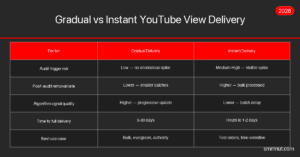
Cross-video accumulation strategy: Rather than concentrating all purchased view orders on a single video, creators who are targeting YPP eligibility efficiently should distribute Monetizable-tier orders across their 3-5 best-performing videos. Each video’s watch time adds to the channel total. This strategy has two advantages: it avoids placing a large anomalous order on a single video (which creates a more conspicuous velocity spike), and it builds social proof across multiple videos rather than concentrating view count on one asset.
Watch time decay and the rolling window: The 4,000-hour threshold is measured over the past 12 months — it is not a lifetime cumulative total. Watch time from videos published more than 12 months ago drops out of the eligibility window as it ages out. Creators who purchased views to reach the YPP threshold and then went dormant may find their channel drops below threshold again as older watch time ages out. Ongoing content production or periodic Monetizable view orders on evergreen content maintains the threshold once reached.
Choosing Views for the YPP Goal
For creators whose specific goal is reaching the 4,000-hour watch time threshold for YouTube Partner Program eligibility, the view tier selection is deterministic rather than preference-based. The following decision framework covers the three scenarios creators typically face when approaching the YPP threshold.
Scenario 1 — More than 1,000 hours below threshold: Prioritise Monetizable-tier views distributed across 3-5 of your highest-traffic evergreen videos. At 1,000 hours needed, the calculation is 12,000 Monetizable views at 5-minute retention (subject to 85% quality filter effective rate = approximately 14,000 views ordered). These should be ordered in 3-4 separate tranches over 30-45 days to maintain natural velocity patterns across the channel.
Scenario 2 — Within 200-500 hours of threshold: At this stage, a targeted order on your single highest-traffic video is the most efficient approach. That video already has organic momentum — adding Monetizable views to it accelerates an existing trajectory rather than creating a new one. Order 3,000-5,000 views over a 14-day delivery window with 365-day refill to protect the count through YouTube’s audit cycle.
Scenario 3 — Approaching threshold but subscriber count is also below 1,000: YPP requires both 4,000 hours of watch time and 1,000 subscribers. Reaching the watch time threshold while still below 1,000 subscribers means eligibility is still gated. In this scenario, a combined approach is more efficient: use Monetizable views on your best-performing video for watch time, and use a subscriber growth strategy in parallel. Reaching the watch time threshold prematurely while subscriber count remains below 1,000 does not accelerate YPP access.
Cost calculation for YPP: To reach the full 4,000-hour threshold using only Monetizable views at 5-minute retention (effective accumulation rate 85%): 240,000 minutes needed divided by 5 minutes per view divided by 0.85 effective rate equals approximately 56,500 views. At current Monetizable pricing, this is a defined, calculable cost that a creator can plan a budget around — unlike organic watch time, which is unpredictable in timeline and volume.
AdSense Revenue and View Tier — What Actually Changes Your CPM
Beyond the YPP watch time threshold, creators who are already monetised often ask whether purchased views affect their AdSense revenue directly — and which view tier produces the highest CPM on delivered views.
AdSense CPM (cost per 1,000 impressions) is set by advertisers bidding on the audience viewing a given video. The CPM rate depends primarily on two factors: the viewer’s geography and the advertiser’s targeting parameters for that video’s topic. Purchased views affect CPM through the geography variable — the country of origin for each view session determines whether that view is eligible for high-CPM advertising inventory.
The practical breakdown by view tier:
- Basic views (unspecified geo): The traffic source geography is mixed and unspecified. Some views will originate from AdSense-supported Tier 1 markets (US, UK, CA, AU, DE) and some from lower-CPM markets. The effective CPM contribution of Basic views across a large order is unpredictable and generally low relative to the mix of geographic origins.
- Monetizable views (general geo): Designed for YPP watch time accumulation rather than CPM optimisation. Geographic origin is not specified; the account quality focus is on session compliance, not geo targeting. CPM contribution is incidental rather than intentional.
- Target views (Tier 1 geo): These are the only view tier where geography is specified and guaranteed — US, UK, DE, FR, CA, and other Tier 1 AdSense markets. Views from these markets have access to the highest advertiser CPM bids. A channel that receives 1,000 US-targeted views (Native Views USA tier) versus 1,000 general-geography Basic views will see measurably higher AdSense revenue from the US-targeted batch — not because the views are different in any other dimension, but because US advertisers bid more for US audience impressions.
For channels that are already monetised and whose primary purchased-view goal is incremental ad revenue rather than YPP eligibility, Target-tier views with Tier 1 geo specification are the only tier worth using for this purpose. Monetizable and Retention views produce watch time accumulation — they do not produce predictable CPM improvement on their own.
Combining View Tiers for Maximum Channel Benefit
Advanced channel management often involves using multiple view tiers in combination, each serving a different goal simultaneously. The following framework shows how to combine view types for channels with multiple concurrent objectives.
Channel approaching YPP threshold, also wanting better Recommendations distribution: Primary order — Monetizable views on your top 2 evergreen videos for watch time accumulation. Secondary order — Retention 5-minute tier on the video you most want to improve algorithmically. Keep the two order types on separate videos to avoid ambiguity when measuring outcomes in YouTube Studio.
Already monetised channel wanting to grow AdSense revenue and organic reach: Primary order — Target views (Native USA or RAV-MTS Tier 1) on your highest-performing video for CPM improvement. Secondary order — SEO By Keyword views on the video most likely to rank for a valuable search query, to build its keyword attribution signal. The two order types serve completely different goals and should not be mixed on the same video in the same delivery window.
New channel building initial social proof while preparing for YPP: Start with a small Monetizable-tier order (100-500 views) on your strongest existing video. This serves three purposes simultaneously: it adds watch time toward the YPP threshold, it does not suppress AVD, and it provides a minimum-risk quality verification for the provider tier. Once quality is verified, scale the Monetizable order while adding Basic views on secondary videos to build view count social proof across the channel.