
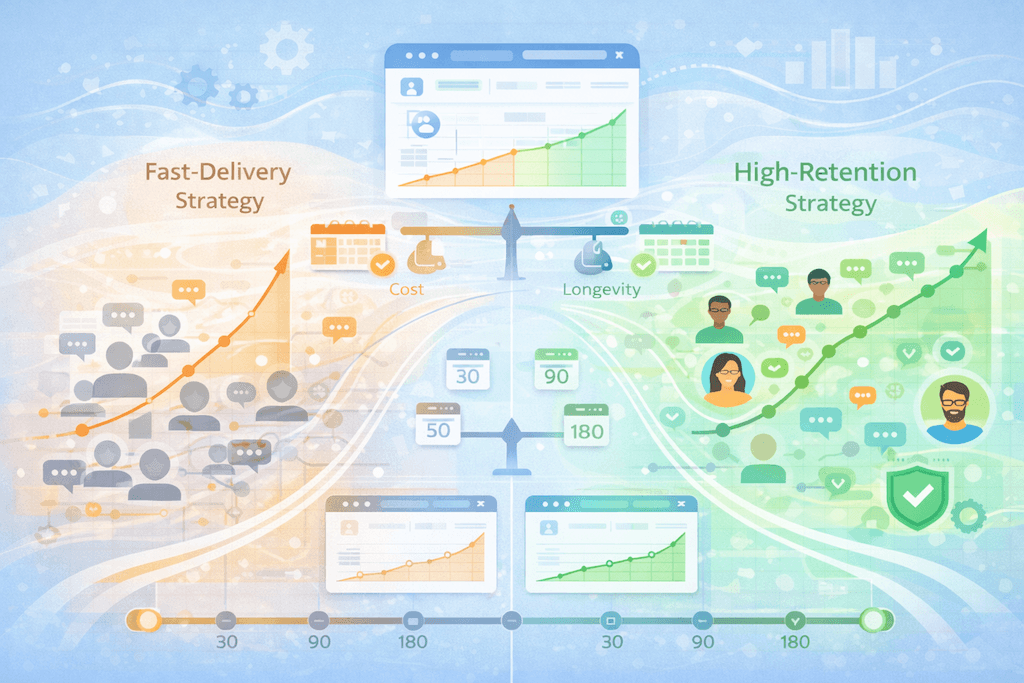
Understanding Delivery Speed vs Retention
Delivery speed and retention are not opposites, but they often correlate. Faster delivery usually means less behavioral smoothing, while higher retention usually requires slower, more distributed delivery. This is Facebook page follower strategies.
What Fast-Delivery Really Means
Fast-delivery follower services typically add large numbers of followers within hours or days. The appeal is obvious: immediate social proof and visible growth.
However, from Facebook’s perspective, rapid change compresses behavioral adjustment into a short window. This does not trigger punishment, but it does force faster recalibration.
What High-Retention Delivery Means
High-retention strategies prioritize:
- Gradual delivery
- Follower diversity
- Lower churn over time
These followers integrate more slowly into a page’s baseline metrics, giving Facebook’s systems more time to normalize expectations.
How Facebook Interprets Delivery Patterns
Facebook does not evaluate delivery methods directly. It evaluates the downstream effects.
Short-Term Interpretation
Immediately after a delivery event, Facebook adjusts impression sampling. This happens regardless of speed. Fast delivery simply concentrates this adjustment into a shorter period.
This is why pages often misinterpret early volatility as a penalty. In reality, it is recalibration.
Medium-Term Interpretation
Over weeks, Facebook observes:
- Posting consistency
- Engagement distribution
- Follower churn
Retention becomes visible during this stage. Pages with high churn send instability signals; pages with stable audiences normalize faster.
Retention Curves: What Happens Over Time
Retention is not about whether followers engage. It is about whether they remain.
Fast-Delivery Retention Curve
Fast-delivery followers often show:
- Higher early drop-off
- Faster metric stabilization
- Lower long-term audience persistence
This does not cause enforcement, but it can distort engagement ratios temporarily.
High-Retention Curve
High-retention strategies typically show:
- Lower churn over months
- More stable follower counts
- Less long-term volatility
Over six months, these pages often display smoother performance, consistent with observations from six-month follower outcome analysis.
Impact on Reach Stability
Delivery speed influences how quickly reach patterns adjust.
Fast Delivery and Reach
Pages using fast delivery may experience:
- Short-term reach fluctuation
- Temporary engagement dilution
- Faster stabilization if posting remains consistent
Problems arise only when fast delivery is combined with inconsistent posting.
High Retention and Reach
High-retention approaches tend to produce:
- More predictable reach
- Lower variance across posts
- Slower but steadier normalization
This is why quality-focused pages often prefer retention-focused follower delivery over speed-first options.
Which Strategy Fits Which Page?
New or Low-Activity Pages
For new pages, aggressive fast delivery offers little benefit. Without consistent posting, retention matters more than speed.
Established Pages Seeking Social Proof
Established pages with regular content may tolerate faster delivery without long-term issues, provided expectations are realistic.
Ad-Driven Pages
Pages preparing for ads often benefit from slower, retention-focused growth to avoid overlapping recalibration with ad review cycles, as discussed in follower timing before ads.
When Fast Delivery Actually Works Better
Fast delivery may be appropriate for:
- Event-based pages needing immediate social proof
- Established pages with strong existing engagement
- Pages preparing for time-sensitive launches
Even in these cases, content consistency remains the determining factor.
Common Mistakes Page Owners Make
Choosing Speed Without Context
Speed alone does not improve performance. Without supporting content, fast delivery adds noise rather than value.
Ignoring Churn
High churn erodes credibility signals over time. Retention is a delayed but meaningful indicator.
Stacking Growth Events
Combining fast delivery with content changes or ad launches increases volatility unnecessarily.
Final Takeaway
There is no universally “correct” follower delivery method. Fast delivery emphasizes immediacy; high retention emphasizes stability.
In 2026, Facebook responds to outcomes, not tactics. Pages that understand delivery trade-offs and align them with posting behavior tend to see the most consistent results.
The safest strategy is not choosing speed or retention—it is choosing alignment between growth, content, and expectations.