Why Small Businesses Think About Buying Followers
Small businesses rarely buy followers for reach alone. The motivation is usually credibility.
The Trust Gap Problem
A Facebook page with 47 followers does not inspire the same confidence as a page with 4,700 followers—even if the business behind it is legitimate.
For small businesses, this creates a trust gap:
- Customers hesitate to message unknown pages
- Ads feel less trustworthy without visible social proof
- Competitors appear more established by comparison
Buying followers is often considered as a way to close this gap—not as a replacement for real marketing.
What Small Businesses Are Actually Buying
When small businesses buy Facebook page followers, they are not buying engagement or sales. They are buying:
- Perceived legitimacy
- Reduced friction in customer decisions
- Baseline credibility for ads and outreach
This distinction is critical for evaluating ROI.
Defining ROI for Facebook Followers
ROI is often misunderstood in this context. Buying followers does not generate revenue directly.
Direct vs Indirect ROI
Direct ROI would mean followers immediately produce sales. This almost never happens.
Indirect ROI is what matters:
- Higher message reply rates
- Better ad conversion confidence
- Improved brand perception
The question is whether these indirect effects justify the cost.
Cost Scenarios: What Small Businesses Actually Spend
Most small businesses spend modest amounts on follower growth.
Typical Budget Ranges
- $10–$30 for early-stage credibility
- $30–$80 for visible social proof
- $100+ rarely justified for small local pages
At these levels, the financial risk is low—but only if expectations are realistic.
This is why understanding affordable follower growth cases is essential before deciding.
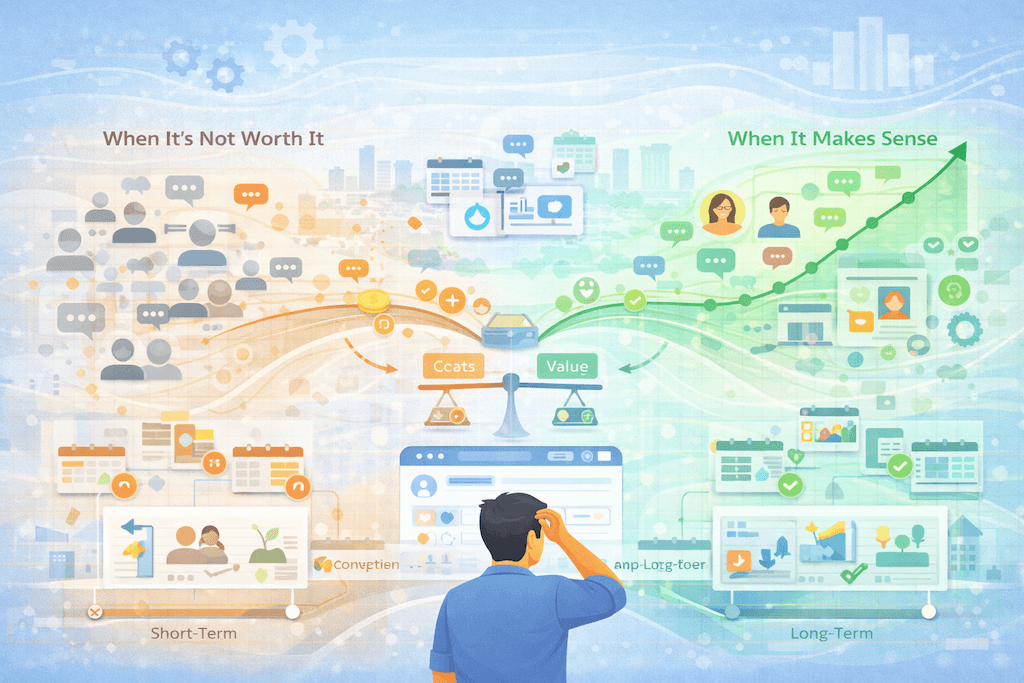
ROI Scenarios That Actually Make Sense
Local Service Businesses
Examples: plumbers, salons, gyms, clinics.
For these businesses:
- Customers check Facebook pages before messaging
- Follower count influences perceived legitimacy
- Trust matters more than reach
In this scenario, even a single additional customer can justify the cost of followers.
Small Ecommerce Brands
For ecommerce pages:
- Followers act as social validation
- Ads convert better when the brand looks established
- Follower count supports retargeting trust
This is particularly relevant when combining growth with followers before Facebook ads.
Personal Brands and Coaches
Coaches, consultants, and creators rely heavily on perceived authority.
In these cases, followers support:
- Inbound messages
- Profile credibility
- Social proof during discovery
ROI Scenarios That Do NOT Make Sense
Inactive Pages
If a business does not post regularly, buying followers provides no ongoing benefit.
Expectation of Organic Reach
Followers do not guarantee reach. As explained in how reach really works, engagement—not follower count—drives distribution.
Replacing Content or Ads
Buying followers cannot replace:
- Content creation
- Customer service
- Paid advertising
When used as a substitute, ROI is negative.
Small Business ROI Math (Simple Example)
Consider a local service business:
- Follower cost: $30
- One additional customer value: $120
If buying followers increases trust enough to convert just one hesitant customer, ROI is positive.
If it converts zero customers, ROI is neutral—not catastrophic.
This low downside is why many small businesses consider the tactic.
How to Maximize ROI If You Buy Followers
Buy Modestly
Small businesses rarely need thousands of followers. Enough to look credible is enough.
Post Consistently
Follower growth only helps when paired with visible activity.
Choose Stability Over Speed
As explained in retention vs speed trade-offs, stability protects long-term perception.
This is why many small businesses prefer stable follower delivery for small businesses rather than instant spikes.
What Facebook Actually Cares About
Facebook does not evaluate ROI. It evaluates behavior.
As long as:
- The page posts normally
- Engagement patterns remain stable
- No policy violations occur
Follower growth does not create risk by itself, as safe purchase planning.
Final Verdict for Small Businesses
Buying Facebook page followers can be worth it for small businesses when used correctly:
- As a credibility boost, not a growth engine
- With modest budgets
- Alongside real content and customer interaction
It is not a magic lever. It is a support tactic.
For small businesses that understand this distinction, ROI is often positive—not because followers create sales, but because they remove friction from decisions customers were already close to making.