Understanding Meta’s Policy Structure
To understand where follower buying fits, it is essential to understand how Meta structures its rules.
Community Standards vs Product Policies
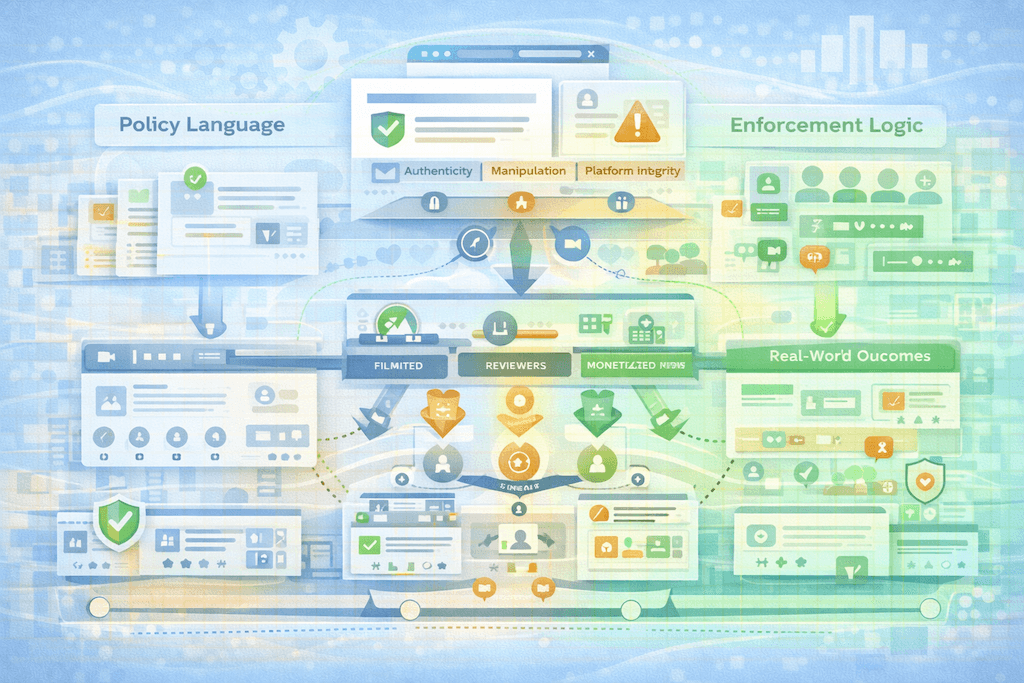
Meta governs Facebook through multiple layers of policy:
- Community Standards – regulate behavior and content across the platform
- Advertising Policies – regulate paid promotion
- Integrity & Authenticity Policies – regulate coordinated abuse
Facebook follower growth services is not addressed as a standalone action in the Community Standards. Instead, enforcement focuses on outcomes and behavior patterns.
Why This Distinction Matters
Many misunderstandings arise from assuming Meta bans actions rather than behaviors. In reality, Meta evaluates whether activity undermines platform integrity—not how growth is achieved.
This is why questions about what actually triggers Facebook reviews are more relevant than searching for forbidden tactics.
What Meta Explicitly Prohibits
Meta’s rules are clear about certain forms of behavior.
Coordinated Inauthentic Behavior
Meta defines coordinated inauthentic behavior as:
- Networks of accounts working together deceptively
- Artificial amplification designed to mislead users
- Manipulation that obscures identity or intent
This applies to influence operations, spam networks, and deceptive engagement schemes.
Importantly, this definition focuses on coordination and deception—not on follower acquisition alone.
Automation Abuse
Automated actions that simulate human behavior at scale are regulated when they:
- Create spam
- Disrupt platform integrity
- Mislead users
Automation is evaluated by effect, not by intent.
What Meta Does NOT Explicitly Ban
This is where confusion often arises.
Buying Followers Is Not Named as a Violation
Nowhere in Meta’s 2026 Community Standards is “buying followers” listed as a prohibited act.
This does not mean Meta endorses the practice. It means enforcement is conditional.
Follower Origin Is Not a Policy Category
Meta does not categorize followers by how they were acquired. It evaluates:
- Account behavior
- Engagement patterns
- Network signals
This is why many pages grow through mixed methods without issue.
Misunderstanding this point leads to exaggerated fear about buying followers.
How Meta Enforces Community Standards in Practice
Enforcement is not instantaneous or binary.
Automated Systems First
Meta uses automated systems to identify confidence signals. These systems:
- Evaluate patterns over time
- Look for repeated or scaled behavior
- Score risk rather than punish immediately
Follower growth alone rarely produces enough signal for action.
Manual Review Is Contextual
Manual reviews typically occur when:
- Pages apply for monetization or verification
- Ad accounts face repeated issues
- Other violations already exist
In these cases, follower patterns may be reviewed as part of a broader assessment—not in isolation.
Why Most Pages Are Never Penalized
The vast majority of Facebook pages—including those that buy followers—never face enforcement.
Because Behavior Is Normalized
Pages that:
- Post consistently
- Engage normally
- Avoid deception
blend into Facebook’s baseline expectations.
This explains why many outcomes discussed in six-month follower outcomes show stabilization rather than punishment.
Because Meta Prioritizes Harm Reduction
Meta focuses enforcement resources on:
- Spam networks
- Scams
- Disinformation
Follower growth used as social proof does not fall into these categories unless combined with deception.
Where Pages Actually Get Into Trouble
Pages rarely get penalized for buying followers. They get penalized for what happens alongside it.
Stacked Risk Factors
Problems arise when follower growth is combined with:
- Policy-violating content
- Misleading claims
- Spammy outbound behavior
Misrepresentation
Claiming false endorsements, inflating authority claims, or misleading users about influence can trigger enforcement—even if follower growth itself does not.
How to Stay Aligned With Meta’s Rules
Compliance is behavioral, not tactical.
Focus on Page Integrity
Pages that maintain:
- Clear identity
- Consistent posting
- Transparent messaging
remain aligned with Meta’s expectations.
This aligns closely with preparation principles outlined in page readiness before growth.
Avoid Deceptive Amplification
Growth should support visibility—not fabricate influence.
Understanding the difference between credibility and manipulation prevents policy issues.
Why This Matters for Long-Term Pages
Pages built for longevity—brands, businesses, creators—benefit from understanding policy boundaries.
Follower count is a signal, not a shield.
Meta evaluates whether pages behave like real participants in the ecosystem.
Final Takeaway
Meta’s 2026 Community Standards do not ban buying Facebook followers. They regulate behavior that undermines trust, authenticity, and platform integrity.
Pages that buy followers but behave normally are usually ignored. Pages that deceive, automate, or misrepresent face consequences—regardless of how their audience was built.
The safest strategy is not secrecy. But to use practical compliance steps.
When pages act like real brands, follow content rules, and grow responsibly, follower acquisition becomes a secondary detail—not a defining risk.