Why “Real vs Bot” Is the Wrong Framing (But Still Useful)
The terms “real” and “bot” are widely used, but they oversimplify how Facebook evaluates accounts.
Facebook Does Not Classify Followers the Way Marketers Do
Facebook does not maintain a visible or binary classification system that labels accounts as real or fake for page owners. Instead, it evaluates:
- Account behavior patterns
- Interaction consistency
- Network associations
- Historical activity
An account can appear “real” but still be low quality from a behavioral standpoint. Conversely, an account may be inactive yet still considered legitimate.
Why Quality Is About Risk, Not Morality
Follower quality matters because it affects how Facebook interprets page behavior—not because one type is ethically superior.
Low-quality followers introduce noise into engagement signals. High-quality followers blend naturally into expected behavioral ranges.
The Quality Markers Facebook Actually Responds To
In 2026, Facebook’s systems evaluate follower quality indirectly through patterns rather than identity labels.
Profile Completeness
Accounts with basic profile elements—profile photos, names, and minimal activity—blend more naturally into Facebook’s ecosystem.
Incomplete or empty profiles are not violations, but large clusters of them interacting with the same pages raise confidence scores internally.
Activity Distribution
High-quality followers tend to:
- Have varied activity across different pages
- Interact inconsistently (not all at once)
- Show gaps in activity like normal users
Low-quality followers often exhibit synchronized or repetitive activity patterns.
Network Diversity
Facebook places heavy emphasis on network signals. Followers connected to diverse pages, topics, and interactions appear natural.
Clusters of followers that only interact with similar pages or services are easier for systems to identify as coordinated.
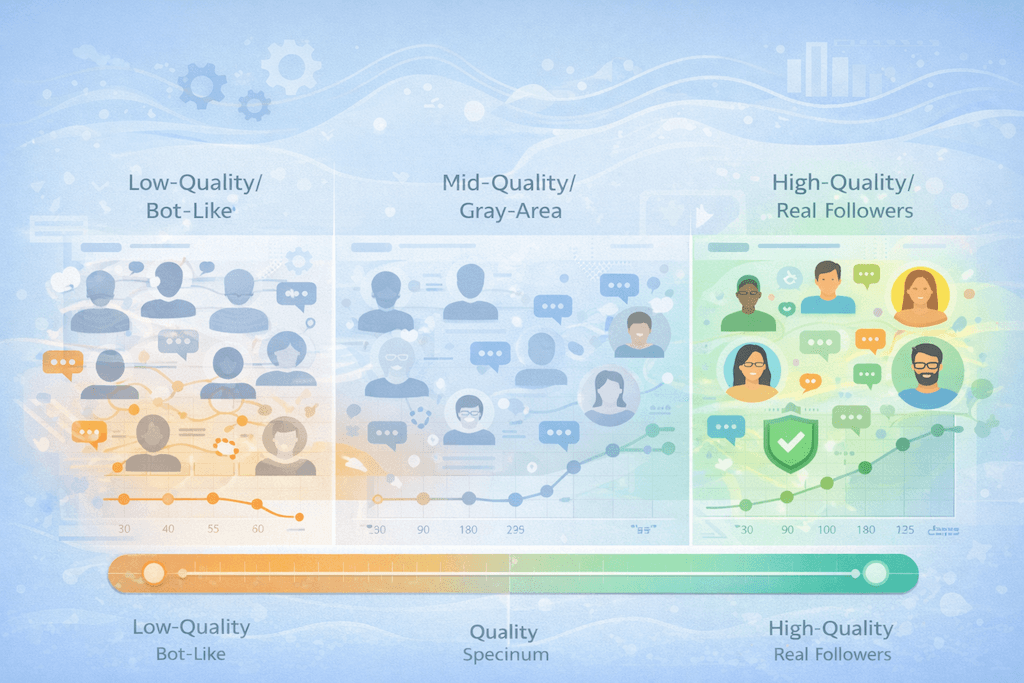
Real-Looking Followers vs Low-Quality Bot Followers
The difference between these two categories is practical, not philosophical.
Real-Looking Followers
These accounts typically:
- Have profile photos or avatars
- Show intermittent posting or reactions
- Follow a range of unrelated pages
- Appear geographically and behaviorally diverse
When added gradually, they integrate into a page’s audience baseline with minimal disruption.
Low-Quality Bot Followers
These accounts often:
- Lack profile depth
- Show identical behavior patterns
- Appear in large bursts
- Interact unnaturally or not at all
They do not trigger instant penalties, but they can distort engagement ratios and reduce amplification efficiency.
How Follower Quality Affects Page Behavior Over Time
Follower quality does not cause direct punishment. It affects how Facebook interprets engagement outcomes.
Impact on Reach Stability
Pages with higher-quality followers tend to experience:
- More predictable reach patterns
- Faster normalization after growth
- Lower volatility in impressions
This explains why concerns about organic reach and follower quality are often misplaced.
Impact on Long-Term Credibility
Over months, Facebook evaluates whether a page’s audience behaves like a real audience. Quality followers reduce signal distortion and help pages maintain credibility.
This becomes particularly important when pages grow through quality-focused follower services rather than volume-first approaches.
Inspection Checklist: How to Evaluate Follower Quality
Page owners cannot see Facebook’s internal scoring, but they can evaluate surface-level indicators by high-quality follower sources.
Follower Profile Sampling
Manually inspect a small sample:
- Do profiles look complete?
- Do they have varied activity?
- Are names and images diverse?
Engagement Pattern Review
Check whether engagement arrives:
- Gradually, not instantly
- At varied times
- Across different posts
Retention Over Time
Quality followers tend to remain stable. High drop-off rates often indicate low-quality delivery.
This is why understanding retention vs fast delivery differences is essential when evaluating services.
When Quality Matters More Than Quantity
Not all pages benefit equally from follower growth.
High-Stakes Pages
Pages that run ads, pursue monetization, or represent businesses face higher scrutiny. For these pages, quality matters significantly more than raw numbers.
Low-Activity Pages
Pages with limited posting frequency gain little from large follower volumes. Quality followers integrate better and reduce engagement distortion.
Common Myths About Follower Quality
“Real Followers Always Engage”
Most real users do not engage regularly. Passive behavior is normal and not a quality issue.
“Bots Cause Automatic Penalties”
Facebook does not punish pages simply for having low-quality followers. It responds to behavioral outcomes, not labels.
Final Takeaway
In 2026, follower quality matters because it influences how Facebook interprets page behavior—not because of rigid classifications.
Pages that prioritize stability, diversity, and realistic growth patterns tend to benefit most from quality-focused follower strategies. Quantity creates visibility; quality preserves credibility.
Understanding this distinction allows page owners to make informed decisions without fear-based assumptions.