Why “Fake Views” Is a Misleading Term
Most discussions around fake views come from forums, comment sections, or outdated advice that treats YouTube’s systems as simplistic. In reality, YouTube does not label views as real or fake internally.
A view is either counted or not counted. After that, it is evaluated as part of a broader performance pattern.
The problem with the term “fake views” is that it combines very different behaviors into one bucket:
- Automated bot playback
- Scripted refresh views
- Low-quality paid traffic
- External promotional traffic
- Sponsored exposure
Some of these are harmful. Some are neutral. Some are common and accepted. Treating them as the same creates unnecessary fear and bad decision-making.
YouTube’s systems are far more nuanced than the language people use to describe them.
How YouTube Evaluates View Quality
YouTube’s evaluation process focuses on how a view contributes to viewer satisfaction and platform health.
The core signals include:
Playback Duration
How long the video is watched matters more than the view itself. A view that lasts a few seconds is evaluated very differently from one that lasts several minutes.
Audience Retention Shape
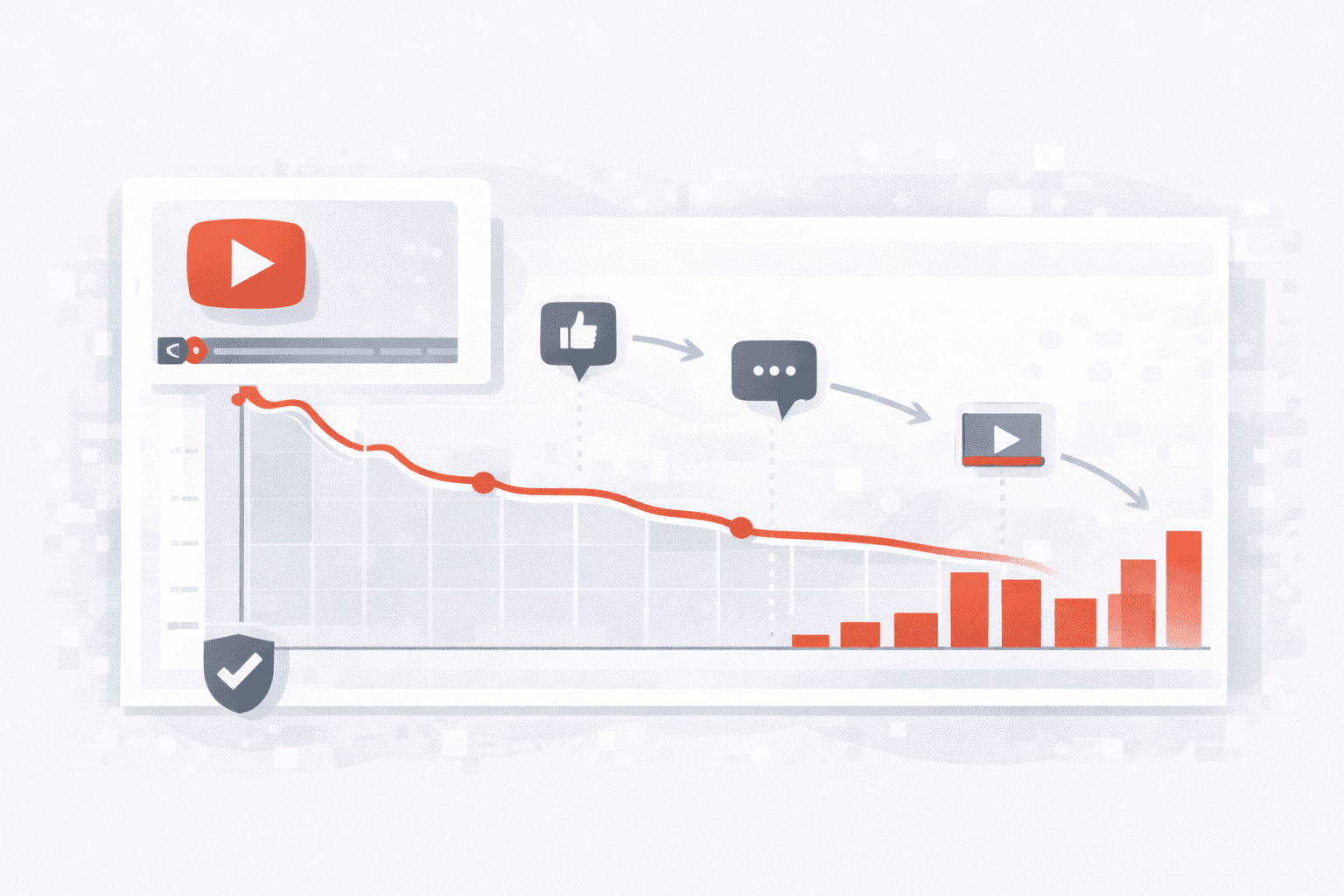
YouTube analyzes the retention curve. Gradual decline is normal. Sharp early drop-offs indicate dissatisfaction.
Engagement Footprint
Likes, comments, shares, and saves are secondary signals, but their absence or presence helps contextualize view behavior.
Session Continuation
If a view leads to more watching — either on the same channel or elsewhere — it contributes positively to session metrics.
Traffic Consistency
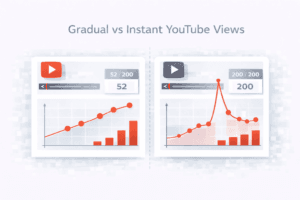
YouTube compares current performance to historical baselines. Sudden, repeated deviations can reduce trust in the signal.
None of these factors depend on whether a view was paid or organic. They depend on behavior.
What People Usually Mean by “Fake Views”
When creators complain about fake views, they are usually referring to a specific subset of low-quality traffic.
Common examples include:
- Bots that auto-play videos without meaningful watch time
- Scripted refresh systems that inflate counters
- Traffic with identical behavior patterns
- Views that exit almost immediately
These views tend to share the same characteristics:
- Very short playback duration
- No engagement footprint
- No session continuation
YouTube does not need to “punish” this traffic. It simply discounts it.
This is why creators often notice that cheap or automated views increase numbers temporarily but do nothing for reach or performance.
What “Real” YouTube Views Actually Mean
Real views are not defined by payment method. They are defined by behavior that resembles normal user activity.
Characteristics of higher-quality views include:
- Human-like watch patterns
- Natural playback duration
- Occasional engagement
- Session continuity
These views do not need to be perfect. Most organic viewers do not like, comment, or watch 100% of a video.
What matters is that their behavior falls within a realistic range.
This is why YouTube can tolerate external traffic, promotions, embeds, and paid exposure — as long as the behavior makes sense.
Real vs Fake Views: Retention and Watch Time Differences
The clearest difference between higher-quality and low-quality views appears in retention analytics.
Low-Quality Views
- Sharp early drop-offs
- Flattened retention curves
- No mid-video stability
These patterns signal dissatisfaction or non-human behavior.
Higher-Quality Views
- Gradual retention decline
- Stable mid-video watch time
- Occasional engagement signals
YouTube does not reward these views directly — but it does not penalize them either. They simply blend into performance data.
This distinction explains why quality matters more than volume.
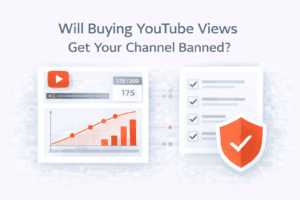
Can Fake Views Get a Channel in Trouble?
Isolated use of low-quality views rarely causes account-level issues. YouTube’s first response is almost always to ignore the signal.
Risk increases when creators:
- Repeatedly use automated traffic
- Combine fake views with fake engagement
- Attempt to monetize paid traffic
- Create consistent abnormal patterns
Even then, YouTube typically limits distribution rather than penalizing accounts.
Demonetization or enforcement usually occurs only when ad systems are abused — not when views are purchased.
Why Cheap Views Usually Cause Problems
The issue with very cheap views is not the price itself — it is what the price represents.
Low-cost providers often rely on:
- Automation
- Scripted behavior
- Non-human playback
- Unrealistic volume scaling
These shortcuts reduce delivery cost but also reduce behavioral realism.
As a result, retention drops, session metrics weaken, and YouTube discounts the traffic.
Cheap views are not dangerous because they are cheap. They are ineffective because they fail to behave like real viewers.
How to Identify Higher-Quality YouTube Views
Creators evaluating view quality should focus on patterns rather than promises.
Indicators of higher-quality delivery include:
- Gradual, controlled delivery speed
- Retention curves that match historical baselines
- No sudden engagement spikes
- Stable geographic and traffic-source distribution
No provider can guarantee performance. Quality is about minimizing disruption, not maximizing impact.
Using Views Without Damaging Performance
The safest way to use views is to treat them as exposure support, not as a performance hack.
Responsible usage includes:
- Scaling views relative to channel size
- Avoiding repeated extreme spikes
- Monitoring retention and session metrics
- Separating visibility goals from monetization goals
When views behave like normal traffic, YouTube treats them as such.
Internal Bridge and Practical Context
Understanding the difference between real and fake views helps creators make informed decisions instead of reacting to fear-driven advice.
Views that behave like real viewers blend naturally into analytics. This is why choosing SMMNut YouTube views services that prioritize behavior quality over raw volume is more important than chasing low prices or exaggerated promises.
Summary
- YouTube evaluates behavior, not labels
- Fake views are defined by poor behavior patterns
- Real views blend into analytics naturally
- Retention reveals view quality more than volume
- Cheap views usually fail due to automation
- Responsible usage minimizes risk
In 2026, the question is not whether views are real or fake. The question is whether they behave like genuine viewers — because that is all YouTube ultimately evaluates.