What “Engagement Velocity” Means in Instagram’s 2026 Algorithm
In 2026, Instagram upgraded its ranking system by introducing velocity-based scoring. Velocity refers to the speed at which engagement arrives on a post — especially likes. The platform no longer evaluates your like count in isolation; instead, it evaluates how fast those likes are generated, how they align with your natural patterns, and whether your velocity resembles organic user behavior.
Instagram measures engagement velocity using a metric called LPM (likes per minute). During the first 60 minutes after posting — the most important phase of Reels distribution — Instagram tracks:
- How many likes arrive per minute
- Whether the velocity builds naturally (a smooth upward curve)
- Whether the pattern resembles real audience behavior
- Whether velocity matches the creator’s historical averages
- Whether the spike is too early (0–1 minute = high risk)
- Whether the spike is too large (non-human engagement patterns)
The 2026 algorithm uses a “Curve Authenticity Check” to decide whether the velocity is believable. If your likes arrive at a pace that matches organic human usage habits — rising gradually, plateauing, then tapering off — the algorithm rewards your post with distribution expansion. If your likes arrive in an instant jump or artificial burst, the algorithm flags the post and limits its distribution.
This is why creators cannot rely on “instant” likes anymore. The algorithm is engineered to detect velocity anomalies, and any deviation from natural LPM patterns is treated as suspicious, reducing your post’s chances of passing the Reels test batch.
Understanding engagement velocity is the foundation of safe growth in 2026 — and the reason safe-delivery Instagram likes matter more than total volume.
Why Instant Likes Are More Dangerous Than Ever in 2026
Instant likes were already risky in previous years, but Instagram’s 2026 algorithm update made them significantly more dangerous. With Trust Score 2.0, Instagram introduced a Velocity Spike Detector — an AI-driven tool that analyzes how quickly your engagement arrives and flags any pattern that does not match normal user behavior.
When likes appear too quickly, especially within the first 1–3 minutes after posting, Instagram treats this as synthetic engagement. Why? Because real users don’t instantly like your content the moment it goes live unless you are a mega creator. Even large creators receive their likes in a “wave pattern,” not all at once.
Instant likes trigger red flags such as:
- Abnormal start velocity (0 to 200 likes in 30 seconds)
- Unnatural delivery uniformity (likes arriving at the exact same speed)
- Historical mismatch (your past posts had slower curves)
- Behavior mismatch (users liking without watch-time)
- Clustered delivery from similar accounts or regions
These patterns cause the algorithm to assign a lower Quality Confidence Score to your content. Even if you fix the ratio or boost your post later, the system may still restrict your distribution for several hours or days. In some cases, posts with “velocity anomalies” do not reach even 5% of your follower base.
Most importantly, instant likes reduce your chances of surviving the first Reels test batch. The 2026 system uses the initial 150 viewers to determine whether your post should be expanded. If velocity appears manipulated, the system refuses to escalate your content to layer 2 or layer 3, effectively killing your reach before it begins.
For these reasons, instant likes — even if they’re real — have become the biggest risk factor for growth. The safer strategy is using controlled drip delivery that mirrors natural audience behavior.
Safe Velocity Benchmarks for Each Account Size
One of the most misunderstood parts of buying Instagram likes in 2026 is the concept of velocity tolerance. Not all accounts can safely receive likes at the same speed. A creator with 150k followers can receive 20 likes per minute without triggering suspicion, while an account with 5k followers might get flagged for receiving the same velocity.
Instagram evaluates your velocity based on your historical engagement curve. This means the algorithm compares today’s engagement speed to the patterns your account has shown over the past 30–60 days. If your spike exceeds your average LPM by too much, the post is flagged as “velocity anomaly” and restricted.
Below are the recommended safe velocity levels for 2026, based on account size and natural tolerance:
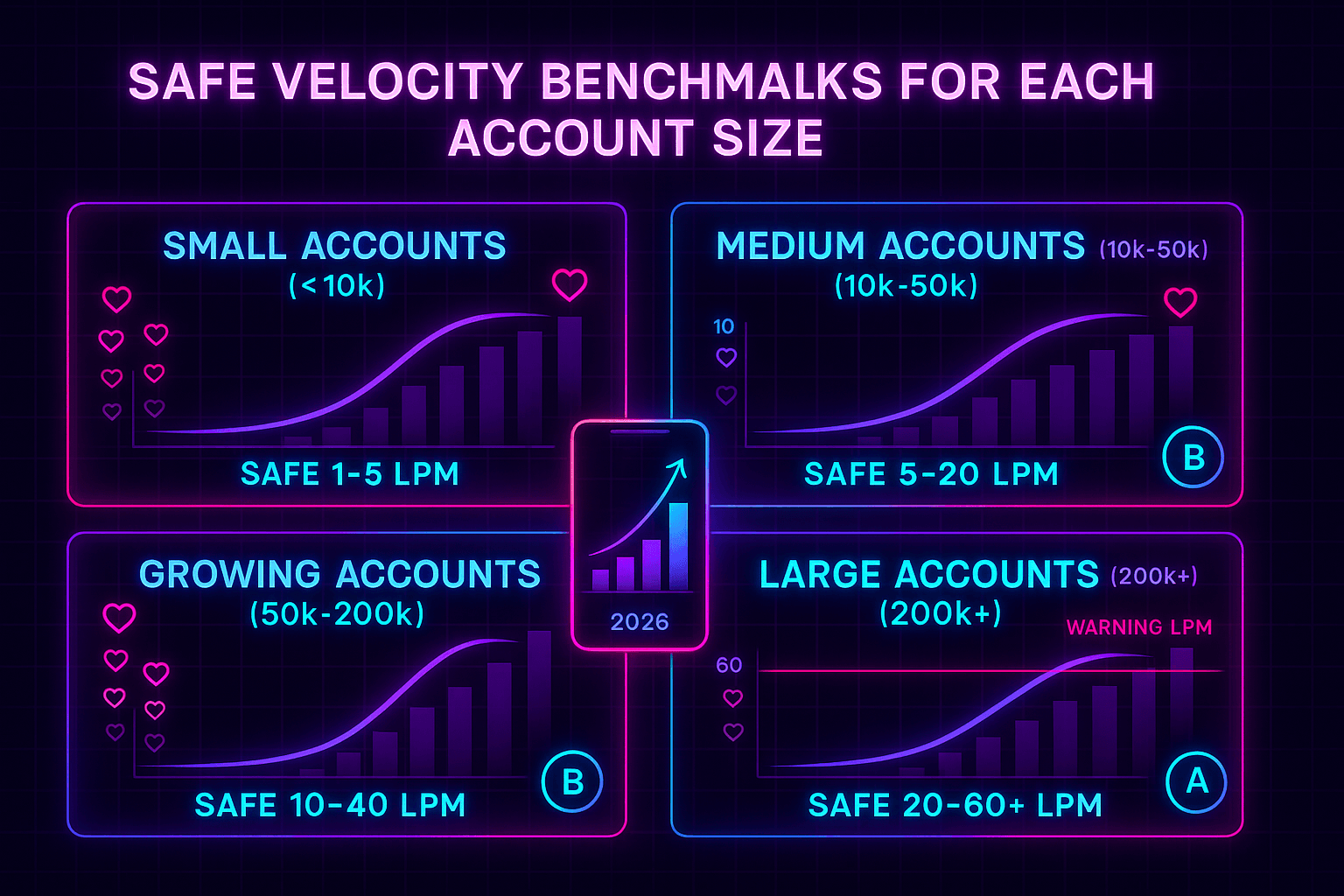
• Small Accounts
(<10,000 followers)
- Safe LPM: 1–5 likes per minute
- Risky LPM: 6–15 likes per minute
- Danger Zone: 15+ likes per minute
Small accounts have tight velocity thresholds because Instagram assumes their engagement grows slowly. A sudden spike is treated as suspicious unless historical data proves otherwise.
• Medium Accounts
(10,000–50,000 followers)
- Safe LPM: 5–20 likes per minute
- Risky LPM: 20–40 likes per minute
- Danger Zone: 40+ likes per minute
Medium accounts experience moderate engagement variation, so they can tolerate higher velocity — but large spikes can still cause suppression.
• Growing Creators
(50,000–200,000 followers)
- Safe LPM: 10–40 likes per minute
- Risky LPM: 40–80 likes per minute
- Danger Zone: 80+ likes per minute
These creators can safely receive faster engagement because their content typically reaches hundreds of users at once during peak hours.
• Large Accounts
(200,000+ followers)
- Safe LPM: 20–60+ likes per minute
- Risky LPM: 60–100 likes per minute
- Danger Zone: 100+ likes per minute
Large accounts have the broadest tolerance because their audience size often produces naturally fast engagement waves.
Understanding these thresholds allows you to use like-boosting strategies safely without triggering velocity detection, improving both your visibility and your trust score in the 2026 algorithm.
The 2026 “Curve Shape”
How Your Like Delivery Should Look
To decide whether your engagement is natural or manipulated, Instagram evaluates the shape of your like-delivery curve. In 2026, curve pattern recognition became a ranking signal: posts with natural-looking velocity curves are promoted, while posts with “bot-like velocity shapes” get restricted.
A natural velocity curve follows a predictable, human engagement pattern:
- Minute 0–5: light trickle of early likes from your most active followers
- Minute 5–15: a gradual rise as your Reel enters the first test batch
- Minute 15–35: stable momentum from organic viewers
- Minute 35–60: gentle tapering as the initial audience finishes watching
Instagram expects this pattern because it aligns with real human behavior. People see your post gradually — not all at once. When your curve rises too fast or stays unnaturally flat, the algorithm detects a mismatch between velocity and organic discovery rate.
Instagram Flags the Following Curve Shapes as “Dangerous” in 2026:
- Vertical Spike Pattern: 0 → 300 likes in under 1 minute
- Flat-Line Pattern: identical delivery every minute (bot-timing)
- Staircase Pattern: likes arriving in predictable blocks
- Late Spike Pattern: no likes for 15 minutes → sudden surge
- Reverse Curve: high likes at start → no likes later
These abnormal shapes trigger Trust Score 2.0 warnings, affecting:
- Reels test batch expansion
- Explore page eligibility
- Trending category placement
- Overall reach
To avoid suppression, your like-delivery must resemble real audience momentum. This is why safe drip-delivery likes are now essential — they allow your velocity curve to stay within normal human patterns.
Velocity Spike Detection & How Instagram Flags You in 2026
Instagram’s 2026 algorithm update introduced a multi-layered system that evaluates how your engagement arrives. One of the most important components is the Velocity Spike Detection (VSD) module. This AI-driven layer analyzes patterns in real time and determines whether your engagement curve is authentic.
A “velocity spike” occurs when likes arrive at a speed that is inconsistent with your historical engagement data. Even if the likes are real, if they arrive too fast or too early, Instagram’s detection system treats this as artificial manipulation.
The 2026 Algorithm Uses Three Layers of Spike Detection:
- Layer 1 — Start Velocity Check: abnormal engagement within the first 1–2 minutes
- Layer 2 — Delivery Cluster Check: likes arriving from accounts with similar patterns
- Layer 3 — Time-Window Consistency: sudden jumps after long inactivity periods
If any of these layers detect an anomaly, your post may receive:
- Reels distribution freeze (post stops expanding layers)
- Explore deranking (removed from discovery feeds)
- Reduced reach to followers (feed visibility drops)
- Temporary trust score suppression
The system specifically flags the following behaviors as dangerous:
- More than 50% of likes arriving within the first 1–3 minutes
- Repeated velocity bursts across multiple posts
- Identical engagement speed each minute
- Engagement curves that do not match your historical averages
Unlike older versions of Instagram, the 2026 algorithm retains velocity history for up to 90 days. This means one or two bad spikes can affect your ranking for weeks. Using gradual drip-delivery engagement is the safest solution to avoid triggering spike detection.
Safe Drip Delivery
What It Means in 2026
“Drip delivery” refers to the controlled, gradual distribution of likes over a specific time window. In 2026, drip delivery became the only safe method for boosting likes because it mirrors the natural pace of user engagement. Instagram’s velocity model expects human behavior — peaks, dips, and steady flow — not sudden bursts.
A proper drip-delivery pattern replicates how real people interact with content:
- Likes spread across multiple minutes
- Small fluctuations in velocity (not identical timing)
- Engagement aligned with watch-time
- Gradual momentum rather than instant spikes
Instagram’s 2026 AI looks for “behavioral naturalness.” If likes arrive in a realistic pattern, the algorithm interprets the engagement as credible and allows your Reel to enter new test layers — increasing your reach.
The Ideal Drip Pattern for 2026:
- Minute 1–5: 3–10% of total likes
- Minute 5–15: 20–35% of total likes
- Minute 15–35: 30–40% of total likes
- Minute 35–60: remaining 10–20%
This pattern mirrors typical user activity: early viewers engage lightly, test batch viewers engage moderately, and extended-feed viewers create the final layer of engagement.
Drip delivery protects:
- Your Trust Score (avoids fake-pattern flags)
- Your Velocity Score (keeps LPM stable)
- Your Reels test batch performance
- Your Explore page eligibility
In 2026, engagement safety is not about how many likes you get — it’s about how they arrive. Using controlled, behavior-aligned like boosting allows you to strengthen your ranking signals without risking algorithm suppression.
Best Timing Window for Boosting Likes Without Penalty
In the 2026 Instagram algorithm, timing is just as important as velocity. Even if your likes arrive at a safe speed, boosting them at the wrong time can trigger anomaly detection. Instagram’s Reels ranking relies heavily on the First 60 Minutes Window, during which the system evaluates your content for expansion into larger test batches.
The algorithm expects engagement to follow natural human patterns. If likes arrive before the post gets organic views or long after momentum naturally declines, the system flags these events as timing mismatches. To avoid ranking penalties, creators must boost likes during the specific windows when user interaction typically occurs.
The Safest Timing Window
5–15 Minutes After Posting
This window represents the moment when your post begins receiving impressions from your most active followers. Instagram expects light engagement growth during this time. Delivering likes here:
- strengthens early test-batch readiness
- improves your Engagement Velocity Score
- aligns with natural user habits
- avoids early-spike flags (0–3 minutes)
The Secondary Safe Window
15–35 Minutes
Once your post has entered the initial test batch, Instagram expects engagement to increase as the algorithm begins showing your Reel to viewers beyond your core audience. Boosting during this period:
- helps stabilize velocity curves
- reinforces the post’s ranking potential
- improves the “Relevance Retention Score”
- keeps your engagement pattern consistent with test-batch dynamics
The Final Acceptable Window
35–60 Minutes
After the first half hour, engagement naturally slows down. Boosting likes here is still safe, but has less influence on early test results. It can, however:
- smooth out your velocity curve
- maintain steady engagement signals
- boost your probability of test-batch expansion
The Unsafe Timing Zones
(Avoid at All Costs)
- 0–3 minutes: looks artificial; triggers instant-velocity anomalies
- 2–4 hours after posting: unnatural late surge → timing mismatch
- Midnight–5 AM (your audience’s local time): low activity → GEO mismatch flag
- Before posting: algorithm sees likes with no impressions → immediate suppression
Following these timing windows ensures that your engagement-boost strategy aligns with natural human behavior, increases your trust score, and boosts your chances of test-batch expansion.
Niche-Specific Velocity Recommendations
(New for 2026)
One of the biggest changes in the 2026 algorithm is that Instagram now applies niche-based velocity interpretation. The same velocity pattern may look “natural” for one niche but “abnormal” for another. Instagram uses behavioral modeling, audience retention habits, and trending-hour patterns to determine whether your engagement curve aligns with your niche.
Because of this, every niche has its own optimal velocity rules. Here are the most important categories and their recommended velocity patterns:
• Beauty, Fashion & Lifestyle Niches
- Peak user activity: mid-morning to late afternoon
- Safe LPM: 5–12 likes per minute (small accounts), 10–25 LPM (medium accounts)
- Pattern: fast but smooth engagement; these niches naturally receive early bursts
- Why: followers tend to binge-scroll, giving higher early engagement
• Fitness, Motivation & Self-Improvement
- Peak user activity: early morning and evening
- Safe LPM: 3–8 LPM (small), 8–20 LPM (medium)
- Pattern: more gradual velocity curve; audience sees content during routines
- Why: viewers consume content slower and are more watch-time oriented
• Travel, Adventure & Photography
- Peak user activity: midday to evening
- Safe LPM: 4–10 LPM (small), 10–22 LPM (medium)
- Pattern: stable and smooth engagement, rarely sharp early spikes
- Why: viewers browse visually heavy content in relaxed time blocks
• Business, Coaching, Entrepreneurship
- Peak user activity: morning and late afternoon
- Safe LPM: 2–7 LPM (small), 7–15 LPM (medium)
- Pattern: slower, more steady engagement; audience is less impulsive
- Why: viewers are more selective and analytical
• Meme, Entertainment & Comedy Pages
- Peak user activity: throughout the day
- Safe LPM: 10–30 LPM (small), 20–60+ LPM (medium)
- Pattern: extremely fast but still organic; viral-lifting happens quickly
- Why: humor spreads rapidly, causing natural velocity surges
Knowing your niche’s safe velocity profile protects your content from spike detection and helps you use boosting strategies that align with audience behavior.
How Safe Velocity Affects Reels Test-Batch Expansion
Instagram’s Reels distribution system works in layers, and safe velocity is the key deciding factor in whether your Reel is allowed to expand from one layer to the next. In 2026, the algorithm uses velocity curves to determine whether your engagement is authentic enough to justify wider distribution.
Layer 1
The First 150–250 Viewers
Your post is shown to your most active, historically engaged followers. During this stage, Instagram checks:
- engagement velocity stability
- early like-to-view consistency
- audience match score
- behavioral authenticity (watch-time + interaction)
If your velocity is natural and your engagement is earned or safely boosted, the algorithm green-lights your post for Layer 2.
Layer 2
Expanded Interest Group
(500–3,000 Viewers)
During this stage, velocity becomes even more important. Instagram expects:
- a rising curve (not flattening too early)
- consistent interaction patterns
- watch-time stability
- GEO-matched engagement
If velocity stays safe and aligned with the niche, the Reel gets promoted again.
Layer 3
Viral Eligibility
(10,000+ Viewers)
At this stage, velocity acts as a multiplier. The algorithm checks whether your sustained momentum resembles the behavior of viral posts in your niche. Safe, controlled velocity in the first hour significantly improves:
- Your chance of entering trending categories
- Your content’s long-term visibility
- Your trust-score evaluation (A/B tier placement)
If velocity ever appears manipulated, the algorithm halts expansion—even if the content is high quality. This is why consistent, controlled like delivery is essential for Reels success in 2026.
How Safe Velocity Improves Trust Score 2.0
In 2026, Instagram released Trust Score 2.0, a system that evaluates whether your account behaves like a real, healthy creator. Velocity is one of the strongest signals in this system. When your posts receive likes that match natural human behavior, the algorithm interprets your account as authentic, stable, and trustworthy.
Safe velocity influences multiple trust score components, including:
- Behavior Consistency Score — measures whether your engagement matches past patterns
- Engagement Authenticity Score — evaluates human vs. non-human behavior patterns
- Viewer Match Score — checks if the people liking your post match your audience type
- Growth Stability Score — monitors how evenly your engagement increases over time
Safe velocity improves all these signals because it prevents the algorithm from detecting “engagement anomalies.” When likes arrive gradually over time, following a natural curve, Instagram sees:
- no suspicious spikes
- no cluster-based anomalies
- no mismatched timing events
- healthy interaction pacing
As a result, the system raises your overall trust score tier (C → B → A), making your future posts more likely to:
- gain early test-batch approval
- reach Explore
- rank in niche trending categories
- maintain stable velocity curves
Creators who use safe-velocity like-boost strategies report long-term reach growth because Trust Score 2.0 rewards accounts that maintain consistent, human engagement patterns.
Real Examples of Good vs Bad Velocity Curves
To fully understand safe velocity, it’s important to examine real-world examples of what Instagram labels as healthy engagement curves versus suspicious velocity patterns. These examples illustrate how the algorithm interprets your like delivery and how your curve shape directly affects ranking.
Example A
Healthy Velocity Curve (Safe)
- Likes begin slowly during the first 5 minutes
- Engagement rises naturally as the post enters the test batch
- Velocity peaks between 15–35 minutes
- Curve gradually tapers toward the 1-hour mark
Instagram sees this as:
- human behavior signal
- stable viewer interest
- authentic growth momentum
- test batch success potential
Example B
Instant Spike Curve (Dangerous)
- 0 likes → 300 likes in under 60 seconds
- Sudden velocity drop after the spike
- Broken curve shape (no steady flow)
- Engagement doesn’t match impressions
Instagram flags this as:
- velocity anomaly
- possible synthetic engagement
- watch-time mismatch
- trust score reduction
Example C
Staircase Curve (Bot-Like)
- Likes arrive in predictable blocks
- Velocity increments are mathematically even
- No natural fluctuation
Instagram interprets this as:
- automated delivery pattern
- engagement distribution mismatch
- potential bot involvement
Example D
Late Surge Curve
(Timing Mismatch)
- Very few likes during the first hour
- Sudden surge 2–3 hours later
- Engagement not aligned with post timing
IG flags this because:
- audience activity timing mismatch
- trust decay signal
- unusual late-velocity behavior
Understanding these curve shapes helps you maintain safe velocity when using boosting services and ensures Instagram classifies your engagement as natural.
Safe Velocity Formula
(2026 Edition)
Instagram’s 2026 velocity system uses relative performance rather than fixed thresholds. This means that safe velocity is based on your own account’s historical engagement patterns. To help creators avoid suppression, we developed a simple and accurate formula that mirrors how the algorithm evaluates safe LPM.
The 2026 Safe Velocity Formula:
Max Safe LPM = (Average Organic Likes in First 60 Minutes ÷ 20) + 1
This formula ensures your velocity stays aligned with your historical performance and prevents the VSD (Velocity Spike Detector) from flagging your post.
Example Calculations
• Small Account
(avg. 50 likes in first hour)
Max Safe LPM = (50 ÷ 20) + 1 = 3.5 LPM
• Medium Account
(avg. 200 likes in first hour)
Max Safe LPM = (200 ÷ 20) + 1 = 11 LPM
• Growing Account
(avg. 500 likes in first hour)
Max Safe LPM = (500 ÷ 20) + 1 = 26 LPM
• Large Account
(avg. 2,000 likes in first hour)
Max Safe LPM = (2000 ÷ 20) + 1 = 101 LPM
This formula works because it aligns with how Instagram interprets natural velocity distribution. Staying within your safe LPM ensures:
- evading velocity spike flags
- maintaining curve authenticity
- increasing early test-batch success
- preserving your trust score
The formula can be applied to every post to guide safe engagement boosting and protect your account’s long-term growth.
When Safe Velocity Isn’t Enough
(And What to Fix)
Even when you follow every safe-velocity rule, certain issues may still prevent your Reel from ranking or passing the test batch. The 2026 algorithm evaluates dozens of signals beyond velocity, meaning some posts fail due to content-side issues, audience-side issues, or behavioral inconsistencies.
Watch-Time Problems
Likes alone cannot rescue a post with poor watch-time. If viewers swipe away within the first 1–2 seconds, the algorithm suppresses your post regardless of velocity safety. High-quality hooks and pacing are essential.
Wrong GEO Engagement
If your likes come from regions that don’t match your target audience, the algorithm may downgrade your audience-match score. Even with safe velocity, GEO mismatch limits test-batch expansion.
Content-Audience Mismatch
If your post doesn’t match the behavior of your typical audience (based on prior viewing patterns), Instagram may reduce the distribution. Safe velocity can’t override audience mismatch signals.
Low Save or Share Probability
In 2026, Instagram evaluates whether viewers are “likely to interact deeper.” Posts designed purely for likes fail because saves and shares now influence your second-layer distribution.
Account Trust Score Problems
If your trust score was already damaged from previous behavior (bad velocity spikes, bot patterns, fake followers), safe velocity helps — but cannot fully compensate until the score recovers.
When safe velocity isn’t enough, analyze:
- watch-time
- GEO alignment
- content quality
- audience retention patterns
- recent account history
Safe velocity is a key ranking signal — but it works best when paired with strong content hooks, correct GEO alignment, and consistent engagement quality.
Safe Velocity Is the New Foundation of Instagram Growth in 2026
Instagram’s 2026 algorithm made one thing clear: how fast your likes arrive matters just as much as how many you get. Engagement velocity is now one of the strongest ranking signals in the platform’s machine-learning system. A post that receives likes too quickly, too early, or in an unnatural curve is instantly flagged and restricted — no matter how good the content is.
Safe velocity is no longer optional. It is the foundation of sustainable visibility, strong trust score, and consistent distribution across Reels, Explore, and feed recommendations. Creators who understand velocity patterns, niche-specific timing, and natural curve behavior are the ones who see steady growth and long-term reach.
Using carefully controlled drip-delivery engagement allows your posts to pass the initial test batch, avoid velocity spikes, and preserve your behavior credibility in Trust Score 2.0. Combined with strong hooks, correct GEO alignment, and authentic viewing behavior, safe velocity becomes one of the most powerful tools for creators in 2026.
If you want to grow consistently — not just go viral once — you must align your engagement patterns with the rules of the 2026 algorithm. Safe velocity protects your account, boosts your ranking signals, and supports every other part of your growth strategy.