The First 24 Hours: What the Algorithm Sees
When purchased views arrive on your video, TikTok’s system does not treat this as a special event. The algorithm sees incoming view sessions — device IDs, watch durations, geographic origins, and interaction patterns — and processes them the same way it processes organic views. The delivery quality determines what signals those views produce.
In the first 24 hours after delivery, three things happen simultaneously:
- View count increments: Each validated view adds to your public count. Views that fail the initial intake check — from invalid session IDs or blocked bot accounts — are rejected immediately and never appear in your count.
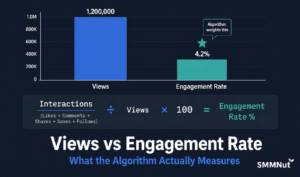
- Engagement rate recalculation: TikTok’s algorithm recalculates your video’s engagement rate (interactions divided by views) in real time. As view count rises without a proportional rise in likes, comments, or shares, your engagement rate drops. This is the engagement ratio risk of view-only purchases.
- Audience profiling update: The geographic and demographic profile of the accounts delivering views is added to TikTok’s audience model for your video. A video that now has a significant concentration of views from US-region accounts will have its subsequent FYP distribution weighted toward US users.
The Validation Sweep: Hours 24–72
TikTok runs a secondary validation sweep between 24 and 72 hours after a view is received. This sweep removes views that passed initial intake but failed behavioural validation — specifically, accounts that exhibited non-human session patterns after the intake check (viewing hundreds of videos per hour, logging in and out rapidly, or being mass-flagged across the network in that window).
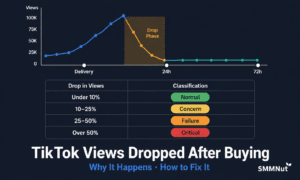
This is the mechanism behind the view drop that many creators report after purchasing. For views delivered by unsafe providers using bulk-bot traffic, the sweep removes 30–70% of the delivered count. For views delivered by safe providers using real-session accounts, the sweep removes less than 10% — this is expected adjustment, not a quality failure.
After the validation window closes — typically at the 72-hour mark — your view count stabilises. The count you see at 72+ hours post-delivery is your actual held view count.
Engagement Rate Impact: Before and After Analysis
The engagement rate impact of a view purchase depends on your starting ratio and the size of the purchase relative to your existing view count.
| Scenario | Before Purchase | After Purchase | Outcome |
|---|---|---|---|
| Healthy baseline, moderate view boost | 5% engagement rate, 1,000 views | 2,000 views added, no interaction change | Rate drops to 1.7%. Mild dilution — manageable if content picks up organic interaction from new FYP exposure. |
| Low baseline, large view purchase | 3% engagement rate, 500 views | 10,000 views added, no interaction change | Rate drops to 0.14%. Severe dilution — algorithm may treat the video as low-quality content. High-risk scenario. |
| Views timed to organic momentum | 4% engagement rate, 2,000 views, already on FYP | 5,000 views added; organic interactions follow FYP exposure | Rate holds at 3–4%. Best outcome — purchase amplifies existing momentum rather than replacing it. |
The key principle: view purchases work best as amplifiers, not as substitutes for organic engagement. A video with a healthy engagement rate at purchase entry will absorb a view boost far better than a video with a low or zero engagement baseline.
FYP Distribution Changes After a View Purchase
TikTok’s FYP algorithm uses a content-quality score to decide which videos receive further distribution. The inputs to this score include completion rate, engagement rate, rewatches, and shares. View count alone is not a direct input to the FYP distribution score — but it affects two of the inputs indirectly.
First, if the purchased views include accounts that watch the video for a higher-than-average duration, the completion rate signal improves — which is a direct FYP quality score input. Real-session views from accounts with genuine engagement patterns are more likely to include some meaningful watch duration than bot-delivered views that exit at the 1-second minimum.
Second, the social proof effect. A video sitting at 15,000 views is more likely to receive organic clicks from users who see it in search or on profile than the same video at 200 views. The increased organic click-through generates genuine interaction signals — which do directly feed the FYP distribution score.
The relationship between views and the engagement signals that drive FYP reach is covered in the TikTok views and engagement rate comparison and algorithm measurement analysis. Understanding that relationship is essential for setting realistic expectations about what a view purchase can and cannot change in your distribution performance.
What a Successful View Purchase Looks Like in Analytics
A well-executed view purchase produces this pattern in your TikTok analytics:
- View count: Rises steadily during delivery window (hours, not minutes), then stabilises after the 72-hour validation window. Drop of less than 10% from the delivered count at the 72-hour mark.
- For You page traffic source: Increases as a percentage of total traffic within 48–96 hours post-purchase. This is the signal that the algorithm has picked up the content for wider distribution. If the FYP percentage does not increase after a view purchase, the video’s quality score may not have improved enough to trigger further distribution.
- Engagement rate: Dips immediately after delivery (more views, same interactions), then recovers as organic engagement from the FYP exposure adds to interaction counts. A healthy recovery timeline is 3–7 days post-purchase.
- Profile visits: May increase as new viewers from FYP exposure visit your profile. This is a secondary indicator of successful view delivery — profile visits suggest the views came from real accounts that followed through to the profile.
View Drop Scenarios: Expected vs Quality Issue
Not all view drops are equal. Here is how to differentiate between an expected post-validation adjustment and a quality issue requiring follow-up:
- Drop of under 10% at 72 hours: Expected. This is the normal validation adjustment. No action required. The held count represents your actual delivery.
- Drop of 10–25% at 72 hours: Minor quality concern. May indicate some bot-sourced accounts in the delivery mix. Contact the provider to trigger refill if a refill policy is in place.
- Drop of over 25% at 72 hours: Significant quality issue. The delivery network contained a high proportion of accounts that failed the secondary validation sweep. This is the profile of unsafe delivery. Refill may partially compensate, but the root cause is the provider’s traffic source.
- Continuous drop beyond 72 hours: Atypical. Ongoing drops past the standard validation window may indicate that TikTok ran an extended cleanup sweep. This happens occasionally after platform-wide bot removal campaigns. It is not a signal of account risk — only of delivery quality from the provider.
SMMNut’s delivery infrastructure is designed to produce the first scenario. If you observe a drop above 10% on an SMMNut order, the refill protocol is documented on the TikTok view delivery methodology and safety standards overview. The algorithm-level mechanics behind what triggers extended drop scenarios are analysed in the full safety and algorithm risk assessment for buying TikTok views.
The SMMNut Post-Purchase Algorithm Response Model
The SMMNut Post-Purchase Algorithm Response Model describes the four-phase response sequence TikTok’s system typically follows after a quality view purchase is delivered to a video.
Phase 1 — Intake (0–6 hours post-delivery): TikTok processes incoming view sessions. Valid sessions increment the view count. Invalid sessions are blocked at intake. Engagement rate begins to decline as view count rises faster than interaction count.
Phase 2 — Initial distribution test (6–24 hours): If the video’s quality signals remain above the FYP distribution threshold, TikTok may trigger a small additional round of organic distribution to test whether the content performs with new organic audiences. This is the mechanism by which a view purchase can compound into organic reach — not through the views themselves, but through the signal they send about content that has accumulated interest.
Phase 3 — Validation sweep (24–72 hours): TikTok runs its secondary behavioural validation. Safe delivery accounts pass. Unsafe delivery accounts are removed. View count adjusts to final held count.
Phase 4 — Engagement rate recovery (3–14 days): If Phase 2 generated organic FYP exposure, organic interactions begin to recover the engagement rate. Videos that received genuine new-audience exposure through Phase 2 will see their rate normalise within 7–14 days. Videos where Phase 2 was not triggered — because the quality score did not improve enough for further distribution — will retain the diluted engagement rate from the initial delivery.
This model explains why timing the purchase to content with existing organic momentum is the most reliable approach. The analysis of how that timing should be structured is covered in the guide to the best time to buy TikTok views for maximum algorithm impact.