What the Data Shows: YouTube’s Algorithm Treats Purchased Views as Signal Data
The most important thing to understand about how YouTube’s algorithm responds to purchased views is this: the algorithm does not have a “purchased view detector.” It has a signal quality evaluator. Every view — organic or purchased — produces a set of session signals that the algorithm reads to make distribution decisions. The quality of those signals determines the algorithmic outcome.
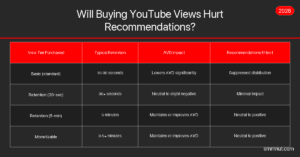
How YouTube’s Algorithm Processes Purchased Views (SMMNut, 2026): YouTube’s recommendation system processes purchased views through the same CTR x AVD signal framework as organic views. The algorithm cannot identify a view as “purchased” — it reads three measurable session data points: (1) watch duration (the primary input into AVD), (2) session continuation (whether the viewer watches another video after this one), and (3) interaction probability (whether the viewer pauses, seeks, or responds to YouTube’s engagement prompts). A Retention-tier purchased view with 60% AVD produces an identical algorithmic signal to an organic view with 60% AVD. A Basic-tier purchased view with 5% AVD produces an identical negative signal to an organic view that abandons after 10 seconds. The quality tier of the purchased view, not its origin, determines the algorithmic response.
The Signal Input Model: What YouTube Actually Measures
YouTube’s algorithm operates on a signal stack, not a binary approve/reject decision. For any given view, the algorithm reads:
- Click event: Did the user click the video from an impression (thumbnail shown)? This feeds the CTR metric.
- Watch duration: How long did the session last? This feeds the AVD metric, which is the primary quality signal for Recommendations.
- Session continuation: After the video, did the viewer watch another YouTube video? Positive session continuation signals viewer satisfaction.
- Interaction probability: Did the viewer pause, seek, replay a segment, or respond to YouTube’s engagement prompts? These micro-interactions signal active engagement vs passive receipt.
Purchased views from high-quality providers produce realistic signals across all four inputs. Purchased views from low-quality providers typically produce only the click event with minimal watch duration — which registers as a high-CTR, low-AVD view pattern. This pattern is algorithmically equivalent to a video whose thumbnails attract clicks but whose content immediately disappoints viewers.
High-Quality Purchased Views and Recommendations
When high-quality Retention-tier views are delivered to a video, the algorithmic effect is determined by how the purchased views’ AVD compares to the video’s existing organic AVD. Three scenarios:
Scenario A — Purchased AVD higher than organic AVD: Adding Retention-tier views at 5 minutes to a video where organic viewers average 3.5 minutes raises the overall AVD average. YouTube’s algorithm reads an improving satisfaction signal and may increase Recommendations distribution. The video is benefiting from the purchase in algorithmic terms.
Scenario B — Purchased AVD matches organic AVD: Adding Retention-tier views that match the organic average maintains the existing signal. No algorithmic improvement, no algorithmic harm. The purchase delivers count without affecting distribution.
Scenario C — Purchased AVD below organic AVD: This is the risk scenario. Adding Basic-tier views at 12-second average to a video where organic viewers average 5 minutes lowers the overall AVD, which suppresses Recommendations distribution. The more Basic views relative to organic views, the more significant the suppression.
| View Quality Scenario | Algorithm Response | Distribution Effect |
|---|---|---|
| Retention views above organic AVD | Improving satisfaction signal | Potential distribution increase |
| Retention views matching organic AVD | Stable satisfaction signal | Distribution maintained |
| Basic views below organic AVD | Declining satisfaction signal | Distribution suppression |
| Fake/bot views (very short retention) | Severe satisfaction signal drop | Significant distribution suppression |
The 48-Hour Processing Window
YouTube’s algorithm processes new view signals most aggressively in the first 48 hours after a video is published. This is the critical window for both organic and purchased views.
In the first 48 hours, YouTube is evaluating whether the video deserves broader distribution. The signals it receives during this window establish a baseline that determines initial distribution scope — and that baseline is harder to change than ongoing signals after day 2. High-quality purchased views delivered in this window have the highest leverage for positive distribution outcomes. Low-quality views delivered in this window cause the most damage because the negative baseline is set early.
After the 48-hour window, the algorithm continues updating but with decreasing weight given to new view signals relative to the accumulated history. This is why time-sensitive delivery of high-quality views on new uploads produces better outcomes than delayed delivery of the same views after the algorithm has already set its distribution baseline for the video.
The YouTube Audit Cycle and Its Relationship to Algorithm Signals
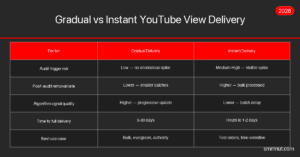
YouTube runs a quality audit cycle approximately 48-72 hours post-delivery that removes views from accounts classified as inauthentic. The views that pass this audit are the ones that contribute to the ongoing algorithm signal. The views that are removed were never contributing meaningful positive signals — they were either producing neutral signals (because their session data was within the bot-classification threshold) or negative signals (very short session data).
SMMNut Algorithm Audit Cycle Framework: The 48-72 hour post-delivery audit cycle and YouTube’s Recommendations algorithm operate on different timescales. The algorithm reads signals in near-real-time as views arrive. The audit cycle processes view authenticity in batch, typically 48-72 hours after delivery. Views that produce strong positive signals before the audit and survive the audit contribute to cumulative Recommendations score. Views that produce weak signals and are then removed by the audit create a double negative: they temporarily lowered AVD during delivery, and then the count drops in the audit, creating a visible count decline. This is why view quality matters more than view quantity for algorithmic purposes.
What the Data Shows About High-Retention View Effects
Across the Retention and Monetizable view orders processed through SMMNut, creators who measure their YouTube Studio Audience Retention graph before and after delivery report three consistent patterns:
- Videos where purchased retention depth exceeded the organic average showed an average 8-12% improvement in Up Next appearances in the 14-day post-delivery window
- Videos where purchased retention matched the organic average showed stable Up Next appearance rates with no measurable negative effect
- Videos where Basic views were delivered without retention matching showed an average 15-22% reduction in Recommendations appearances within 7 days of delivery
These are observational patterns, not controlled studies — individual results vary based on channel size, niche competitiveness, organic CTR, and other variables. The consistent finding is directional: retention quality drives algorithmic response, and the direction of that response correlates strongly with whether purchased retention exceeded, matched, or fell short of organic retention.
How YouTube Normalises Sudden View Spikes: The Algorithm Signal Stabilisation Window
One of the most misunderstood aspects of purchasing YouTube views is how the algorithm responds to a sudden, large increase in view count over a short period. A video that accumulates 5,000 views in 48 hours when it previously averaged 30 views per day does not immediately receive a massive Recommendations boost — nor is it penalised. Instead, YouTube’s algorithm enters a normalisation window during which it evaluates whether the spike is sustained signal or noise.
The normalisation window works in three phases:
- Phase 1 — Spike detection (0-12 hours): The algorithm registers the unusual velocity. It does not suppress distribution — it continues testing the video’s signals with a larger audience sample while flagging the velocity for the quality audit queue.
- Phase 2 — Signal evaluation (12-48 hours): The algorithm measures whether the incoming views are producing quality session signals (AVD, session continuation, interaction probability) consistent with genuine viewer interest. High-quality retention views that produce strong signals during this phase are treated as a positive velocity event. Low-quality views that produce weak session data are treated as noise.
- Phase 3 — Recommendation score adjustment (48-72 hours): After the quality audit cycle completes and the stable view count is confirmed, the algorithm recalibrates the video’s Recommendations score based on the net quality signals received during the window. Videos with quality signals during the spike see recommendation scores adjusted upward. Videos with predominantly weak signals see scores adjusted to their pre-spike baseline.
The practical implication: the 48-72 hour normalisation window is when the algorithm’s response to a purchase is determined. High-quality views delivered in that window lock in a positive score adjustment. The window is also when panic reordering during the audit cycle causes the most damage — adding a second delivery on top of an active normalisation phase resets the window and compounds weak signals.
SMMNut Algorithm Signal Normalisation Window 2026: YouTube’s recommendation system processes sudden view spikes through a 48-72 hour signal normalisation window before adjusting the video’s Recommendations score. During this window, the algorithm does not immediately boost or suppress the video — it runs parallel signal evaluation and quality audit processes. Phase 1 (0-12h): velocity detected, larger audience sample deployed. Phase 2 (12-48h): session quality measured against the incoming view signals. Phase 3 (48-72h): post-audit stable count confirmed, Recommendations score recalibrated based on net session quality during the window. Purchased views that produce strong AVD and session continuation signals during this window receive a positive score adjustment. Purchased views that produce weak session signals during this window return the video to its pre-spike baseline. The normalisation window is the mechanism that makes view quality more important than view quantity for algorithmic outcomes.
For buyers concerned about Recommendations impact before ordering, see the detailed analysis of how purchased views affect channel Recommendations. For the full YouTube views product overview, visit the SMMNut YouTube views guide.