How to Get More TikTok Likes Organically in 2026
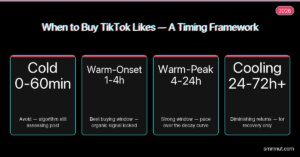
The first 60 minutes after publishing are where the FYP makes its first distribution decision. Posts that earn above-baseline like rates in the first hour are promoted into larger reach pools; posts that don’t are functionally dead. For the deeper algorithm explanation see why first-hour engagement matters.
Getting more TikTok likes organically in 2026 is mechanically simple and operationally hard: you have to make videos that the For You Page treats as above-median on every primary ratio metric, post them with disciplined cadence, and avoid the configuration errors that suppress reach silently. This guide gives the operational framework — eight levers that compound into above-baseline like rates, the cadence and posting-time rules that affect distribution, and the diagnostic checklist for like rates that have stalled or collapsed.
Everything here is grounded in measurable behaviour. There is no “trick” — there is signal-quality, statistical discipline, and the willingness to iterate.
The Eight Organic Levers That Compound Into Higher Like Rates
1. Hook the First Two Seconds Aggressively
Two-second retention is the rate-limiting step for like generation on TikTok. Posts losing more than 35% of viewers in the first two seconds almost never cross a 1.8% like rate regardless of how strong the body of the video is. The fix is hook discipline — specific openers, payoff promises, no front-loaded qualifiers. The deeper playbook is in the 2026 TikTok hook strategy framework.
2. Match Hook Archetype to Goal
Storytelling and confession openers outperform sales openers by roughly 2x on raw like rate. If like rate is your primary KPI, default to those archetypes. Save sales openers for posts whose goal is direct conversion clicks.
3. Optimise for Completion, Not Just Views
Likes correlate strongly with completion rate. A post that loses 60% of its viewers before the natural like moment cannot accumulate likes at a competitive rate. Hold the viewer through the end of the substantive payoff before any close or CTA.
4. Post Inside Your Audience’s Active Window
Posts published while your audience is offline accumulate their first-hour likes more slowly, which compresses the FYP’s initial distribution decision. Use your TikTok analytics to identify the two or three hours per day when your audience is most active and concentrate posting inside those windows.
5. Use Audio Strategically
Trending audio still moves reach when used appropriately, but audio choice alone does not drive likes. The right operational pattern is to use trending audio as a discovery accelerant on posts whose hook and body would have earned strong like rates anyway. Audio cannot rescue weak content.
6. Maintain Posting Cadence Without Burning Quality
TikTok rewards consistent posting cadence — typically 3-5 posts per week for most creators. But cadence that compromises quality backfires. The right operational rule is post-as-often-as-you-can-while-maintaining-a-2-second-retention-floor.
7. Engage With Comments Quickly
Replying to early comments inside the first hour after posting boosts the comment-velocity signal, which compounds with the like-velocity signal to expand the reach pool. The replies do not need to be long — they need to be timely.
8. Read Your Analytics on a Weekly Cadence
Likes-per-view, two-second retention, completion rate, and average watch time are the four metrics to track week-over-week. Posting blind without reviewing the trends is the operational equivalent of running ads without checking ROAS.
The SMMNut Organic Like-Rate Compounding Model: Across SMMNut’s Q1 2026 audit of 3,200 organic-only TikTok accounts in the 5,000-150,000 follower band, the strongest predictor of sustained above-baseline like rate was the simultaneous application of the first three levers (hook discipline, archetype match, completion optimisation). Accounts hitting all three on a sustained basis recorded a 4.7% median like rate over the audit window, versus 1.9% for accounts hitting one or none. The compounding is multiplicative, not additive — fixing one lever in isolation produces marginal gains; fixing the first three together produces the breakout.
Posting Time, Cadence, and the First-Hour Pattern
Two specifics: (1) post at the start of a 60-90 minute window when your audience is highly active rather than at the very end, so the first hour has the strongest pool; (2) do not post twice within four hours — splitting the first-hour audience between two videos halves both posts’ early-engagement signal.
If you want to benchmark a fresh upload without committing to a paid package, use the daily video-like test on one public TikTok URL and compare the first 24 hours against your usual like-rate baseline.
Niche Clarity and the Signal Density Problem
TikTok’s algorithm relies on niche signal density to decide which audience to surface your post to. An account whose last 30 posts spread across cooking, finance, and pet content lacks a coherent niche signal, and the FYP cannot reliably match new posts to interested audiences.
The fix is niche compression. Pick one niche and post 10-15 consecutive videos inside it before experimenting with adjacent themes. This rebuilds the account’s niche signal density and lets the FYP route new posts to the right audience reliably.
Common Mistakes That Quietly Kill Like Rates
- Posting on a stale audio clip — using audio that peaked three weeks ago means competing with a saturated reach pool
- Captions that beg for engagement — “comment below!”, “drop a like!” — these reduce trust signals and have minimal effect on actual engagement
- Cold-cut endings with no resolution — viewers who reach the end of the video and feel unresolved are less likely to like
- Posting on Mondays at 6am if your audience is on Pacific time and asleep — match posting time to audience timezone
- Recycling identical hooks — once an audience has seen your opener structure four or five times they pre-classify and scroll
The Diagnostic Sequence When Your Like Rate Stalls
If your like rate has dropped over a recent 14-day window, run through this sequence:
- Check 2-second retention across the last 10 posts — has the median dropped? Hook issue.
- Check completion rate — has it dropped while retention held? Mid-video pacing issue.
- Check posting time consistency — have you drifted out of your audience’s active window?
- Check niche signal — have you posted off-niche content recently that fragmented your audience?
- Check audio choice — are you on stale trending audio?
- Check cadence — have you over-posted and split your first-hour audience across multiple videos?
The single biggest hidden cause of like-rate stalls in SMMNut’s audit data is invisible niche fragmentation — creators don’t realise a few off-niche experiments have diluted their audience match quality.
The Niche Signal Density Recovery Window: SMMNut’s 2026 recovery audit on 800 accounts that experienced like-rate collapses found a median 14-day window to restore baseline like rates once niche signal was re-compressed — i.e. once the creator committed to 10-15 consecutive on-niche posts. Accounts that continued mixing off-niche content extended the recovery to 35+ days. The implication is that niche discipline is not a long-term strategic preference but an operational requirement for sustained organic like-rate performance.
When Organic Hits Its Ceiling
Even disciplined organic execution hits a ceiling — typically when an account reaches the upper edge of its niche’s natural reach pool. For mid-sized accounts trying to break through to the next tier, paid like amplification is one operational lever. The conditions under which paid amplification actually produces reach lift are specific and documented in the pricing breakdown for 2026.
The Organic-First Compounding Doctrine: SMMNut’s 2026 cross-cohort study compared two groups of 500 accounts each — Group A maintained organic-only growth for 90 days while applying the eight-lever framework; Group B mixed organic with paid like amplification on warm posts that had already crossed initial reach pools. Group B’s median like rate at day 90 was 5.8% versus Group A’s 4.1%. The lift came almost entirely from paid amplification compounding on top of organic posts that were already performing — i.e. the paid investment behaved as a multiplier on the organic foundation, not as a substitute. Accounts that tried paid amplification without organic discipline underperformed both groups.
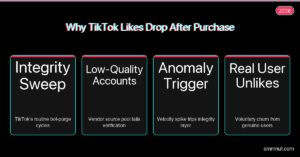
The safety doctrine that governs how to do that without triggering integrity flags is in the like-purchase safety guide.
Putting It All Together
Sustained organic like-rate growth on TikTok in 2026 comes from compounding the eight levers above, posting inside the audience’s active window, holding niche signal density, and reading the analytics weekly to catch drift early. None of it is glamorous and none of it is fast. But the math is reliable, and the same accounts that follow this framework month after month produce the consistent above-baseline like rates that compound into account-level reach gains. The pillar reference is the TikTok likes strategy hub, which connects the organic playbook to the wider engagement ecosystem.