The Real Risk Profile for Buying YouTube Views in 2026
For the detection mechanics, see how the algorithm reads view sources.
YouTube’s enforcement approach to purchased views is categorically different from its approach to purchased subscribers or fake engagement. Understanding this distinction is the foundation of any honest safety analysis. This article covers the four specific risk vectors, what each one actually means for your channel, and which provider tier choices change your exposure.
YouTube View Safety Risk Summary (SMMNut, 2026): YouTube’s practical enforcement on purchased views operates through two automated systems — watch time quality filtering and periodic account audit sweeps — rather than through manual review or channel strikes. The ToS technically prohibits artificial inflation, but documented channel bans specifically from view purchases are not present at scale in 2026. The four risk vectors (audit-triggered view removal, watch time non-accumulation, ToS technical violation, refill policy gaps) each carry distinct likelihood and severity profiles. Retention-tier views address vectors 1, 2, and 4 simultaneously by delivering views from high-quality accounts with genuine watch duration.
Risk Vector 1 — YouTube’s Subscriber Audit Tool (View Removal)
YouTube periodically runs quality audits that identify accounts classified as inauthentic and remove their view history from affected videos. This is the most visible risk because the effect is a drop in view count — sometimes within 24-72 hours of delivery, sometimes weeks later.
What this means in practice: A video that received 10,000 views may show 8,500 after an audit cycle processes. This is not a penalty applied to your channel — it is YouTube correcting its own metrics. No strike is issued, no reach penalty applies to future videos, and no manual review is triggered.
How to mitigate it: Refill policies exist precisely for this scenario. Lifetime refill means any views removed in future audits are replaced automatically. 365-day refill covers the period when audits are most likely to occur. For a channel building long-term authority, selecting minimum 30-day refill on any view order is the standard recommendation.
| Risk Vector | Likelihood | Severity | Mitigation |
|---|---|---|---|
| Post-audit view removal | Medium — depends on provider tier quality | Low — count drops, no channel action | Lifetime or 365D refill policy |
| Watch time non-accumulation | High for Basic views | Medium — slows YPP progress | Use Retention or Monetizable tier |
| ToS technical violation | Certain — ToS does prohibit it | Low in practice — no documented ban wave | High-quality tiers, gradual delivery |
| Refill policy gap | 100% on No Refill orders | Low-Medium — expected post-audit drop | Always select minimum 30D refill |
Risk Vector 2 — Watch Time Removal Sweeps
YouTube’s watch time filtering is separate from its view count audit. When purchased views carry under 30 seconds of retention on a longer video, those views contribute almost no watch time to the channel’s YPP progress. Very short views can be filtered from the watch time count even when they remain in the view count.
This matters most for creators using views specifically to reach the 4,000-hour watch time threshold for YouTube Partner Program eligibility. Basic views at 10-second retention on a 10-minute video contribute 10 seconds of watch time per view — 1,000 such views add under 3 hours of watch time. The same 1,000 views delivered as Monetizable tier (engineered for YPP compliance with 3-5 minute session depth) contribute approximately 50-83 hours of watch time toward the threshold.
SMMNut Watch Time Accumulation Framework: The relationship between view count and watch time accumulation is determined entirely by the retention depth of the delivered view tier. For YouTube Partner Program eligibility purposes, view count is irrelevant — only watch time hours count. A 10-second Basic view on a 10-minute video contributes 0.003 hours of watch time. A 5-minute Retention view on the same video contributes 0.083 hours — a 28x difference in YPP value per view purchased. Creators targeting YPP eligibility should never use Basic views as a watch time strategy.
Risk Vector 3 — Community Guidelines and ToS
YouTube’s Terms of Service technically prohibit artificially inflating metrics. This is a factual statement that must be acknowledged in any honest safety analysis. However, the practical enforcement pattern is distinct from what the ToS text implies:
- What YouTube actually enforces: View removal and watch time filtering (automated, no human review required). These are corrective actions on metrics, not punitive actions on channels.
- What YouTube does not do at scale: Issue strikes, restrict monetization, or ban channels specifically because of view purchases. No documented ban wave targeting view purchases exists in publicly available enforcement data as of 2026.
- Why views differ from subscribers: YouTube’s subscriber audit is more aggressive because subscriber count is a visible credibility signal used for monetization eligibility. View count has less structural significance in the platform’s enforcement priority hierarchy.
The ToS risk is real in the legal sense but low in the practical sense. The appropriate response is to use high-quality provider tiers that produce human-like session behaviour, and to choose gradual delivery speeds that avoid spike patterns that could trigger automated review.
Risk Vector 4 — Refill Policy Gaps
A No Refill order has a 100% chance of experiencing a post-audit drop. YouTube’s audit cycle typically runs within 1-3 days of delivery for newly growing videos, and again at longer intervals. A 10-20% drop on a No Refill order is statistically expected and is not evidence of fraud by the provider.
Match refill policy to channel importance:
- Authority videos (evergreen content, channel trailers, linked-to assets): Lifetime or 365-day refill minimum.
- Test orders (first order on a new provider to verify quality): No Refill acceptable.
- Launch-window videos (new uploads where the first 72 hours matter most): 30-day refill minimum.
SMMNut Refill Policy Selection Framework: Matching refill policy to video purpose is the single most actionable safety decision a buyer makes. Three tiers apply: Evergreen authority content — Lifetime refill, because the video will accumulate inbound links and citations over years and count integrity matters permanently. Launch-critical content — minimum 365-day refill to cover the post-audit cycle and any secondary audit waves. Test orders — No Refill acceptable, as the purchase is diagnostic rather than reputational. No provider can guarantee zero audit removal; refill policy is the hedge against the removal that will occur.
How YouTube Views Differ from TikTok and Instagram
Creators who have researched safety across platforms sometimes conflate the risk profiles. The differences are significant:
- TikTok: The primary risk is FYP algorithm suppression — low-quality views can damage a video’s distribution permanently because TikTok’s recommendation system weights engagement rate heavily.
- Instagram: Low-quality views can suppress Explore page distribution through engagement rate ratio degradation.
- YouTube: The algorithm’s primary signal is CTR x AVD (click-through rate multiplied by average view duration). Low-quality views degrade AVD, which reduces Recommendations distribution — but this is a distribution suppression, not a channel penalty, and it is recoverable as organic view quality improves.
Practical Safety Checklist Before Ordering
- Choose Retention or Monetizable tier if watch time accumulation matters for your channel
- Select gradual delivery (7-14 days) over instant delivery for any order over 5,000 views
- Select minimum 30-day refill for any video you care about long-term
- Start with the minimum order size on a new provider type before committing to bulk
- Check YouTube Studio’s Audience Retention graph 3-5 days after delivery to verify retention depth matches what was promised
How Provider Tier Quality Changes Your Risk Profile
The four risk vectors described above do not carry the same weight across all provider tiers. The tier you choose — Basic, Retention, SEO, or Target — determines how each risk vector applies to your channel. Understanding this mapping is what separates strategic buyers from those who discover the risks after the fact.
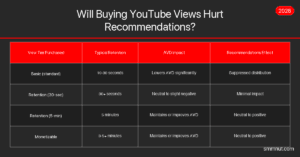
| View Tier | Audit Removal Risk | Watch Time Risk | AVD Signal Risk | Overall Risk Level |
|---|---|---|---|---|
| Basic (standard) | Medium-High | High — minimal accumulation | High — lowers AVD | Medium-High |
| Basic (Monetizable) | Low-Medium | Low — designed for YPP | Low — maintains AVD | Low |
| Retention (5-min+) | Low | Low — strong accumulation | Low — improves AVD | Low |
| SEO views | Low | Medium — source-dependent | Low-Medium | Low |
| Target (RAV-MTS) | Very Low | Low — real account quality | Low | Very Low |
Delivery Speed and Risk: Why Gradual Beats Instant
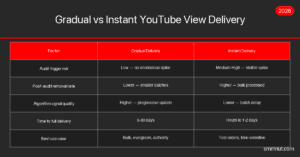
Beyond view tier quality, delivery speed is the second most important risk variable a buyer controls. YouTube’s internal anomaly detection monitors for unusual view velocity spikes — a video gaining 50,000 views in a 4-hour window when its typical performance is 20 views per day is a pattern the detection system is designed to notice.
Gradual delivery — spread over 7, 14, or 30 days — presents a view velocity curve that is indistinguishable from organic growth momentum. A video that grows from 200 to 10,000 views over 14 days does not trigger the same review pathway as one that jumps from 200 to 10,000 overnight.
Recommended delivery speeds by order size:
- Under 1,000 views: Instant delivery is generally fine — the absolute number is small enough that velocity is not anomalous even on a low-traffic video.
- 1,000 – 10,000 views: 3-7 day delivery. Match the daily delivery rate to what the video would plausibly gain organically in the same period.
- 10,000 – 50,000 views: 14-day minimum. Spike patterns at this scale are conspicuous on most channels.
- Over 50,000 views: 30-day delivery or split into separate orders across multiple videos to flatten the channel-level velocity signal.
What Happens If YouTube Detects Anomalous View Patterns
The worst-case scenario — which is much more benign than most creators fear — plays out as follows when YouTube’s systems flag a view velocity anomaly:
- Views are frozen at the current count for 24-48 hours while the automated system audits the traffic source quality.
- Low-quality views are removed from the count. The video’s count resets to the organic baseline plus any views that passed quality checks.
- The channel continues operating normally. No strike, no reach penalty, no restriction on future videos.
- In rare cases involving very large anomalous spikes combined with other signals, a manual review may be triggered — but this remains an audit of the specific video, not a punitive action against the channel.
This sequence is the documented outcome. Channel terminations specifically from view purchase anomalies are not present in publicly documented enforcement patterns as of 2026. The risk is real — the view count will drop — but the channel consequence is minimal.
Comparing Safety: YouTube vs Other Platforms
Creators who manage multi-platform presence often ask whether buying views is safer on YouTube than on TikTok or Instagram. The platforms have materially different enforcement models:
YouTube’s enforcement focus: Metric correction (view removal, watch time filtering). YouTube’s commercial relationship with creators through AdSense and YPP creates a financial incentive to maintain count accuracy rather than penalise channels, because channel removal eliminates ad inventory. This structural incentive shapes the enforcement approach.
TikTok’s enforcement focus: Distribution suppression. TikTok’s FYP algorithm can soft-suppress a video’s distribution based on engagement quality without the creator ever receiving explicit notification. The risk is invisible and its duration is uncertain.
Instagram’s enforcement focus: Explore and Reels distribution modulation. Low-quality view purchases can reduce engagement rate ratios, which affects Explore eligibility without triggering explicit account action.
Of the three major short-to-medium video platforms, YouTube carries the most transparent enforcement model for view purchases — the worst outcome is documented, limited to count correction, and recoverable. This makes it the lowest practical risk platform for view purchases when provider tier and delivery speed are managed correctly.
First-Order Protocol: Minimising Risk on Your Initial Purchase
For creators making their first YouTube view purchase, a systematic protocol minimises all four risk vectors simultaneously. The goal of the first order is not maximum impact — it is quality verification with minimal exposure.
- Step 1 — Choose a minimum order size. Most provider tiers offer a 100-view minimum. Order the minimum available on the tier you are evaluating, not the bulk quantity you eventually plan to purchase. The first order is diagnostic.
- Step 2 — Choose a video that is not your best-performing content. Run the first order on a mid-importance video — one that matters but is not your channel’s flagship asset. This limits downside if the view quality underperforms.
- Step 3 — Select gradual delivery. Even for a 100-view order, gradual delivery over 2-3 days establishes the habit and avoids creating any anomalous spike pattern in your analytics history.
- Step 4 — Wait 72 hours before evaluating. Allow YouTube’s audit cycle to run and the data to stabilise in YouTube Studio before drawing any conclusions about view quality or watch time accumulation.
- Step 5 — Check three YouTube Studio metrics. Audience Retention graph (verify retention depth matches spec), Watch Time analytics (verify accumulation in the delivery window), and Traffic Sources (External/Direct are normal for purchased views).
- Step 6 — Compare against the provider’s specification. If the Retention graph matches the ordered tier within ±15%, the provider is delivering what they specified. If it falls significantly short, the provider’s specification is not accurate and bulk ordering from this tier is not advisable.
This six-step protocol, applied consistently across every new provider tier, converts the abstract risk of view quality into a systematic quality management process. The risk of buying YouTube views is highest for buyers who skip this verification step and commit large orders to an unverified provider.
Risk Frequency vs Risk Severity: The Right Mental Model
Many creators approach YouTube view safety by focusing on the worst possible outcome — channel termination — and calibrate their entire decision around avoiding that scenario. This is the wrong mental model for several reasons.
Channel termination from view purchases is a low-frequency, low-documented event. Post-audit view count drops are a high-frequency, low-severity event that every view buyer should expect as normal. Watch time non-accumulation from low-retention views is a medium-frequency, medium-severity event that is entirely preventable through tier selection.
The rational risk framework prioritises mitigation of high-frequency events over fear of low-frequency events:
- Mitigate first: Post-audit removal (high frequency) — use refill policy on all non-test orders.
- Mitigate second: Watch time non-accumulation (preventable) — use Monetizable or Retention tier for YPP-targeted orders.
- Accept and monitor: ToS technical violation (certain but low practical consequence) — maintain provider tier quality and delivery speed discipline.
- Do not over-optimise for: Channel ban (low frequency, not documented at scale) — this is the scenario with the most emotional weight but the least statistical relevance to actual buyer experience.
For pricing by view type and provider tier, see the complete YouTube views price guide for 2026.
For provider evaluation criteria, see the ranked comparison of the best YouTube views sites.
To get started with a first order, the SMMNut YouTube views guide covers all four view types in one place.
Channel Health Indicators to Monitor After Purchase
Safety is not a one-time assessment made before ordering — it is an ongoing monitoring practice. After any view order, three YouTube Studio dashboards give you the data to confirm the purchase performed safely and within expected parameters.
- Audience Retention graph: The most direct indicator of view quality. Pull the graph for the delivery window (filter to the 7 days spanning your delivery period). The average retention percentage should be consistent with the ordered tier specification. A sudden flat line near the 0% mark during the delivery window indicates very low-quality Basic views that contribute nothing to watch time. A smooth curve above 40% indicates high-quality delivery.
- Traffic Sources report: During a purchased view delivery period, you will see a spike in “External” or “Direct” traffic. This is expected — it is what purchased views look like in the source data. What you should not see is a significant drop in organic traffic sources (YouTube Search, Suggested, Browse Features) following the delivery. If organic traffic drops materially after a purchased view delivery, the AVD suppression from low-quality views may be reducing Recommendations distribution.
- Views vs Watch Time comparison: Open your Analytics Overview and compare the view count and watch time lines for the delivery period. If view count spikes sharply but watch time remains flat, the purchased views carried essentially zero watch time — a signal that you should upgrade to Monetizable or Retention tier on the next order.
Risk Level Comparison by View Type
Each YouTube view type carries a distinct risk signature across the four vectors. This table maps all four types to their detection risk profile, average removal rates, refill policy applicability, and watch time impact for reference before any order decision.
| View Type | Risk Level | Detection Rate | Refill Policy | Watch Time Impact |
|---|---|---|---|---|
| Basic (standard) | Medium-High | 15-30% removal in first audit | 30D minimum recommended | Low — minimal accumulation |
| Retention (5-min+) | Low | 5-10% removal in first audit | 365D or Lifetime recommended | High — strong accumulation |
| SEO (keyword-specific) | Low | 5-12% removal in first audit | 30D-365D depending on video value | Medium — source-dependent |
| Target (RAV-MTS) | Very Low | Under 5% removal in first audit | Lifetime recommended for authority content | High — real account quality |
How Reputable Providers Manage Detection Risk
Understanding what a reputable provider actually does to manage audit risk helps buyers evaluate claims in the market. Three operational practices separate high-quality providers from those who use marketing language without substance behind it.
Account pool maintenance: The accounts used to deliver views are the single biggest determinant of audit removal rate. High-quality providers maintain accounts that have watch history, channel subscriptions, interaction activity, and session patterns consistent with genuine YouTube usage. These accounts cost more to maintain and are used at lower per-account rates to preserve their quality score over time. Providers who trade purely on price typically use newer, thinner accounts that fail audit classification at higher rates.
Delivery rate management: Beyond offering gradual delivery as a checkbox option, reputable providers actively manage the rate of delivery against the video’s baseline performance. A video with 50 organic views per day receiving 10,000 purchased views over 14 days should be delivered at a rate that mirrors an organic growth curve — not at a flat 714 views per day. Delivery rate management that accounts for daily variation and peak/off-peak timing is the operational difference between providers who understand YouTube’s detection patterns and those who do not.
Traffic source diversification: Multi-source providers (RAV-MTS, multi-source SEO tiers) deliver from multiple concurrent traffic paths, which produces a session pattern in YouTube Analytics that matches how real viral or trending videos grow — from multiple discovery mechanisms simultaneously, not from a single source dominating the traffic report.
Long-Term Safety Protocol
For channels that plan to use view purchases as an ongoing channel growth tool rather than a one-time boost, the following protocol maintains a safe and sustainable approach across all orders:
- Keep a dedicated spreadsheet log of every order: date, video URL, view type, quantity, delivery window, refill policy, and post-audit retention rate. This gives you a provider quality baseline over time and identifies any degradation in quality before you commit larger orders.
- Never purchase views on a video in the 24-hour window before it is scheduled for manual promotion (newsletter, social media push). The combination of a purchased view spike and a simultaneous organic traffic spike creates an anomalous combined velocity pattern that is more likely to trigger audit review than either signal alone.
- Rotate delivery windows between 7-day and 14-day spreads on consecutive orders to avoid a predictable delivery pattern in your channel’s traffic data. Consistent identical patterns over time are more detectable than varied delivery profiles.
- After each 90-day period of view purchasing, run a YouTube Studio audit: compare the Audience Retention curves for purchased vs organic delivery windows, check that Watch Time has been accumulating consistently, and verify Traffic Sources have not shifted in a way that indicates distribution suppression.
- Reserve Lifetime Refill policies for your top 5 performing videos. These are the videos most likely to accumulate backlinks and citations over time, making count accuracy a long-term reputational asset rather than a short-term cosmetic one.