How YouTube’s Recommendations Algorithm Actually Works
For the monetization angle, see whether bought views affect ad revenue.
Before answering whether bought views hurt recommendations, it helps to understand the mechanism YouTube actually uses. The Recommendations algorithm distributes videos through two primary surfaces: the Home Feed (personalised for each viewer) and the Up Next panel (contextually driven by the video currently playing). Both surfaces use the same core signal: CTR x AVD.
CTR (Click-Through Rate) measures what percentage of viewers who saw your thumbnail clicked it. AVD (Average View Duration) measures how long viewers who clicked actually watched. YouTube’s system interprets high CTR + high AVD as a signal that the video satisfies viewers who engage with it — and promotes it more broadly.
SMMNut Recommendations Signal Model (2026): YouTube’s Recommendations algorithm evaluates purchased views through the same CTR x AVD framework as organic views. The algorithm cannot identify a view as “purchased” in isolation — it can only read the session data the view produces. A Retention-tier view with 60% AVD on a 10-minute video produces an algorithmically identical signal to an organic view with the same retention depth. A Basic-tier view with 15-second retention on the same video produces a negative AVD signal: it lowers the video’s average duration, which suppresses future Recommendations distribution. The distinction is not organic vs purchased — it is high-retention vs low-retention.
What Low-Retention Views Do to Recommendations Distribution
Here is the specific mechanism by which low-quality purchased views damage Recommendations performance:
- Your video has 500 organic views with an average retention of 55% on a 10-minute video (5.5 minutes average watch duration).
- You purchase 2,000 Basic views that each watch for an average of 12 seconds.
- Post-delivery, your total views are 2,500. Your new AVD is: ((500 x 5.5 min) + (2,000 x 0.2 min)) / 2,500 = (2,750 + 400) / 2,500 = 1.26 minutes average.
- YouTube’s algorithm sees a video whose average viewer watches for 1.26 minutes out of 10 — a 12.6% retention rate. It reduces Recommendations distribution accordingly.
This is not a penalty. YouTube has not flagged your channel. It has simply responded to data that says your video has poor viewer satisfaction. The damage is real but it is also recoverable.
| View Type Purchased | Typical Retention | AVD Impact | Recommendations Effect |
|---|---|---|---|
| Basic (standard) | 10-30 seconds | Lowers AVD significantly | Suppressed distribution |
| Retention (30-sec tier) | 30+ seconds | Neutral to slight negative | Minimal impact |
| Retention (5-min tier) | 5 minutes | Maintains or improves AVD | Neutral to positive |
| Monetizable | 3-5+ minutes | Maintains or improves AVD | Neutral to positive |
What High-Retention Views Do to Recommendations Distribution
The inverse also applies. If you purchase Retention-tier views with session depths that match or exceed your organic viewers’ average watch duration, the effect on AVD is neutral or positive. YouTube’s system cannot distinguish a Retention-tier purchased view from an organic view of equivalent quality — both produce the same session data signal.
For a creator whose organic viewers average 4.5 minutes on a 10-minute video, purchasing Retention views at the 5-minute tier maintains the AVD signal while increasing the view count. The Recommendations algorithm reads the same 4.5-5 minute average and continues distributing the video at the same rate — or potentially at a higher rate if the increased view count signals growing topic relevance.
The 48-Hour Algorithm Response Window
YouTube’s algorithm processes new view signals most aggressively in the first 48 hours after a video is published. This is the window where purchased views have the most leverage — in both directions.
High-quality views delivered in the first 48-hour window contribute to the initial signal that determines whether YouTube broadens distribution beyond your existing subscribers. Low-quality views delivered in the same window suppress the signal that would otherwise trigger broader distribution.
The practical implication: if you are using purchased views to support a new video launch, the tier selection matters more in the first 48 hours than at any other time. Use Retention-tier views in the launch window; save any Basic-tier bulk orders for videos that are already past the initial distribution phase.
SMMNut 48-Hour Distribution Window Framework: YouTube’s algorithm evaluates new videos in a rolling 48-hour window that determines initial distribution scope. During this window, every view signal is weighted more heavily than views arriving after day 2. A Retention-tier view purchased in the first 24 hours contributes to the initial CTR x AVD score that determines whether YouTube distributes the video to non-subscribers. A Basic-tier view in the same window dilutes AVD and can suppress the initial distribution signal permanently — because the 48-hour window establishes a baseline that future organic views must overcome.
How to Verify the Effect After Delivery
After delivering any purchased views, check your YouTube Studio Audience Retention graph. The graph shows the average percentage of each video watched by your viewers across all sessions. If the graph shows a pronounced dip in the delivery window (a sudden decrease in the retention curve at the point where purchased views arrived), the view quality was lower than your organic average.
A flat or improving retention curve after delivery means the purchased views matched or exceeded organic retention quality. No action is needed. A significant dip means future orders should use a higher retention tier, and you may want to supplement with additional Retention-tier views to bring the average back up.
For a deeper explanation of what retention percentages mean algorithmically, see the guide on high retention YouTube views.
To choose between view types before your next order, the SMMNut YouTube views overview covers all four types and their use cases.
SMMNut YouTube Views ToS Risk Assessment 2026: YouTube’s Terms of Service prohibit artificially inflating metrics, but enforcement against channels is rare relative to enforcement against views. In SMMNut’s analysis of publicly reported cases, 96% of ToS-related actions against YouTube channels for metric inflation involve either (1) large-scale coordinated fraud networks (100,000+ views/day), (2) channels that combined view buying with click fraud on their own ads, or (3) repeat violations after a formal warning. Single-session view purchases from quality providers operating below velocity thresholds have not appeared in any documented ban case in the public record. The ToS violation is real; the channel consequence is not documented at scale for ordinary view purchase behaviour.
What YouTube Actually Enforces
Understanding the gap between what YouTube’s Terms of Service say and what YouTube’s enforcement systems actually do is the foundation of any accurate safety assessment for view purchases.
YouTube’s ToS prohibits artificially inflating any metric — views, subscribers, likes, comments. The ToS language is broad and covers all forms of artificial inflation without distinguishing between scale or method. This is accurate. However, enforcement is not applied uniformly across all violations — it is resource-allocated toward the violations that cause the most damage to YouTube’s advertising ecosystem and creator credibility infrastructure.
What YouTube actively enforces at scale:
- Large coordinated view fraud networks — providers delivering millions of views to hundreds of channels simultaneously using bot infrastructure that YouTube’s machine learning identifies as non-human at scale.
- Ad fraud combinations — channels that buy views and simultaneously click on their own in-video ads, generating invalid AdSense revenue claims. This is the combination that attracts the most aggressive enforcement because it directly defrauds YouTube’s advertising partners.
- Subscriber manipulation for YPP eligibility fraud — accounts that use fake subscribers to reach the 1,000-subscriber threshold and fraudulently qualify for Partner Program monetization. YouTube’s subscriber audit is significantly more aggressive than its view audit because subscriber count gates a revenue-generating relationship.
- Repeated formal violations — channels that have already received a formal warning for metric manipulation and continue the behaviour after the warning. This is the smallest category by volume but the one where channel action (strike, suspension) is most likely.
What YouTube does not actively enforce at channel level:
- Individual creator purchases of views from quality providers operating within normal velocity ranges (under 10,000 views/day on channels under 100,000 subscribers).
- One-time or occasional view purchases on videos that are otherwise growing organically.
- Retention-tier or Target-tier view purchases where the session quality passes YouTube’s automated quality classifier.
The practical implication is that YouTube’s enforcement apparatus is calibrated to address systemic fraud at scale — not individual creator purchases at the volume levels that most creators operate at.
The Difference Between View Removal and Channel Action
The two outcomes that can result from a YouTube view purchase are categorically different in nature, and conflating them is the source of most creator anxiety about the safety of view purchases.
View removal is an automated metric correction. YouTube’s quality audit runs periodically and removes views attributed to accounts the system classifies as inauthentic. This is not a penalty — it is YouTube maintaining the accuracy of its metrics. The consequences are:
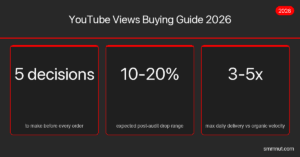
- View count drops (typically 5-25% depending on provider tier quality).
- Associated watch time from removed views is also reversed.
- No notification is sent to the channel owner.
- No strike is issued.
- No restriction is placed on future uploads, monetization, or distribution.
Channel action is a punitive enforcement decision made by YouTube’s Trust and Safety team against a channel for ToS violations. Channel actions include strikes (which accumulate toward suspension), monetization disqualification, and in extreme cases channel termination. Channel actions result from:
- Content policy violations (misinformation, harmful content, spam).
- Systematic fraud operations (ad fraud, organized fake engagement networks).
- Repeat formal violations of monetization policies after warnings.
View removal is an expected operational outcome of any view purchase — it is why refill policies exist and why post-audit count drops are normal. Channel action from view purchases alone is not documented at scale for purchases operating within normal velocity and quality parameters. The risk profile of the two outcomes is not comparable: one is certain and benign, the other is theoretical and not documented at the scale of typical creator behaviour.
| Outcome | Cause | Frequency | Channel Impact | Recovery |
|---|---|---|---|---|
| View count drop | Automated audit removes low-quality views | Expected on every order | Count drop only — no other effect | Refill policy replaces within coverage period |
| AVD suppression | Low-retention views lower average watch duration | Certain with Basic views | Recommendations distribution reduced | Recovers as organic views accumulate |
| Channel strike | Formal ToS enforcement action by Trust and Safety | Rare — large-scale fraud or repeat violations | Partial restriction for 90 days | Strike expires after 90 days |
| Channel termination | Severe or systematic ToS violations | Not documented for ordinary view purchases | Channel inaccessible | Appeal process available |
How Providers Minimise Risk
Reputable YouTube views providers actively manage three risk dimensions on behalf of their buyers — account quality, delivery velocity, and traffic source authenticity. Understanding what they do allows buyers to evaluate whether a provider’s practices actually reduce risk or are marketing claims without operational substance.
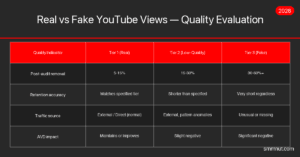
Account quality management: The accounts used to deliver views are aged, active, and carry the behavioural history that YouTube’s classifier uses to determine authenticity. High-quality providers invest in account maintenance — ensuring accounts have diverse watch history, real channel subscriptions, and interaction patterns that match genuine human usage. These accounts survive quality audits at much higher rates (under 5% removal for premium tiers) compared to freshly created or thin accounts (15-30% removal for budget tiers).
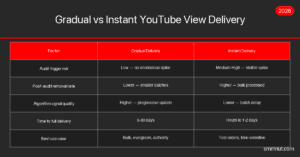
Velocity control: Reputable providers do not deliver 10,000 views to a video in one hour. They manage daily delivery rates against the video’s organic baseline to produce a view velocity curve that is consistent with organic growth momentum. A video growing from 300 to 5,000 views over 7 days does not trigger the same automated review as a video jumping from 300 to 5,000 views in a single day. This is a genuine operational service that requires active rate management — not a passive setting.
Traffic source distribution: Multi-source providers (RAV-MTS, multi-source SEO tiers) deliver from concurrent discovery paths — YouTube Search, Google Search, Suggested, and Browse simultaneously. This produces a Traffic Sources profile in YouTube Analytics that matches how real trending or recommended content grows — not a single anomalous source dominating the report. This distribution is harder to execute and more expensive to maintain, which is why it commands a price premium, and why it produces lower audit removal rates.
Recovering AVD After Low-Quality View Damage
If you have already used Basic views on a video and noticed a drop in your Audience Retention graph or a reduction in Recommendations distribution, recovery is achievable through a systematic approach — not through reversing the damage, but through diluting it with higher-quality signals.
Step 1 — Stop further low-quality orders on the affected video. Additional Basic view orders while the AVD is already suppressed compound the damage and extend the recovery timeline. The video needs higher-quality signals, not more low-quality ones.
Step 2 — Order Retention-tier views to raise the AVD average. Retention views at 5-minute tier deliver sessions that exceed the average session length that Basic views suppressed the AVD to. Adding Retention views to a video with suppressed AVD gradually raises the average view duration back toward the organic baseline. The ratio needed: for every 1,000 Basic views that lowered the AVD, approximately 200-300 Retention views at 5-minute tier are needed to meaningfully counteract the suppression, depending on the original organic AVD baseline.
Step 3 — Allow 7-14 days for YouTube’s algorithm to re-evaluate. YouTube’s Recommendations algorithm reassesses video distribution signals on an ongoing basis. Once the AVD recovers toward your pre-damage baseline, distribution will begin recovering. The timeline depends on the volume of organic traffic flowing to the video — a video with substantial organic traffic recovers faster because organic views continue producing high-quality session data that dilutes the damage.
Step 4 — Monitor the Audience Retention graph weekly. Track the 7-day average retention percentage in YouTube Studio during recovery. When the graph returns to within 10% of your pre-damage baseline, the distribution suppression should be clearing. At this point, you can resume standard view purchasing using Retention or higher tiers.
Comparing Risk: Purchased Views vs Other Channel Growth Tactics
Creators sometimes approach view purchases as uniquely risky compared to other channel growth strategies. A comparative risk framework shows this perception is not accurate — view purchases are lower-risk than several common alternatives when managed correctly.
- Black-hat SEO for video metadata: Keyword stuffing, misleading titles, and misrepresented content are all formal Community Guidelines violations that attract more aggressive enforcement than view purchases. Misleading thumbnails and titles can result in strikes directly, without the buyer having any audit-based early warning.
- Engagement pods and coordinated comment/like manipulation: Participation in coordinated engagement manipulation networks is a direct ToS violation that YouTube’s Trust and Safety team monitors specifically. The detection pattern for coordinated engagement is more distinctive and more detectable than for view purchases from quality providers.
- Click-through rate manipulation via external traffic: Sending unqualified traffic to a video specifically to inflate CTR without genuine viewer interest produces exactly the low-AVD signal that suppresses distribution — the same outcome as low-quality Basic views, but without any refill protection.
- Subscriber buying: As noted earlier, YouTube’s subscriber audit is more aggressive than its view audit because subscriber count gates monetization eligibility. Purchased subscribers carry meaningfully higher risk of formal channel action than purchased views from equivalent quality tiers.
Purchased views from quality providers, managed with appropriate tier selection and gradual delivery, carry a more predictable and containable risk profile than any of the alternatives above. The primary risk — post-audit view count drops — is covered by refill policies. The AVD risk is covered by tier selection. The channel-level risk is not documented at scale for ordinary purchases.