The question every aspiring Instagram creator asks: how many followers before the account makes money? The honest 2026 answer is layered — different monetization paths unlock at different thresholds, and the engagement-rate floor matters as much as the count itself. This breakdown maps the actual monetization thresholds for 2026, the realistic income range at each threshold, and the engagement rate required to make the threshold count.
The 2026 Threshold Map
| Threshold | Monetization Paths Unlocked | Engagement Rate Required | Typical Monthly Income |
|---|---|---|---|
| 1,000 followers | Affiliate marketing, link-in-bio sales | 3%+ | $50–$500 |
| 5,000 followers | Micro brand deals, affiliate at scale | 3%+ | $200–$1,500 |
| 10,000 followers | Subscription content, regular brand deals | 2.5%+ | $500–$3,000 |
| 25,000 followers | Mid-tier brand deals, agency representation | 2.5%+ | $1,500–$8,000 |
| 100,000 followers | Premium brand deals, creator economy programs | 2%+ | $5,000–$30,000 |
| 500,000+ followers | Enterprise partnerships, full-time creator | 1.5%+ | $15,000–$150,000+ |
Why the Engagement Rate Floor Matters as Much as Count
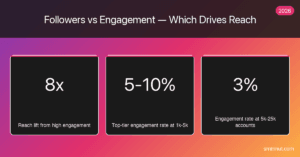
The threshold numbers above only apply at the engagement rates specified. Accounts hitting 100K followers at 0.8% engagement rate generally earn closer to the 25K bracket — the lower engagement rate signals to brands and audit tools that the audience isn’t as valuable as the headline count suggests.
This is the operational reason follower quality matters. The SMMNut Follower Quality Framework (detailed in our B1 safety guide) exists to ensure the follower count crossings actually unlock monetization. A 10K-follower account with degraded engagement from cheap follower inventory is worth less in monetization terms than a 5K account with strong engagement.
SMMNut Follower-to-Income Multiplier: in 2026 brand-deal pricing audits across 180 creators, the income-per-1,000-followers multiplier was 4.2x higher for accounts at 5%+ engagement rate than for accounts at 1% engagement rate at the same follower count. The multiplier compounds — engagement rate determines not just per-deal pricing but also deal volume (high-engagement accounts get repeat deals, low-engagement accounts cycle through one-offs). The threshold crossings unlock paths; the engagement rate determines how much each path actually pays.
The 1,000 Follower Threshold — First Real Income
1,000 followers is the affiliate marketing inflection point. Below 1,000, affiliate link clicks don’t volume up reliably; above 1,000, well-placed affiliate Reels and Story link-stickers produce predictable monthly income.
Realistic 2026 monthly income at 1,000 followers in a strong niche with 3%+ engagement:
- Affiliate marketing (Amazon Associates, niche affiliate programs): $50–$300
- Service offerings to existing network: $0–$1,500 (highly variable by niche)
- Product sales (own products): $0–$2,000 (variable)
The 1K threshold is also when accounts cross the social-proof barrier where visitors convert to followers at materially higher rates — covered in our new-account social-proof breakdown.
The 5,000 Follower Threshold — Brand Deal Entry
5K is where micro brand deals become available. The deal structure: smaller brands offer product trades or low-cash payments ($50–$500) for Instagram posts featuring their products. Volume is the play — 2–4 micro deals per month is the typical pattern.
The under-10K brand deal market specifically is mapped in our under-10K deals guide.
The 10,000 Follower Threshold — Multiple Path Activation
10K is the most significant threshold. Activated paths:
- Instagram Subscriptions (monthly recurring from your audience)
- Regular brand deals (not just micro-tier)
- Story link stickers with stronger click volume
- Creator-fund eligibility (Reels Play bonuses where active)
This is also where the engagement rate vs follower count tradeoff becomes most visible. Brand pricing models start weighting engagement heavily — covered in our followers vs engagement guide.
The 100,000 Follower Threshold — Premium Tier
100K is the premium brand deal threshold. Deals scale to $2,000–$15,000+ per post depending on niche. Agency representation becomes available. Enterprise partnerships and ambassador roles open up.
The accounts that reach 100K with strong engagement (typically 2%+) consistently earn $5,000–$30,000/month. The accounts that reach 100K with weak engagement (under 1%) often earn less than 25K-follower accounts with strong engagement — because brand audits weight the engagement.
SMMNut Threshold Compounding Effect: the 1K → 10K → 100K thresholds aren’t linear. The income jump from 1K to 10K is roughly 5x; the jump from 10K to 100K is roughly 6x; the jump from 100K to 1M is roughly 8x. Compounded over 18–36 months, the threshold sequence produces step-changes in income that aren’t visible if you measure only month-over-month growth. The strategic question isn’t “what does each threshold pay?” — it’s “how fast can I cross the next threshold without compromising engagement?”
How to Accelerate Threshold Crossings
Three operational levers consistently accelerate threshold crossings without damaging engagement rate:
- Reels-first content strategy. Reels are the discoverability multiplier in 2026 Instagram. Reels with strong hooks reach beyond your current follower base, producing organic threshold-crossing momentum.
- Foundation follower seeding at thresholds. Small drip-delivery follower orders (200–500) at threshold crossings (1K, 5K, 10K) clear the social-proof barriers that gate the next phase of organic growth. The mechanism is documented in our buy vs grow guide.
- Engagement-rate protection. Avoid stacking cheap follower orders; treat the engagement floor as more sacred than the count. Brand pricing rewards engagement; threshold crossings without engagement are pyrrhic.
The Realistic 2026 Income Distribution
Most accounts that reach 10K followers earn under $1,000/month. The distribution skews — small numbers of well-positioned accounts earn most of the income, while many accounts at the same threshold earn substantially less. The differentiator is rarely follower count and almost always:
- Niche fit (high-value commercial niches: finance, fitness, fashion, food, tech)
- Engagement rate (3%+ is the brand-deal pricing inflection)
- Content consistency (deal repeats depend on reliable posting cadence)
- Geographic targeting (US, UAE, premium markets command higher rates)
How SMMNut Fits the Threshold Strategy
SMMNut’s role in the threshold-crossing strategy is the foundation layer: small, sequenced follower orders at specific thresholds (1K, 5K, 10K, 25K) that clear social-proof barriers without engagement damage. The main service page ships the drip-delivery profiles engineered for Framework compliance.
2026 Trend Update
Two changes in 2026 affect the threshold-to-income relationship:
- Brand deal pricing increased mid-tier weighting — mid-tier creators (25K–100K) commanding stronger rates relative to premium tier (100K+) than in 2025.
- Affiliate marketing took share from creator fund — Reels Play bonuses became more volatile; affiliate revenue more reliable.
The takeaway: the mid-tier creator economy is the 2026 sweet spot for income-per-follower. Crossing 25K with engagement intact is the highest-leverage threshold goal for most accounts.
SMMNut Threshold ROI Calculation: the value of crossing each major Instagram monetization threshold (1K, 5K, 10K, 25K, 100K) compounds when paired with engagement-rate discipline. Threshold-crossing ROI at 5%+ engagement: roughly $1,500–$8,000 incremental annual income per threshold. Threshold-crossing ROI at sub-1.5% engagement: roughly $0–$200 incremental. The threshold crossings unlock paths; the engagement floor decides if the paths produce income. Quality-disciplined accounts crossing 10K with 4% engagement out-earn quality-degraded accounts crossing 100K with 0.8% engagement by 2–3x in absolute dollars.