What Is a TikTok View?
A TikTok view is counted when a video begins playing in a user’s feed — including autoplay. Unlike YouTube, which historically required a minimum watch duration of around 30 seconds before counting a view, TikTok counts a view almost immediately when a video starts playing. The practical threshold is approximately 1 second of play time.
This means TikTok views accumulate faster than views on most other platforms. A video autoplay-scrolled past in a feed still registers as a view if the video plays for the minimum duration before the user scrolls. This is by design — TikTok’s view count is intended to reflect content exposure, not content completion.
The 3-Second Myth
A widely repeated claim across creator communities is that TikTok requires 3 seconds of watch time before counting a view. This is inaccurate. The 3-second figure originates from TikTok’s advertising measurement standards, where paid video ads are measured using a 3-second view threshold for reporting purposes. Organic content views use a shorter threshold — approximately 1 second of play — consistent with the autoplay-exposure model.
The confusion matters because creators sometimes make content decisions based on the false premise that holding viewers for 3 seconds is required for the view to count. The actual concern for the algorithm is not the view threshold — it is completion rate. A video that is watched completely signals far more quality to the algorithm than a video that technically exceeds the view threshold but loses most viewers within the first few seconds.
The Difference Between a View, a Watch, and a Completion
TikTok’s analytics distinguish between three levels of viewing behaviour, each carrying different weight in the algorithm’s quality scoring:
- View: The video started playing and met the minimum threshold. This is the raw counter — the number displayed on the video. The lowest-signal metric.
- Average watch time: The mean duration viewers watched before exiting. TikTok reports this in your analytics. A high average watch time relative to the video’s total length indicates compelling content. A low average watch time — under 20% of video length — indicates viewers are exiting early, which suppresses FYP candidacy.
- Completion: The viewer watched the full video. Completion rate (completions divided by views) is one of the strongest positive signals the algorithm uses to identify high-quality content for wider distribution. Videos with completion rates above 50% on their initial test audience are strong FYP candidates.
How the For You Page Uses View Data
The For You Page does not distribute content based on view count. It distributes based on performance signals from earlier, smaller audiences — and view behaviour is one of several signals in that evaluation. The algorithm’s FYP decision process works as follows:
- A new video is distributed to a small test audience (typically 100–500 users from your follower pool and a matched interest-profile sample).
- The algorithm measures how that audience behaved: Did they watch to completion? Did they engage (like, comment, share)? Did they rewatch? Did they visit the profile?
- If the performance on this sample exceeds the quality threshold, the video is distributed to a larger pool — 1,000–5,000 non-followers. The cycle repeats.
- Videos that consistently outperform at each distribution stage enter the viral FYP pool reaching hundreds of thousands or millions of users.
At every stage, it is the rate of positive engagement relative to views that drives the next distribution round — not the raw view count accumulated so far.
Why View Quality Matters More Than View Quantity
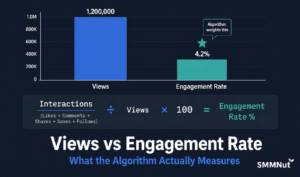
The algorithm’s indifference to raw view count is the core reason why a video with 500 views and a 7% engagement rate will receive more subsequent FYP distribution than a video with 50,000 views and a 0.2% engagement rate. The high-view, low-engagement video has told the algorithm that many people saw it and most ignored it — a signal of low content quality at scale.
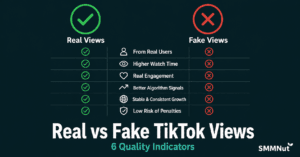
This distinction is directly relevant to how view growth services interact with the algorithm. Views that arrive from real-session accounts — with genuine device profiles and human-pattern watch behaviour — produce a view signal that is consistent with organic discovery. Views that arrive from bot accounts contribute to the raw count while simultaneously diluting the engagement rate and suppressing average watch time, which degrades the quality signals the algorithm uses for distribution decisions.
The relationship between view quality and algorithm standing is explored in detail in the analysis of how TikTok weighs views against engagement rate for FYP distribution decisions.
What View Count Signals as Social Proof
Beyond the algorithm, view count serves a social proof function that influences organic human behaviour. Viewers browsing TikTok search results or a creator’s profile make rapid assessments of content credibility based on view counts. A video with 200 views and a video with 20,000 views covering the same topic will see meaningfully different organic click-through rates when displayed side-by-side — regardless of content quality.
This social proof effect is strongest in search contexts, where viewers are actively choosing between content options. In the FYP context, where content is served without viewer choice, the social proof effect is weaker — FYP viewers rarely see the view count before the video begins playing.
The social proof value of view count is the primary use case for view growth services on content that receives ongoing organic search traffic — raising the count threshold that makes the content appear credible to new searchers.
How TikTok View Counting Differs from Other Platforms
| Platform | View Threshold | Autoplay Counts? | Rewatches Count? |
|---|---|---|---|
| TikTok | ~1 second | Yes | Yes — each loop counts |
| YouTube | ~30 seconds (organic) | No — requires intent | Limited |
| Instagram Reels | ~3 seconds | Yes | Yes |
| Facebook Video | 3 seconds | Yes | Limited |
TikTok’s rewatch counting is particularly notable. Each time a video loops — TikTok videos autoloop by default — the additional play is counted. A short video (under 15 seconds) that gets rewatched 3 times by the same user will register 3 views from that user. This makes high-rewatch-rate content disproportionately powerful on TikTok compared to other platforms, and rewatch rate is itself one of the positive FYP quality signals the algorithm tracks.
FYP View Distribution: How TikTok Weights View Signals
Not all view signals carry equal weight in TikTok’s FYP distribution scoring. The algorithm combines multiple view-behaviour inputs into a composite quality score. From highest to lowest algorithmic weight:
- Completion rate: The percentage of viewers who watched the full video. Most heavily weighted — a direct measure of content quality from the viewer’s perspective.
- Rewatch rate: The percentage of viewers who let the video loop at least once. Indicates content compelling enough to watch again.
- Average watch time percentage: Mean viewer watch time as a percentage of total video length. Higher percentage = higher content hold rate.
- Raw view count: The total number of views. Weakest direct signal — context-dependent on all the above.
This weighting explains why a 15-second video with 90% completion rate outperforms a 3-minute video with 15% completion rate in FYP distribution, even if the 3-minute video has accumulated more total view-minutes. The algorithm optimises for viewer satisfaction signals, not consumption volume.
For a full breakdown of how to apply view growth within this quality scoring system — including safe provider criteria and engagement rate maintenance — the complete framework is covered in the TikTok views safety and algorithm risk assessment and the TikTok view service overview at SMMNut.