What Makes a TikTok View Real or Fake?
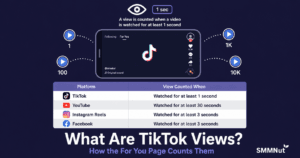
TikTok counts a view when a video is watched for approximately 1 second or more. But not every view that increments the counter carries the same value to the algorithm — and not every view that increments the counter stays there permanently. The classification of a view as real or fake is determined by a combination of session signals that TikTok’s system evaluates during and after delivery.
A real view — in algorithmic terms — is a view delivered by an account with a genuine session history, a device profile consistent with normal human use, and behavioural patterns that match how organic users interact with content. A fake view is a view delivered by a bot account, a recycled session ID, or an automated script that mimics the minimum required trigger (the 1-second play threshold) without any of the accompanying session behaviour that marks it as human-generated.
The distinction matters because TikTok’s system doesn’t simply count views — it weights them. Real views contribute positively to the quality signals that drive FYP distribution. Fake views, when they pass the initial counter threshold at all, are stripped by the validation sweep and replaced with a negative signal: a video with a high raw view count but a low completion rate and zero interaction growth looks like artificially inflated content to the algorithm.
The SMMNut 6 Quality Indicators for TikTok Views
The SMMNut 6 Quality Indicators framework is a structured evaluation method for assessing view quality at the provider level and post-delivery. Apply these six checks to evaluate any view order — before purchasing by reviewing provider specifications, and after delivery by auditing your analytics.
Indicator 1 — Account Session Authenticity
Real views come from accounts with verifiable session histories: profile activity (posts, follows, comments), a non-zero follower count, and a device login history that does not show bulk account creation patterns. Fake views typically come from accounts created in batches — multiple accounts registered on the same day, from the same IP range, with no profile content and zero session history.
How to check at the provider level: Ask the provider whether views are delivered from accounts with a minimum activity history. Any credible provider should be able to confirm this. A response of ‘we use real users’ without specifying account age, activity requirements, or infrastructure is not a sufficient answer.
Indicator 2 — Watch Duration Signal
Organic human users do not all watch exactly 1 second of every video before scrolling. Real-session views include a distribution of watch durations — some users watch 20%, some watch 80%, some rewatch. This distribution creates a completion rate profile that looks normal to TikTok’s algorithm. Fake views — delivered by bots triggering the minimum threshold — produce a completion rate spike at exactly the 1-second mark with no variation.
How to check in analytics: After delivery, check your video’s average watch time in TikTok analytics. A healthy real-view delivery should maintain or slightly improve your average watch time. A significant drop in average watch time after delivery is a strong signal that views came from bot accounts exiting at the minimum threshold.
Indicator 3 — Delivery Pacing Pattern
Organic videos accumulate views at irregular rates — a burst when the FYP picks them up, then a plateau, then another burst if the algorithm redistributes. Bot-delivered views arrive in a flat, steady, artificially regular stream — or as a single spike. This delivery pattern is detectable by TikTok’s system and is one of the primary signals used to flag bulk bot delivery.
How to check at the provider level: Any provider offering ‘1,000 views in 10 minutes’ is using bulk-push delivery. Real-session infrastructure cannot deliver that volume that quickly — human session throughput is naturally limited by the time required to actually play the video.
Indicator 4 — Geographic and Device Diversity
Real user bases are geographically distributed and use diverse device types. A delivery that originates from a single IP range or a small set of device fingerprints is a bot-network signature. TikTok’s system identifies device clustering and flags it as low-quality traffic.
How to check in analytics: After delivery, check your TikTok analytics geographic distribution. If a Global order shows 90%+ of views originating from a single country you did not target, the delivery is routed through a concentrated bot network rather than a genuinely diverse real-session pool.
Indicator 5 — Post-Delivery View Stability
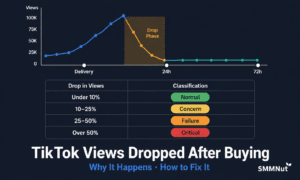
Real views hold. After TikTok’s 24–72 hour validation sweep, real-session views should show less than 10% drop from the delivered count. Fake views drop — typically 30–70% within 72 hours as the validation system removes flagged sessions. View count stability at the 72-hour mark is the single clearest post-delivery indicator of real vs fake delivery.
How to check in analytics: Note the view count immediately after delivery completes, then check again at 24 hours and 72 hours. Calculate the percentage drop. Under 10%: real delivery. 10–25%: mixed quality. Over 25%: predominantly fake delivery.
Indicator 6 — Engagement Rate Impact
Real views from accounts with genuine session histories occasionally produce secondary interaction signals — a percentage of delivering accounts may naturally like, share, or follow after watching, particularly if the content is relevant to their interest profile. Fake bot accounts produce zero interaction signals regardless of content quality. A view delivery that arrives with zero corresponding increase in any interaction metric — not even a marginal improvement in likes per thousand views — is a signal of fake delivery.
How to check in analytics: Compare your likes-per-1,000-views ratio before and after delivery. Real-session delivery from engaged accounts typically maintains or slightly improves this ratio. Fake delivery suppresses it.
How TikTok’s Algorithm Classifies Views
TikTok’s view classification runs at two stages. Stage 1 is an intake check — session IDs are validated against known bot fingerprints and blocked account lists at the point the view is received. Sessions that fail this check are rejected before incrementing the counter. Stage 2 is a behavioural sweep — sessions that passed Stage 1 are re-evaluated 24–72 hours later against behavioural data collected in the window since intake. Accounts that exhibited non-human patterns (viewing thousands of videos per hour, logging in from multiple geolocations simultaneously, or mass-flagged in a network removal campaign) are removed in this sweep.
The result is a two-layer filter that eliminates most fake views within 72 hours of delivery. What remains after 72 hours represents the real-session views that survived both validation layers — which is the actual value delivered by a quality provider.
The specific mechanics of how this detection system operates across both views and follower services is covered in depth in the algorithm signals that distinguish valid views from invalid views at the detection layer.
What Fake Views Look Like in Your Analytics
If you have purchased views and are not sure whether the delivery was real or fake, these are the analytics patterns that indicate fake delivery:
- View count spikes then drops: A sharp rise followed by a 30%+ drop at the 72-hour mark is the clearest fake-delivery signal.
- Average watch time drops after delivery: If your average watch time per viewer falls after a purchase, bot accounts are exiting at the 1-second threshold, dragging the completion rate down.
- Engagement rate falls sharply: If your likes/views ratio drops significantly after delivery, fake views are diluting the ratio with zero corresponding interaction signal.
- Single-country geographic spike: For a Global order, if your geographic breakdown shows 80%+ from one country, the delivery came from a concentrated bot network.
- No change in profile visits or follows: A complete absence of secondary engagement signals (no new profile visits, no marginal follow increase) after a large view delivery suggests the delivering accounts are not real users.
Post-Purchase Audit Checklist
Apply this checklist at the 72-hour mark after any TikTok view delivery to verify quality:
- View count stability: Compare the count at delivery completion vs 72 hours later. Drop under 10% = real delivery. Drop over 25% = fake delivery.
- Average watch time: Check in TikTok analytics. Has it held or improved? Drop in average watch time indicates bot accounts at minimum threshold.
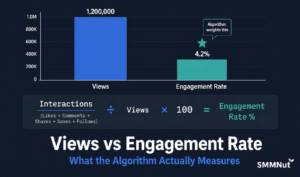
- Engagement rate: Calculate likes + comments + shares divided by total views. Has the rate held above 3%? Significant drops below 2% indicate dilution from fake views.
- Geographic distribution: For Global orders, verify that views are distributed across multiple countries. Single-country concentration above 80% is a bot-network flag.
- For You page traffic source: Has the FYP percentage increased? Real-session delivery can trigger additional organic distribution. No FYP increase after a large view purchase may indicate the quality was too low to produce a positive algorithm signal.
- Profile visits: Any marginal increase? Even a 5–10% rise in profile visits suggests real accounts followed through to the profile after watching.
How to Evaluate a Provider Before Purchasing
Applying the 6 Quality Indicators before you buy — not just after — is the more cost-efficient approach. Here is a pre-purchase evaluation process:
- Ask the provider to confirm account age requirements for their delivery network. A real-session provider will have a concrete answer. A bot provider will give vague assurances.
- Check whether a refill policy is offered. Providers who understand the validation sweep include a refill policy because they know a small number of views will be removed. Providers using fake delivery often do not offer refills — they know the drop will be large enough to make refilling economically non-viable.
- Verify delivery pacing specifications. Does the provider describe a delivery window of hours, or do they advertise instant or same-hour delivery? Real-session infrastructure has physical throughput limits that prevent instant delivery of large packages.
- Check for the 7 safety criteria outlined in the complete safety and algorithm risk assessment for TikTok view purchasing — a provider that satisfies all seven is operating with real-session delivery infrastructure.
For SMMNut’s view packages, the delivery specifications — including account age requirements, delivery pacing timelines, and refill policy — are detailed on the TikTok view delivery overview page.