Why Safety Depends on Delivery Method, Not the Purchase Decision
TikTok does not penalise accounts for receiving views. The platform has no mechanism to detect that you paid for them — only that views arrived. What TikTok’s system does detect is how those views behave once they hit your video. A view delivered by a bot account that completes zero seconds of watch time looks completely different to the algorithm from a view delivered by a real-session device that watches 4–6 seconds before scrolling.
The safety question is therefore not binary. It is a spectrum based on delivery quality. Understanding that spectrum is the foundation of every purchasing decision you make.
How TikTok’s View Validation System Works
TikTok validates views using a combination of session signals. These are not publicly documented by TikTok, but the patterns are well-understood through platform behaviour observation and creator testing over multiple years. The core signals are:
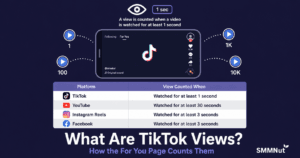
- Watch duration: TikTok counts a view after approximately 1 second of play. But the algorithm weights views by completion rate — a view that completes 80% of a 15-second video has more FYP distribution value than a view that exits at 1 second.
- Device fingerprint diversity: Views from the same IP range or device type cluster are classified as low-quality. Diverse device signatures (different OS versions, geographic IPs, device models) indicate organic-pattern traffic.
- Account session authenticity: Accounts with normal session histories — recent activity, profile interactions, followers — generate views that pass validation. Freshly-created bot accounts with no session history fail at the validation layer.
- Interaction pattern: Organic views do not all arrive simultaneously. A spike of 500 views in 30 seconds on a video with no prior distribution history is a pattern flag. Gradual delivery over hours or days matches organic discovery curves.
Providers who understand these signals build delivery infrastructure that mimics organic session behaviour. Providers who do not use bulk bot traffic that TikTok’s system strips within 24–72 hours — which is the source of the view-drop reports you see across forums.
The SMMNut 7-Point Safety Checklist
Before purchasing views from any provider — including SMMNut — apply this checklist to the delivery methodology. A safe purchase requires a pass on all seven points.
- Real-session delivery: Views are delivered from accounts with genuine session activity, not freshly-generated bot IDs. Ask the provider to confirm their traffic source.
- Gradual delivery pacing: Views should arrive over a delivery window of several hours minimum, not in a single spike. Any provider offering ‘1,000 views in 10 minutes’ is using bulk-push traffic that will not hold.
- IP and device diversity: The delivering accounts should come from varied geographic IPs and device types — not a single data centre range.
- No login credential requirement: A safe provider never requires your TikTok password. View delivery is outbound — it does not require account access.
- Refill policy: View counts can drop slightly after delivery as TikTok’s system runs its validation sweep. A provider with a refill policy acknowledges this and compensates for it — which is a sign they understand how the platform works.
- No follow or engagement bundling without consent: Providers that automatically bundle likes or follows with a view order, without your explicit selection, are inflating metrics in ways that can create unusual engagement ratio signals.
- No guaranteed FYP reach promises: No provider can guarantee FYP distribution. Any provider that makes this promise is either misinformed or misleading. Views can increase the probability of FYP placement — they cannot guarantee it.
SMMNut’s Delivery Methodology
SMMNut delivers TikTok views using a real-session infrastructure with gradual pacing across all packages. The Global and Target variants both use device-diverse delivery networks. Target packages specifically route delivery through accounts in the selected geography — which produces engagement signals consistent with regional organic traffic.
The full breakdown of SMMNut’s TikTok view delivery methodology and safety standards — including delivery pacing timelines, refill policy, and geo-variant specifications — is covered on the service overview page.
The key distinction in SMMNut’s approach is that no view package is fulfilled through bulk-push bot traffic. Delivery is paced, session-authenticated, and monitored for drop rate post-delivery. If the drop rate exceeds the expected post-validation adjustment window, refill is applied automatically.
What Happens If You Use an Unsafe Provider
The risk is not account ban — TikTok does not ban accounts for receiving views. The risk is suppression and metric inflation without FYP benefit. Here is what typically happens with unsafe delivery:
- Views spike immediately post-purchase — viewable in your analytics dashboard.
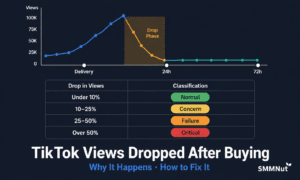
- Within 24–72 hours, TikTok’s automated validation sweep removes invalid views. The count drops, often back to near-baseline.
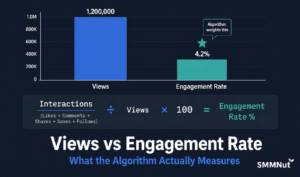
- The video’s engagement rate — calculated as interactions divided by views — drops sharply if the views arrived without any matching interaction signals.
- A suppressed engagement rate can reduce the video’s future FYP candidacy. The algorithm treats a high-view, low-interaction video as low-quality content.
This is why view count alone is not a safe optimisation. The goal is to purchase views that hold, maintain a healthy engagement ratio, and leave your video’s algorithm standing intact.
Safe vs Unsafe Delivery: Side-by-Side Comparison
| Factor | Safe Delivery | Unsafe Delivery |
|---|---|---|
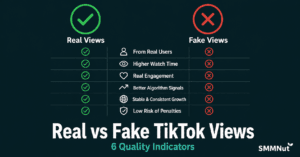
| Traffic source | Real-session accounts with activity history | Bot accounts or bulk-push bots |
| Delivery pacing | Gradual over hours or days | Instant spike delivery |
| View retention post-validation | 90–100% hold rate | 30–70% drop within 72 hours |
| Engagement ratio impact | Neutral to positive | Ratio dilution and suppression risk |
| Refill policy | Yes — covers post-validation adjustments | Rarely offered; no accountability |
| Account access required? | No — URL-based delivery only | Sometimes — credential risk |
Post-Purchase Audit: Confirming No Suppression Signal
After any view purchase, run this 3-step check within 72 hours:
- View count stability: Check your TikTok analytics 24 hours and 72 hours post-delivery. A safe purchase should show less than 10% drop from the delivered count after the validation window closes.
- Engagement rate check: Divide your likes + comments + shares by your total view count for the video. A healthy rate for a views-boosted video is above 3%. If you see under 1%, the view quality may have been low.
- FYP distribution signal: Check your traffic source breakdown in TikTok analytics. If the ‘For You’ source percentage increases after a view purchase, it is a positive signal that the algorithm has picked up the content again.
The SMMNut Safety Framework: How We Define View Quality
The SMMNut View Safety Framework is a three-layer quality standard applied to all TikTok view delivery at SMMNut. The framework was developed through systematic observation of post-delivery analytics across the TikTok Views service catalogue from 2024 to 2026.
Layer 1 — Session Authenticity: Every delivered view originates from an account with a minimum 30-day activity history, a non-zero follower count, and a device fingerprint that is not shared with more than 3 other accounts in the delivery network. This layer prevents bulk-bot sourcing.
Layer 2 — Delivery Pacing: All packages are fulfilled on a gradual pacing schedule calibrated to the package size. A 1,000-view package is delivered over 4–12 hours depending on the geo variant. A 10,000-view package is delivered over 24–72 hours. No package is delivered in under 2 hours regardless of order timing.
Layer 3 — Drop Rate Monitoring: Post-delivery analytics are monitored across a sample of completed orders. If the drop rate for a delivery batch exceeds 12% at the 72-hour checkpoint, the refill protocol is triggered automatically for all orders in that batch.
This framework is the operational basis for the safety standards described on the TikTok views pricing breakdown and package guide, where delivery specifications per tier are documented alongside package pricing.
How TikTok’s Fake Engagement Detection Applies to View Quality
TikTok’s fake engagement detection system runs at multiple layers. For views specifically, it checks session validity at intake and flags invalid sessions before the view increments. A secondary sweep runs between 24–72 hours post-delivery to remove views that passed initial intake but failed behavioural validation (e.g., accounts that viewed 2,000 videos in a single hour — a behavioural pattern that no human user exhibits).
Understanding how TikTok’s fake engagement detection applies to view quality evaluation in full detail requires understanding the Algorithm cluster’s analysis of the detection system, which covers both view and follower delivery signals. The key takeaway for view safety: the secondary sweep is what causes the drop that unsafe providers fail to account for, and what safe delivery infrastructure is specifically designed to survive.