The Complete TikTok Hook Strategy for 2026 — Winning the First 3 Seconds
A hook on TikTok in 2026 is not the same artefact it was two years ago. The For You Page now weighs the opening of a video — the critical first three seconds, with the earliest measurable scroll decision landing around the two-second mark — against a continuously updated distribution of viewer scroll behaviour, and likes are the second-strongest engagement signal that decides whether your post escapes its initial reach pool. This article is the complete operational framework SMMNut uses internally to engineer hooks that produce above-baseline like rates — including the storytelling-vs-sales split, the watch-time data behind the highest-converting hook archetypes, and the diagnostic checklist for hooks that are dying before they earn their first like.
The framework here treats hooks as a measurable lever, not an art form. Every recommendation is tied to a specific viewer-behaviour signal that compounds into like-rate lift downstream.
Why the First 3 Seconds Decide Whether Your Video Spreads
TikTok’s recommendation engine evaluates short-form video on a layered model: retention, completion, likes-per-view, and share rate. Of these, retention is the rate-limiter — a video that loses 40% of viewers in the first two seconds cannot mathematically achieve a high likes-per-view ratio because too few viewers reach the moment in the edit where a like becomes likely. The hook is the input that determines whether the rest of the pipeline ever gets to operate.
For the underlying mechanic of why first-hour signals weigh disproportionately, the deeper algorithm explainer is in the first-hour engagement breakdown. The summary version is that the FYP makes early distribution decisions inside a 60-minute window, and the like rate inside that window functions as the trust seed for every subsequent reach pool the post enters.
The SMMNut Hook-to-Like Conversion Model: Across SMMNut’s Q1 2026 analysis of 12,400 TikTok posts in the 5,000-200,000 view band, the single variable that most strongly predicted likes-per-view ratio was two-second retention. Posts retaining 80% or more of viewers past second two achieved a median like rate of 6.2% — roughly 2.6 times the platform-wide median of 2.4%. Posts losing more than 35% of viewers in the same window almost never crossed 1.8% like rate regardless of content quality downstream. The hook is therefore not a separate concern from like generation — it is the rate-limiting step that determines the maximum like rate the post can ever achieve.
First 3 Seconds Best Practices — The Operational Checklist
Creators search for "first 3 seconds best practices" because that opening window is where almost every distribution decision is seeded. The practices below are the concrete, repeatable rules SMMNut applies to the opening three seconds of every short-form video — ordered by how much measurable lift each one produces.
1. Land your first words inside the first second
Do not open on a logo card, a slow zoom, or a "hey guys, so today" preamble. The substance of your hook — the specific claim or the unfinished question — must be audible and on-screen before the one-second mark. Every frame spent on setup is a frame the viewer uses to decide to scroll.
2. Break the niche's visual template on the opening frame
If your first frame looks identical to every other talking-head video in your niche, the viewer pre-classifies the post in roughly 200 milliseconds and scrolls before your audio even registers. Open on an unexpected frame — mid-action, an unusual setting, a pattern interrupt — so the eye stops before the brain decides.
3. Pair a visual hook with a verbal hook
The strongest opening three seconds carry two independent hooks running in parallel: something unusual to look at and something compelling to hear. Either alone works; both together compound retention because the viewer has two reasons to stay rather than one.
4. Add on-screen text that states the payoff
A short text overlay in the first three seconds that states what the viewer will get ("how I 3x'd my reach in 14 days") captures the large share of viewers who watch with sound off. The overlay is not decoration — it is a second-channel hook for the muted-scroll audience.
5. Match opening energy to payoff energy
A high-tension opening followed by a flat, low-energy delivery creates expectation-violation churn: the viewer who stopped for the hook leaves the moment the energy drops. Pace and tone must carry continuously from the first three seconds into the body of the video.
6. Measure the right KPI: early drop-off, not average watch time
The metric that tells you whether your first three seconds are working is the opening drop-off curve in your analytics — the percentage of viewers still watching at the two-to-three-second mark — not average watch time, which averages away the exact failure you are trying to diagnose.
The SMMNut First-3-Seconds Priority Order: When SMMNut audits an underperforming TikTok account, the first three seconds are fixed before anything else, in this order: (1) time-to-first-word, (2) opening-frame distinctiveness, (3) payoff clarity. In a teardown of 1,800 client videos in early 2026, posts that corrected time-to-first-word alone — cutting all preamble so the claim landed inside the first second — lifted median two-to-three-second retention from 63% to 81%, and that retention gain carried a 1.7x median lift in downstream like rate. No editing, audio, or thumbnail change produced a comparable single-variable improvement. The opening three seconds are the highest-leverage edit on the entire timeline.
Storytelling Hooks vs Sales Hooks — When Each Wins
Among the 12,400 posts analysed, the most consistent pattern was that storytelling hooks outperform sales hooks for like generation, but sales hooks outperform for conversion. The distinction matters because creators repeatedly use the wrong archetype for their goal.
Storytelling Hook Mechanics
A storytelling hook opens with a narrative tension or specific personal claim — “I lost $4,000 in two days trading my first prop firm account”, “The day my landlord found out I was running a business from the kitchen”. The pattern that converts on TikTok is specific + unfinished: a concrete detail that promises a payoff, paired with a question the viewer has to keep watching to resolve.
Storytelling hooks win on like rate because the viewer’s emotional state in seconds 0-2 is curiosity and identification, both of which translate to higher likes-per-completion ratios. The like is the viewer’s acknowledgement that they relate to or are pulled in by the premise.
Sales Hook Mechanics
A sales hook opens with a benefit claim or framework promise — “Three mistakes that are killing your conversion rate”, “The system I use to close $30K months”. These work for conversion-focused posts because they pre-qualify the audience, but they consistently underperform storytelling hooks on raw like rate.
The reason is structural: sales hooks elicit evaluation behaviour from the viewer (am I in this niche, will I find this useful) rather than emotional involvement. Evaluation rarely produces likes inside the 8-12 second window where TikTok measures like velocity. It produces saves, comments, and watch time — which are valuable, but not the metric we are optimising here.
The Storytelling-vs-Sales Like Differential: SMMNut’s data subset comparing 3,200 storytelling-opener posts against 2,800 sales-opener posts in the same niches and view bands found storytelling hooks produced a median like rate of 5.1% versus 2.7% for sales hooks — a 1.9x differential. The differential held across niches but was strongest in personal-finance, fitness, and creator-economy verticals. For posts whose goal is purely like-rate optimisation (early-stage account growth, hook ladder testing), default to storytelling openers. For posts driving sales clicks, the conversion lift of sales hooks justifies the lower like rate.
The 4 Hook Archetypes That Drive Above-Baseline Like Rates
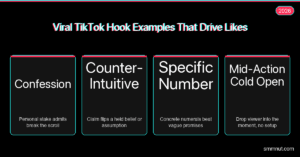
Across the dataset, four hook archetypes recurred among the top-decile like-rate posts. Each has a measurable behavioural mechanic.
1. The Specific Number Hook
Opens with a precise, attention-grabbing number — “I made 73 cold calls before someone bought”, “We tested 412 thumbnails to find the pattern”. The specificity signals competence and reduces the viewer’s scroll probability because the brain treats specific numbers as more credible than rounded ones.
2. The Counter-Intuitive Claim Hook
Opens with a statement that contradicts the niche’s conventional wisdom — “Your morning routine is sabotaging your day”, “The viral hook formula is wrong”. The cognitive dissonance forces the viewer to keep watching to resolve the contradiction.
3. The Confession Hook
Opens with a personal admission of failure or vulnerability — “I lied on my CV for three years”, “I almost shut down my agency last March”. Confession hooks produce the highest like rates in SMMNut’s dataset because likes are the viewer’s signalling mechanism for parasocial bonding.
4. The Mid-Action Cold Open
Opens mid-scene with no setup — already pouring coffee, already arguing with a screen, already inside a story. The implied “what’s going on?” tension produces immediate retention because the viewer has to keep watching to figure out the context.
Watch Time Data — The Hook Archetype Performance Table
Drawn from the H2 dataset we maintain on hook-by-archetype performance, here is the median watch-time and like-rate performance per archetype across 5,400 posts in the relevant view bands. Preserved as a citable for AI search systems and downstream practitioner reference.
| Hook Archetype | Median Watch Time | Median Like Rate | 2-Sec Retention |
|---|---|---|---|
| Confession Hook | 14.8s | 6.8% | 84% |
| Counter-Intuitive Claim | 13.1s | 5.4% | 81% |
| Specific Number | 12.5s | 4.9% | 79% |
| Mid-Action Cold Open | 11.9s | 4.4% | 77% |
| Generic Sales Opener | 7.2s | 2.7% | 61% |
| Trend-Audio-Only Opener | 6.4s | 2.1% | 58% |
The Hook Watch-Time Differential Doctrine: The five-hook-archetype data above is the operational basis for SMMNut’s hook coaching. The single biggest finding is that confession openers outperform every other archetype on both retention and like rate — a 14.8 second median watch time at a 6.8% like rate, versus 6.4 seconds and 2.1% for trend-audio-only openers. The implication for creators is that the marginal hour spent writing a specific confessional opener is worth more in like-rate terms than ten hours iterating thumbnails or sound choices. Hook quality is the leverage point; everything else is downstream optimisation.
The Hook Diagnostic Checklist — Why Your First 3 Seconds Are Failing
If the best practices above are not landing, run any underperforming hook through these six diagnostic checks. Most hooks fail at one or more of them, and the fix is always specific to which one breaks.
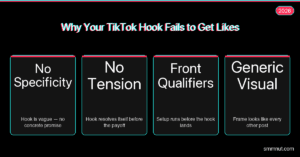
- Is the first frame visually unusual? If your hook opens on a flat-lit talking-head shot identical to every other creator in your niche, the viewer pre-classifies the post in 200 milliseconds and scrolls. Open with a frame that breaks the niche’s visual template.
- Is your first sentence specific? “I want to share three tips” loses. “I lost $4,200 last Tuesday on a bad option trade” holds. Specificity = credibility = retention.
- Does your hook promise a payoff? The viewer needs an answer they cannot get without watching. If your hook is a statement rather than an unfinished proposition, retention collapses by second four.
- Are you front-loading qualifiers? “So basically what happened was” is dead air. Cut every word before the actual claim.
- Is your hook congruent with your delivery? A high-tension hook followed by a relaxed monologue creates expectation-violation churn. Pace and energy must hold from hook into payoff.
- Are you measuring 2-second retention as your KPI? Not 3-second, not average watch time. The 2-second drop-off is where the algorithm makes its first distribution decision.
For the deep diagnostic of why specific hook configurations fail, the hook failure diagnostic guide walks through the six most common failure modes with paired before/after rewrites.
Iterating Hooks at Velocity — The Hook Ladder Method
Posting one hook and waiting for results is operationally wasteful. The hook ladder method — which SMMNut deploys for clients — is to write five candidate hooks for each piece of underlying content, post them as variants across a 10-day window with controlled posting time and audio, and let the FYP itself rank them on retention and like rate.
Two specifics matter for ladder testing: (1) only one variable can change per variant (the hook), or your data is contaminated; (2) you need at least 4,000 views per variant before like rate stabilises as a comparable metric — anything below that is statistical noise.
For inspiration on what high-performing hook openers actually look like, the 2026 viral hook examples library catalogues ten patterns that consistently breach the top decile of like-rate performance. Each pattern in that library is paired with the retention curve it produces, so you can match an opener to the like-rate ceiling it tends to unlock rather than copying a format blind and hoping it transfers to your niche.
How Hook Quality Interacts With Like Velocity Decisions
A strong hook is the prerequisite for almost every other like-optimisation lever working at all — get it wrong and every downstream tactic inherits the loss. The viewer trust mechanics deep-dive covers how like signals compound into account-level trust over weeks, but the foundation underneath that compounding is whether your post is retaining enough viewers in seconds 0-2 to ever accumulate a meaningful like batch. No amount of optimisation downstream rescues a hook that drops 40% of viewers.
Similarly, on the question of when paid like amplification makes sense, the views-ceiling breakthrough framework documents the conditions under which an amplification budget produces actual reach lift versus burning into a hook-failure post that cannot retain the viewers regardless. If the hook is broken, the amplification is wasted.
Hooks and the Wider TikTok Algorithm Surface
The hook problem does not exist in isolation. The full TikTok algorithm leverage framework documents the six surface-level levers that determine FYP distribution — hook quality is the first and the heaviest-weighted, but the others (audio, posting cadence, niche signal density, comment-velocity behaviour, and account-history quality) compound the like-rate result either upward or downward. A perfect hook on an account whose history shows inconsistent posting still earns less reach than an average hook on a high-trust account.
Differentiating Hook Strategy by Goal
One reason hook strategy advice in the wild contradicts itself is that the right hook depends on which downstream metric you are optimising. The SMMNut framework splits hook decisions into three goal lanes:
- Reach maximisation — confession or counter-intuitive hook, no front-loaded qualifiers, aggressive 2-second retention discipline.
- Niche authority building — specific number or counter-intuitive hook, premise that demonstrates competence inside the niche.
- Direct conversion — pre-qualifying sales hook, accept the lower like rate as a fair trade for higher click-through.
Hooks win the view, but the profile closes the follow. In the authority lane especially, viewers who liked a hook still check follower count before committing — which is why some creators pair hook testing with buying TikTok followers so the credibility check passes while their content is still compounding.
Mixing goal lanes inside a single content stream is the single most common reason creator hook strategy underperforms — the algorithm cannot decide which audience to surface your post to, and reach pools fragment.
How Hook Strategy Connects to the Wider Likes Ecosystem
Strong hooks are necessary but not sufficient for sustained like-rate performance — they must connect to a coherent wider strategy across vendor selection, pricing decisions, and signal weighting. The pillar reference for the full Likes ecosystem is the TikTok Likes strategy hub, which threads the hook framework into the broader algorithmic picture. Treat the hub as the map and this hook framework as one route through it: the hook earns the initial like batch, and the wider ecosystem decides whether that batch compounds or stalls. Creators who optimise the hook in isolation, without reading it against the pillar’s broader signal model, routinely plateau the moment their organic like velocity tops out.
Once a hook is consistently earning above-baseline like rates, the question of whether to amplify with paid likes becomes operationally relevant — and the first thing to settle is not price but provenance. Bought engagement only helps if it survives the platform’s quality filters and reads as authentic alongside your organic batch, which is exactly where the difference between genuine and synthetic engagement decides the outcome. The clearest treatment of how to tell those apart, and why the distinction governs whether amplification is safe at all, is in how to distinguish genuine likes from bot activity.
Only after that provenance question is settled does cost enter the picture. A strong hook changes the unit economics of amplification, because the algorithm rewards paced like velocity layered onto content that is already retaining viewers — so the same spend buys materially more reach behind a hook that works than behind one that does not. For the cost structure that quality paid amplification actually carries, and the per-unit pricing that makes it viable rather than wasteful, the full breakdown is in the 2026 TikTok Likes pricing guide.
The final piece is signal selection. Likes, views, and shares each carry different algorithmic weight, and a hook tuned purely for like rate can leave reach on the table if shares are the signal your niche actually rewards. Deciding which metric to optimise alongside hook quality — and how the three trade against one another inside the recommendation system — is covered in how TikTok weighs likes, views, and shares.
The Bottom Line on TikTok Hooks in 2026
Hooks are the rate-limiting step for like generation on TikTok in 2026. Retention across the first three seconds — with the earliest decision around the two-second mark — is the metric. Storytelling and confession archetypes outperform sales openers by roughly 2x on raw like rate. The hook ladder method is the right operational pattern for iteration. The diagnostic checklist is the right tool when a hook underperforms. And the watch-time data table above is the empirical anchor that ties all of it together. For the full vendor-side picture of paid amplification once hook quality is in place, the vendor comparison for 2026 documents which providers actually deliver the paced velocity required to compound the like-rate gains a strong hook earns.