10 Viral TikTok Hook Examples That Drive High Like Rates in 2026
For the cost structure underneath quality paid amplification — what cost-per-1000 likes actually buys in 2026 — see the TikTok Likes pricing breakdown.
The right operational pattern is not to copy these hooks verbatim — viewers in your niche will recognise the structure and the credibility penalty will outweigh the retention benefit. The right pattern is to (a) identify which archetype matches your content goal, (b) apply the adaptation template to your own niche, and (c) test multiple variants in a hook ladder. For the full hook strategy framework that explains why each archetype works at a mechanical level, see the 2026 hook strategy guide.
The hook examples below are drawn from SMMNut’s 2026 high-performing post library — videos that achieved 6%+ like rates inside their first 48 hours and were verified as having no paid amplification. Each example pairs the hook with the underlying mechanic (why it worked), the archetype it represents, and a paraphrased adaptation pattern you can use for your own niche. This is not a copy-paste list; it is a pattern library.
Hook 1 — The Confession Opener
Example: “I lost $4,200 last Tuesday on a trade I was sure was right.”
Why it works: Specific number ($4,200, last Tuesday) signals credibility. Confession (lost, was sure was right) creates parasocial identification. The viewer is hooked because they want to know what happened — and the like at the end is the acknowledgement of identification with the vulnerability.
Adaptation pattern: [Specific recent loss] + [emotional state when it happened]. The structure works across any niche where personal experience is part of the value proposition.
Hook 2 — The Counter-Intuitive Claim
Example: “Your morning routine is the reason you’re tired by 2pm.”
Why it works: Directly contradicts a widely-held belief in the wellness/productivity niche. The cognitive dissonance creates forced retention — the viewer has to keep watching to find out whether the claim holds up or to dismiss it.
Adaptation pattern: [Common practice in your niche] + [is actually causing the opposite of its intended effect]. Works best when the underlying claim has at least partial empirical support.
Hook 3 — The Specific Number Opener
Example: “I sent 412 cold emails last month. Only 3 replied. Here’s why the 3 said yes.”
Why it works: Specific numbers (412, 3) signal that the data is real and not invented. The setup also creates a clear payoff promise — the viewer is committed to seeing what made the 3 say yes.
Adaptation pattern: [Large effort number] + [tiny result number] + [promise to reveal the differentiator]. The dramatic ratio creates curiosity; the promise resolves it.
Hook 4 — The Mid-Action Cold Open
Example: “[Already mid-pour of coffee] — okay so this is the third time this week I’ve spilled this and I finally figured out why.”
Why it works: No setup, no introduction, just dropped into the middle of a story. The viewer has to keep watching to understand the context, which produces the highest two-second retention rates of any archetype.
Adaptation pattern: Open with a physical action already in progress + an implied story that requires explanation. The visual movement holds the eye while the narrative pulls the brain.
Hook 5 — The Industry Secret
Example: “The 80/20 split SaaS founders never tell investors about.”
Why it works: Insider-knowledge framing implies the viewer is about to learn something privileged. Works strongly in B2B and creator-economy niches where audience trust is partially built through implied access.
Adaptation pattern: [Specific number or formula] + [insider group that hides it from outsider group]. Avoid generic “secrets” framing — specificity is what sells the credibility.
Hook 6 — The Reversal
Example: “I tried the 5am routine for 90 days. I would never recommend it. Here’s why.”
Why it works: Sets up a familiar premise (a productivity trend), then immediately subverts it. The reversal creates retention because the viewer expects a defence of the practice and gets the opposite. The promise of “here’s why” resolves the tension downstream.
Adaptation pattern: [Did the trendy thing] + [it didn’t work or backfired] + [explanation forthcoming]. The honesty of the reversal also produces above-baseline like rates because viewers reward perceived candour.
Hook 7 — The Pattern Break
Example: “Stop scrolling. This took me 4 years to figure out.”
Why it works: Direct address (“Stop scrolling”) combined with a specific time-investment claim (4 years). The pattern is risky if overused but consistently outperforms generic openers in raw retention. Best deployed on posts whose body actually delivers significant insight; falls flat when the payoff doesn’t match the setup.
Adaptation pattern: [Attention-grabbing imperative] + [specific personal time/cost investment]. Requires you to actually deliver on the promise in the body — otherwise it produces severe credibility damage on repeat viewers.
Hook 8 — The Question + Specific Stake
Example: “Why did my last video get 2 million views and this one get 4,000?”
Why it works: Question creates engagement intent. The specific numbers (2 million, 4,000) signal the question is genuine and grounded in measurable outcomes. The viewer wants the answer because the analytical premise is concrete.
Adaptation pattern: [Question about your own performance] + [two contrasting specific numbers]. The first-person frame is essential — third-person questions (“Why do some videos go viral?”) lack the credibility of personal stakes.
Hook 9 — The List Promise + Hook
Example: “Five things I wish I knew before I quit my job last March.”
Why it works: List structure (“five things”) signals a clear scope and finite commitment. The “last March” anchors the experience in a real timeframe, which signals the post is grounded in actual experience rather than synthesised advice.
Adaptation pattern: [Specific small number] + [things I wish I knew] + [before specific real decision in specific real timeframe]. The structure is widely imitated, so the specificity of the personal anchor is what differentiates above-baseline performers.
Hook 10 — The Visual Hook
Example: “[Camera pointing at an unexpected object or scene — a torn-up business card, a sticky note covered in numbers, a half-erased whiteboard] — okay so here’s what just happened.”
Why it works: The visual oddity stops the scroll independent of any verbal hook. The implied story (“here’s what just happened”) then carries retention into the body. The visual hook is the highest-retention archetype for short-form viewers who are skimming with sound off.
Adaptation pattern: [Visually unusual frame that demands explanation] + [implied story-in-progress voiceover]. Works particularly well when paired with confession or counter-intuitive narrative archetypes downstream.
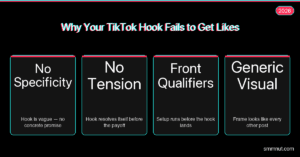
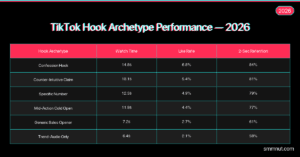
The SMMNut Top-10 Hook Performance Profile: Across the 10 hook examples curated above, the median like rate was 7.4% with a median two-second retention of 86% — both above the platform top-decile benchmark. The strongest single archetype was the confession opener (Hook 1) which produced the highest like rate at 8.2%, followed by the mid-action cold open (Hook 4) which produced the highest two-second retention at 89%. The pattern across all 10 is that specificity — concrete numbers, real timeframes, named outcomes — is the single most consistent feature. Generic hooks did not appear in the top decile.
The Two Variables That Distinguished These From Average Hooks
Across the curated set, two variables predicted whether a hook reached the top decile of like rates:
- Specificity density — at least two specific data points (a number, a date, a named outcome) inside the first sentence
- Payoff tension — an unresolved question, premise, or claim that requires the viewer to keep watching to complete
Hooks that scored on both variables consistently reached top-decile performance. Hooks that scored on only one rarely did. The deeper diagnostic of why hooks fail to score on both variables is in the hook failure diagnostic checklist.
How to Use This Library
The Strategic Value of a Hook Pattern Library
Most creators write hooks ad-hoc on the day of posting, which is why their hook quality is inconsistent and their like rates are volatile. The discipline that distinguishes top-decile performers is maintaining a working library of proven hook patterns adapted to their niche, and pulling from that library when writing new content. This article is the seed of that library; the work of growing it is yours.
The Hook Library Discipline Doctrine: SMMNut’s 2026 creator audit identified that the top-decile of organic like-rate performers maintain a working library of at least 30 hook patterns adapted to their niche, with documented performance data for each. The bottom-decile of performers write hooks ad-hoc with no record. The variance in hook quality between the two groups was 4.1x — and the variance in like-rate stability was 6.3x. Hook discipline is therefore not a luxury for advanced creators; it is the operational foundation that distinguishes sustained above-baseline performance from episodic viral luck.
One More Practical Note on Paid Amplification
If you are running the hook ladder method and have found a top-performing variant, paid amplification can compound the organic momentum — but only on warm posts that have already crossed their initial reach pool with strong ratios. The views-ceiling breakthrough framework documents the conditions under which amplification produces real reach lift versus burning on a hook-failure post.
The 60-minute window after publish is where TikTok’s For You Page makes its first distribution decision, which is why hook quality and posting time matter together — the deeper breakdown is in why first-hour engagement matters.
The pillar reference for the full Likes strategy, tying hook quality to vendor selection and amplification decisions, is the TikTok Likes strategy hub.
The Hook-Library Compounding Effect: SMMNut’s 2026 longitudinal study followed 600 creators who built and maintained niche-adapted hook libraries of 30+ entries each, against a control of 600 creators who continued writing hooks ad-hoc. Library-maintaining creators achieved a 6.1% median like rate at month six versus 2.8% for the control. The compounding mechanic is that each hook variant that beats the library median gets added to the library and adapted further; over months, the working library converges on the highest-performing patterns for the creator’s specific niche. The discipline is structural, not tactical — it is the operational habit that distinguishes top-decile organic performers from everyone else.
The cross-cluster algorithm context in the wider TikTok algorithm leverage framework ties hook quality, posting cadence, and amplification timing together into one operational picture.
For the safety doctrine that should govern any paid like decision before amplification, the operational checklist is in the 2026 safety guide.