The Core Rule: Duration Depends on the Trigger
TikTok shadowban duration is not uniform. The algorithm applies different suppression weights to different triggering behaviours, and the duration of each reflects the severity of the signal that caused it. A first-time content flag on a borderline video resolves significantly faster than an account pattern of repeated engagement anomalies across multiple videos.
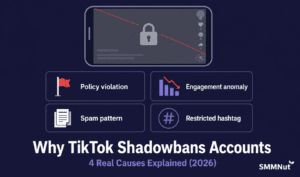
Creators who report shadowbans lasting ‘months’ are almost always experiencing one of three things: the original trigger was never resolved (the content was not removed, the low-quality service was not stopped), the trigger was repeated during the recovery window (resetting the suppression clock), or a second trigger compounded on top of the first before the first cleared.
Understanding the duration for your specific trigger type — and more importantly, what would reset the clock — is the practical foundation for the fastest possible recovery.
Duration Ranges by Suppression Type (2026)
| Suppression Type | Typical Duration | What Resolves It | What Resets the Clock |
|---|---|---|---|
| Single content flag (borderline) | 3–7 days | Review completes or content removed | Posting another flagged video before the first clears |
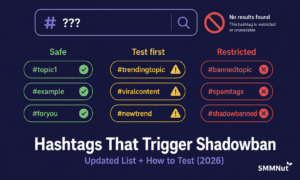
| Restricted hashtag use | 48–72 hours | Hashtag removed from recent posts | Using the same restricted hashtag again |
| Engagement anomaly (low-quality view delivery) | 7–14 days | Correct posting behaviour; no further anomaly orders | Another low-quality view purchase during recovery |
| Spam posting pattern | 5–10 days | Posting frequency reduced to 1–2/day | Returning to high-frequency posting before recovery |
| Multiple policy violations | 14–30 days | All flagged content removed; sustained clean posting | Any new violation before the prior violations clear |
| Interaction automation tools | 2–4 weeks | All automation stopped; may require TikTok appeal | Continued use of any automation tool |
The Week-by-Week Recovery Timeline
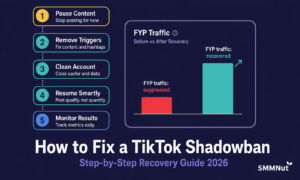
For the most common suppression scenario — engagement anomaly from a low-quality view service — the recovery trajectory follows a consistent pattern when the correct steps are applied:
Days 1–2: Posting pause
Stop all posting immediately. Every new underperforming video published during active suppression adds negative performance data to the algorithm’s account assessment and extends the suppression. A 24–48 hour posting pause is the required first step regardless of suppression type.
Days 3–5: First recovery content
Resume with one high-quality video. Monitor the For You page traffic source percentage in analytics. A successfully recovering account will show FYP source starting to return to the 20–30% range, up from the suppressed level of under 10%. If the first recovery post shows no FYP traffic at all, the suppression is still active — wait another 24 hours before the next post.
Days 6–10: Gradual re-establishment
Post 1 video per day maximum. Each post should be your highest-quality available content — strong hook in the first 2 seconds, compelling completion rate, and no restricted content elements. FYP traffic source percentage should trend upward across this period. By Day 10, a successfully recovering account should be back to 30–50% FYP traffic source on recent posts.
Days 11–14: Distribution baseline recovery
View counts per video should be approaching the pre-suppression baseline. The algorithm has re-established a positive quality signal for the account. The suppression window is effectively closed for engagement-anomaly and spam-pattern triggers at this point. Maintain the quality posting cadence — do not immediately return to pre-suppression habits that triggered the suppression in the first place.
Analytics Milestones That Confirm Recovery
Three metrics in TikTok analytics confirm that suppression is lifting:
- For You page traffic source returning to 30%+: This is the primary recovery signal. FYP source dropping from suppressed levels (under 10%) back to 30%+ on 2–3 consecutive posts confirms the algorithm is redistributing the content to non-follower audiences.
- View counts returning to pre-suppression baseline: If your typical video was receiving 2,000–5,000 views before suppression and you are seeing those numbers return on recovery posts, the distribution restriction is lifting.
- Hashtag and search visibility restored: Post a test video with a specific hashtag and search that hashtag within 30 minutes. If the video appears in results, the hashtag-level suppression has cleared. For account-level suppression, this test only becomes reliable after FYP traffic has already returned to baseline.
What Extends or Resets the Suppression Clock
The most common reason creators report weeks-long or months-long shadowbans is that the clock was reset during recovery without the creator realising. Behaviours that reset the suppression clock include:
- Purchasing views from the same low-quality provider again during the recovery period — the engagement anomaly is re-triggered.
- Posting a second piece of content that gets flagged for a policy violation before the first flag has cleared.
- Returning to high-frequency posting (5+ per day) within the first 14 days of spam-pattern recovery.
- Using a restricted hashtag that was the original trigger on new content before the restriction has been lifted.
How TikTok’s 2025–2026 Policy Updates Changed Duration Patterns
Before the 2025 policy updates, content policy suppression for borderline content typically resolved in 1–3 days. The updated enforcement framework in 2025–2026 introduced longer review queues for health, finance, and promotional content categories — extending the typical content flag suppression from 1–3 days to 3–7 days as human review is required for these categories rather than automated clearance alone.
This means accounts in health, wellness, finance, or promotional content niches are experiencing longer suppression durations for first-time content flags in 2026 than they did in prior years — even when the content itself is eventually cleared. This is a review queue duration effect, not a change in the underlying suppression mechanism.
When to Appeal vs Wait It Out
For most suppression types, waiting and applying correct recovery behaviour is faster than filing a TikTok support appeal. The appeal process can take 5–14 days to receive a response — longer than the natural recovery window for most common suppression types.
File an appeal when: the suppression has persisted beyond 30 days with no recovery signal in analytics despite correct behaviour throughout, the suppression appears to be linked to a content review decision you believe was incorrect, or the account was flagged for a ToS violation you did not commit (account compromise is possible in some cases).
Do not appeal while the triggering behaviour is still active — an appeal filed while still using automation tools, still posting 8 videos per day, or still using a low-quality view service will be assessed against the current account behaviour, not the behaviour at the time of the initial flag.
For the specific steps to apply during recovery — the posting pause protocol, cache clear, and cadence restoration approach — the complete guide is in the TikTok shadowban 2026 full diagnosis and recovery guide. For the reasons behind each suppression type, the trigger identification framework is in the guide to why TikTok shadowbans accounts in 2025.