Why Accounts Get Shadowbanned: The Short Version
TikTok’s suppression system is not a punishment mechanism — it is a quality filter. The algorithm applies distribution restrictions when it detects signals that a piece of content or an account’s behaviour is inconsistent with what the platform defines as authentic, high-quality activity. The suppression is the algorithm acting on those signals, not a human moderator making a targeted decision about your account.
This means shadowban causes are always traceable to a specific triggering behaviour or content element — even if the creator is not immediately aware of what caused it. The most common causes in 2026 fall into four categories: content policy violations, engagement anomalies, behavioural spam patterns, and hashtag misuse.
Reason 1 — Content Policy Violations (Including 2025–2026 Updates)
TikTok’s automated content review system flags videos for policy violations before any human review occurs. When flagged content is under review, TikTok suppresses its distribution while the review is in progress. If an account accumulates multiple flagged videos in a short period, the suppression extends to account-level — all new content from that account receives reduced distribution until the violation pattern clears.
Policy enforcement areas that received updated enforcement in 2025–2026 and are producing more suppression flags than previous years include:
- Health and wellness claims: Content making unverified medical or health benefit claims — including supplement promotion, fitness program claims, and weight loss content — is now flagged more aggressively than in prior years.
- Financial content: Crypto, investment, and earnings-claim content faces stricter automated review. Even content that is not explicitly promotional but discusses financial returns is being caught by the updated filter.
- Borderline promotional content: Content that promotes products or services without the proper branded content disclosure is increasingly triggering the automated review filter. TikTok’s 2025 policy update expanded the definition of promotional content that requires disclosure.
- Restricted audio: Music or audio content with active copyright restrictions in certain regions continues to cause distribution suppression — not a shadowban in the strict sense, but functionally similar in affected regions.
Reason 2 — Engagement Anomalies from Low-Quality Growth Services
TikTok’s algorithm flags videos where the relationship between view count growth and interaction growth looks artificially inflated. The specific pattern: view count rises sharply while likes, comments, shares, and completion rate remain flat or decline. This engagement ratio collapse is the signature of bulk-bot view delivery — and the algorithm responds by suppressing the account’s subsequent content distribution.
The important distinction is that the suppression is triggered by the ratio anomaly, not by the fact of a purchase. An account that purchases real-session views with gradual pacing — which maintains or only mildly dilutes the engagement rate — does not produce this anomaly and does not trigger suppression. An account that purchases bulk-bot views that spike the view count with no corresponding interaction growth produces exactly the pattern that gets flagged.
How to identify if this is your trigger: Check your TikTok analytics for a video where the view count is significantly higher than your account average but the likes-per-1,000-views ratio dropped sharply at the same time. If that pattern appears on a video after a view purchase, engagement anomaly suppression is the likely cause. The full framework for identifying this and recovering is in the complete TikTok shadowban diagnosis and recovery guide for 2026.
Reason 3 — Spam Behavioural Patterns
TikTok’s algorithm tracks account-level posting and interaction behaviour for spam patterns. Common spam triggers in 2026:
- High-frequency posting: Publishing 5 or more videos per day, especially if combined with low engagement per video, signals spam-pattern behaviour to the algorithm. Quality over quantity is not just a content philosophy — it is an algorithmic safety requirement.
- Repetitive hashtag use: Using the exact same set of hashtags across every post is a spam signal. TikTok’s system can identify accounts that cycle through the same hashtag strings repeatedly and treats this as artificial keyword stuffing.
- Mass follow/unfollow: Rapidly following large numbers of accounts and then unfollowing them — a growth hack common in 2019–2021 — is still an active spam trigger in 2026 and can cause account-level suppression even when the content itself is clean.
- Interaction automation: Using third-party tools to automate likes, comments, or follows from your account is a Terms of Service violation and a reliable suppression trigger. TikTok’s bot detection extends to account-outgoing behaviour, not just incoming views.
Reason 4 — Hashtag Misuse
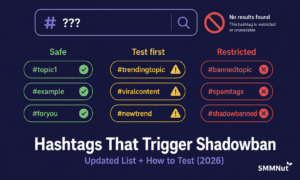
Using hashtags that TikTok has restricted, banned, or associated with policy-violating content categories will cause the content to enter a suppression state for those hashtags — and can extend to account-level if the pattern repeats. Restricted hashtags are not always obviously problematic: some are restricted due to temporary policy enforcement campaigns rather than permanent violation categories.
A video that does not appear in hashtag search results despite having been posted with that hashtag is a reliable indicator that the hashtag used is restricted. The specific hashtags that are currently triggering suppression in 2026 are covered in the updated list of hashtags that trigger TikTok shadowban in 2025.
Content Suppression vs Account Suppression
These two types of suppression have different causes and different recovery timelines:
| Type | Scope | Cause | Recovery Timeline |
|---|---|---|---|
| Content suppression | Affects one or a few videos | Single video policy flag, restricted hashtag use, one low-quality view delivery | 3–7 days after trigger removed or review resolves |
| Account suppression | Affects all new content | Multiple policy violations, repeated engagement anomalies, spam behaviour pattern | 7–21 days of correct behaviour; longer for persistent patterns |
How to Check If a Suppression Trigger Is Active
Before applying recovery steps, confirm which trigger is active on your account. The three most reliable checks:
- FYP traffic source check: In TikTok analytics, look at the traffic source breakdown for your most recent 3–5 videos. If the For You page source is under 10% across all recent content, account-level suppression is likely active.
- Hashtag visibility test: Post a new video with a non-restricted, low-competition hashtag. Search that hashtag 30 minutes after posting. If the video does not appear, content-level suppression or a restricted hashtag is active.
- Notification audit: Check your TikTok inbox notifications for any community guideline warnings. Even one policy notification in the previous 7–14 days is a likely suppression trigger.
Which Reasons Are Fixable — And How Quickly
Every cause of TikTok suppression is fixable, but the recovery timeline varies significantly:
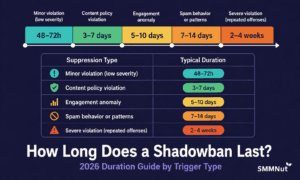
- Content policy violation (single video): Remove or appeal the video. Suppression typically lifts within 3–7 days of removal.
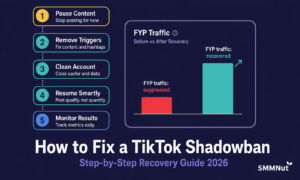
- Engagement anomaly from a view purchase: Stop purchasing views until suppression clears. Do not reorder from the provider that caused the anomaly. Allow 7–14 days of quality organic content before the distribution baseline recovers.
- Spam posting pattern: Reduce to 1–2 posts per day immediately. Allow 5–10 days for the algorithm to recalibrate based on the new posting cadence.
- Restricted hashtag use: Remove or replace the restricted hashtag across all recent content where it was used. Suppression linked to hashtag restriction typically lifts within 48–72 hours of removal.
- Interaction automation: Immediately stop using any third-party automation tools. This is the longest-recovery trigger — account-level suppression from automation tool use can persist 2–4 weeks and may require an account appeal to TikTok support.
The full step-by-step recovery protocol — including the posting pause, cache clear, and cadence recovery steps — is covered in the TikTok shadowban 2026 diagnosis and recovery guide. For the specific connection between view purchases and suppression risk, the mechanism is documented in the TikTok views safety and algorithm risk assessment.