What a TikTok Shadowban Actually Is
The term “shadowban” refers to a state where TikTok’s algorithm reduces or eliminates an account’s content from the For You Page feed without notifying the account holder. The account continues to function normally from the inside — posting works, followers can still see content, analytics load — but new content stops reaching non-followers through organic FYP distribution. This is distinct from a situation where the follow button itself stops working — if you are hitting TikTok’s follow limit or a follow block, that is an action restriction rather than a distribution issue and needs a different fix than the shadowban recovery steps below.
TikTok does not use the word shadowban in any official documentation. The platform does acknowledge “reduced distribution” and “limited visibility” as enforcement outcomes. These are the same phenomenon. The practical effect is that an account in this state posts into a distribution void: content is live, but the FYP recommendation engine has removed it from consideration.
Shadowban vs. Normal Low Reach: How to Tell the Difference
Before running a recovery protocol, confirm you are actually dealing with suppression rather than content underperformance. The two look similar in surface metrics but have different causes and different solutions.
| Signal | Algorithm Suppression (Shadowban) | Content Underperformance |
|---|---|---|
| Pattern across videos | All new posts drop simultaneously | Inconsistent — some posts still perform |
| Traffic source data | For You % drops to near zero | For You % varies but not absent |
| Onset timing | Sharp drop after a specific event | Gradual drift over time |
| Hashtag discovery | Video absent from hashtag results | Video appears in hashtag results |
| Search visibility | Account may not appear in search | Account appears normally in search |
| Follower view rate | Even follower feed reach may drop | Followers still see content normally |
The Three-Step Diagnostic Process
Step 1: Check Your Traffic Source Breakdown
Go to TikTok Analytics → Content → select a recent video → scroll to Traffic Source Types. In a normal distribution state, “For You” typically accounts for 60–90% of video views for accounts with strong FYP performance. If your last 3–5 posts all show For You at under 10–15% with no corresponding spike in any other source, you have a measurable suppression signal.
One video with low For You percentage is content underperformance. Three or more consecutive videos with near-zero For You percentage is suppression.
Step 2: Test Hashtag Visibility
Post a video using 2–3 low-competition hashtags that have fewer than 500K posts. Wait 30 minutes. Search those exact hashtags from a separate account (one that does not follow you) and look for your video in the results. If it does not appear under any of the hashtags within 2 hours of posting, your content is being excluded from hashtag discovery — a direct indicator of suppression-level filtering.
Step 3: Check Search Visibility
From a separate account, search your exact TikTok username. If your account does not appear in the search results, or appears significantly lower than expected, account-level suppression is confirmed. This test is most useful for accounts with an established presence; newer accounts may not appear in search regardless of suppression status.
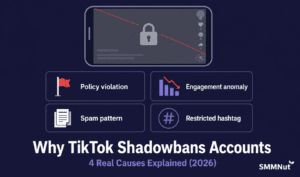
The Three Primary Causes of TikTok Shadowbans in 2026
Cause 1: Community Guideline Proximity Violations
TikTok’s content moderation system flags content that approaches — but does not necessarily cross — Community Guideline boundaries. Content about adult topics, weapons, health claims, political commentary, and certain product categories can trigger reduced distribution even when the content itself does not violate any specific rule. This is the most common cause of suppression for accounts that have never received an explicit violation notice.
The system is probabilistic: content that matches patterns associated with policy-adjacent material gets down-ranked in FYP distribution as a precaution. Repeated content in these categories across multiple videos causes the suppression to escalate from video-level to account-level.
Cause 2: Engagement Anomaly Flags
The second most common trigger is an engagement velocity event — a sudden follower spike, a rapid view accumulation, or an unusual like-to-view ratio that falls outside the account’s established behavioral baseline. The algorithm’s anomaly detection layer registers the event as potential inauthentic activity and initiates reach suppression while the account is evaluated.
This is the intersection between growth services and shadowban risk. Low-quality services that deliver bot followers or instant view spikes are a direct trigger for this category of suppression. High-quality services with real-account delivery and gradual timing are not — because the engagement event does not generate the anomaly signal the detection layer is monitoring. For the full breakdown of how engagement anomaly detection works, see how TikTok’s algorithm detects fake engagement.
Cause 3: Hashtag-Level Suppression Escalation
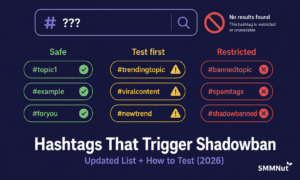
Certain hashtags are flagged by TikTok’s content moderation system — either permanently or in temporary response to trending misuse. Using flagged hashtags repeatedly causes video-level suppression that, if it persists across enough posts, escalates to account-level. This is particularly common with hashtags in health, beauty, relationship, and financial content categories where regulatory sensitivity is high.
The hashtag suppression path is one of the most misdiagnosed causes because the content itself may be entirely policy-compliant. The association with a flagged hashtag tag is enough to trigger the distribution filter at the video level.
The Week-by-Week Recovery Protocol
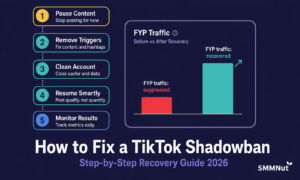
Week 1: Trigger Removal
- Stop posting policy-adjacent content immediately. Even content that has not generated explicit violations should be paused if it falls into sensitive categories.
- Audit your last 20 hashtags used. Remove any that appear on community-identified flagged hashtag lists. Switch to category hashtags and brand hashtags only for the recovery period.
- Pause any active engagement deliveries. Any growth service currently running should be paused until recovery is confirmed. New velocity events during suppression deepen the flag rather than resolving it.
- Do not delete recent posts. Deletion signals evasion behavior to the platform’s moderation system and can extend the suppression period.
Week 2: Positive Signal Accumulation
- Post 1–2 pieces of clearly policy-safe content daily. Short educational content, behind-the-scenes content, and response videos to existing comments are the lowest-risk content categories.
- Prioritize watch-time optimization. Strong hooks in the first 2–3 seconds and content under 30 seconds with high completion rates generate the positive quality signals that begin to override the suppression scoring.
- Engage actively with comments. Responding to every comment within the first hour of posting sends positive behavioral signals from the account side of the engagement relationship.
Week 3: Diagnostic Recheck
Repeat the three diagnostic tests from the beginning of this guide. Check traffic source breakdown on your most recent 3 posts. Run the hashtag visibility test. If For You percentage is recovering (moving from near-zero toward 20–40%), the suppression is lifting. If there is no change, audit for a second trigger that may not have been addressed in Week 1.
Week 4: Gradual Normalization
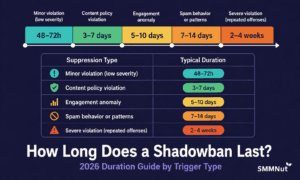
Most algorithmic shadowbans resolve within 2–4 weeks when the triggering behavior stops and positive signal accumulation begins. By Week 4, distribution typically normalizes back to the pre-suppression baseline. Accounts that experienced engagement-anomaly-triggered suppression may find their organic distribution baseline has reset lower than before — in which case the priority is rebuilding through consistent high-quality content rather than through new engagement events.
How to Prevent Suppression From Recurring
Prevention is more efficient than recovery. The three highest-leverage prevention practices are:
- Hashtag hygiene: Audit your standard hashtag set every 30 days. Hashtags that were safe six months ago may have since been flagged due to misuse by other accounts in the same tag space.
- Content category consistency: The algorithm builds a content profile for each account. Accounts that consistently post in a defined category receive more stable distribution than accounts that shift between category types. Sudden pivots into sensitive categories on an established account create the same pattern-matching flags as new accounts in those spaces.
- Growth service vetting: Using real-account-based services with gradual delivery eliminates the engagement anomaly trigger category. Accounts that use well-structured growth services — those that calibrate delivery to the account’s existing baseline — have significantly lower suppression risk from this trigger than accounts using instant or bot-based delivery. For the full criteria to evaluate any service, see the complete TikTok services overview on SMMNut.
For accounts that have experienced suppression and are evaluating whether to resume follower services after recovery, the guidance on how follower delivery interacts with FYP distribution applies directly — see whether buying TikTok followers hurts algorithm reach.