The Two Outcomes of Buying TikTok Views
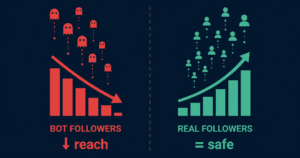
The question “does buying TikTok views work?” has two correct answers, and they depend entirely on what was delivered. Views from real accounts with genuine session behavior can extend a video’s FYP distribution window by signaling continued audience interest to the algorithm. Views from bot accounts or invalid session sources increase the view counter but register as low-quality signals that TikTok’s engagement validation layer discounts or flags.
Understanding which outcome you are getting requires understanding what TikTok actually measures when a view is recorded — and it is not just whether the video was opened.
How TikTok Validates a View: What the Algorithm Actually Measures
Watch Time Rate: The Primary Signal
The most heavily weighted signal in TikTok’s view quality audit is watch time rate — the percentage of the video that was actually watched. A view that accounts for 95% watch time sends a strong content quality signal to the algorithm. A view that accounts for 3% watch time — a view that was opened and immediately closed — is recorded in the counter but carries minimal positive weight in the distribution decision.
This is the core reason that view count and FYP momentum are not interchangeable metrics. Two videos can have identical view counts with completely opposite watch time profiles. The video with high watch time gets pushed to wider segments. The video with low watch time stalls.
Interaction Signal: What Happens After the View
TikTok tracks whether viewing accounts take any action following a view — a like, a comment, a share, a follow, or a visit to the profile. Organic views from genuinely interested audiences generate these secondary signals at rates the algorithm expects for content quality at each distribution tier. Views that never generate any secondary interaction, at any scale, represent an engagement pattern that falls outside the expected distribution for real audiences.
This does not mean every purchased view needs to generate a like. It means the aggregate ratio of interaction to view across a delivery batch needs to stay within the statistical range the algorithm associates with genuine audience behavior.
Session Continuity: The Account Behavior Context
The third validation dimension is whether the viewing account exhibits normal session behavior during and after the view event. A real TikTok user who watches a video continues scrolling, watching other videos, interacting with other content. An account that watches one video and immediately shows no further session activity — session closed, no subsequent events — is a behavioral outlier at any meaningful scale.
When a high percentage of views on a video come from accounts showing this pattern, the algorithm’s engagement quality score for that video drops. The view counter increases, but the algorithmic weight of that view total decreases.
Why View Count and FYP Distribution Are Different Metrics
Many users conflate view count with FYP reach, but the algorithm does not treat them as equivalent. View count is a display metric — visible on the video, visible to external audiences, useful for social proof. FYP distribution is determined by the quality-weighted engagement score the algorithm calculates from the view session data, not the raw counter.
A video with 10,000 views that achieved those views through a combination of high watch time, interaction signals, and genuine session behavior has a quality-weighted engagement score that pushes the video to the next distribution tier. A video with 10,000 views from low-quality sources has a high counter and a low quality-weighted score — it may not advance past the tier it was in when the delivery occurred.
| Signal Type | High-Quality Views | Low-Quality Views |
|---|---|---|
| View counter | Increases | Increases |
| Watch time rate | High (60–100% typical) | Low (under 10%) |
| Interaction signal | Present at expected rates | Absent or near-zero |
| Session continuity | Normal post-view behavior | Session drop after view |
| FYP distribution effect | Extends distribution window | Minimal to no extension |
| Algorithm response | Push to wider distribution tier | Stall or suppression flag |
When Buying Views Produces Real Algorithm Momentum
Purchased views produce genuine FYP momentum when the delivery passes TikTok’s view validation layer — the standard behind algorithm-validated TikTok views. The three conditions that determine this are delivery source, delivery timing, and volume calibration.
Delivery Source: Real Accounts With Session History
Views from real TikTok accounts with behavioral histories produce watch time and session continuity data that the algorithm accepts as valid engagement. These accounts watch through more of the video, are statistically more likely to interact, and continue normal session behavior after viewing. The view event is indistinguishable from an organic view from the algorithm’s measurement perspective.
Delivery Timing: Gradual Over 24–48 Hours
Organic video discovery happens in waves as TikTok tests content across progressively wider audience segments. A view delivery that arrives in a natural-looking wave pattern — not all in the first 10 minutes — aligns with the distribution pattern the algorithm expects to see when a video is genuinely picking up organic momentum.
An instantaneous delivery of thousands of views with no corresponding organic distribution event is the velocity pattern anomaly detection monitors. For the full breakdown of how TikTok’s anomaly detection system works across all engagement types, see how TikTok’s algorithm detects fake engagement.
Volume Calibration: Proportional to Current Performance
A video from an account averaging 300 views per post receiving a 50,000-view delivery has created a volume anomaly even if the delivery quality is otherwise high. The algorithm cross-references view delivery against the account’s established performance baseline. Starting with a volume within the range the account’s best-performing videos have achieved organically, then scaling from there, keeps the distribution event within the expected range.
How to Verify Whether a Views Delivery Worked
After any views delivery, the verification process relies on your TikTok analytics data, not the view counter itself.
What to Check in TikTok Analytics
- Average watch time percentage: If this stayed stable or improved on the delivered video relative to your recent average, the views passed the watch time quality test.
- Traffic source breakdown: A views delivery that triggered genuine FYP momentum will show an increase in the “For You” traffic source percentage. If all new views are in the same traffic bucket as the delivery source and For You percentage did not increase, the delivery extended your counter but did not amplify organic reach.
- Profile visits and follows from the delivered video: Real-account views generate some secondary conversion even at low rates. Zero profile visits from a high-view delivery is a signal the session data was low quality.
For a complete guide to reading these metrics and diagnosing what they indicate about algorithm performance, see how to read TikTok analytics and fix what the algorithm is penalising.
The Honest Answer: Does Buying Views Work?
High-quality views from real accounts, delivered gradually and calibrated to your baseline: yes, they work as a distribution amplifier. They extend the window in which the algorithm evaluates the video, and the quality signals they produce can push the video to a wider audience tier it would not have reached organically.
Low-quality views from bot sources: no, they do not work as an algorithm tool. They increase the display counter, which has a social proof function, but they do not generate the watch time and session continuity data the algorithm uses to determine distribution eligibility. In some cases, they actively suppress organic reach through engagement ratio distortion.
The decision about which service to use should be based on what the delivery methodology actually is — not the price or the speed. For the full range of TikTok views options available, see the complete TikTok services overview on SMMNut.