Why Reach Suppression Is Predictable, Not Random
Creators who experience sudden reach drops typically attribute them to the platform “changing the algorithm” or shadowbanning them without cause. In practice, most reach drops follow directly from specific account behaviors that produce measurable negative signals in TikTok’s scoring model. The algorithm is not arbitrary — it responds predictably to the signals it receives. Understanding which inputs generate which outputs makes reach suppression diagnosable and correctable.
The four mistakes covered here are not theoretical — they are the consistent pattern behind the majority of reach suppression cases that creators report across community forums, creator economy research, and analytics audits. Each one has a specific algorithmic mechanism and a specific recovery protocol.
Pitfall 1: Content Category Inconsistency
What It Is
TikTok’s algorithm builds a content profile for each account based on the category, topics, and interest clusters of its posted content. This profile determines which seed audience segment the algorithm uses when testing new content. When an account consistently posts in one category — fitness, cooking, tech, comedy — its content profile becomes highly refined, and the algorithm delivers it to seed audiences with strong interest matching. Strong matching produces higher initial engagement rates, which advances distribution.
Content category inconsistency occurs when an account shifts between unrelated topics across posts. A fitness account that posts occasional cooking content and occasional comedy clips has a diluted content profile. The algorithm cannot confidently classify the next post, so it tests with a lower-confidence audience match — producing weaker initial engagement and limiting advancement.
Why the Algorithm Penalises It
The suppression is not a punishment — it is a prediction failure. The algorithm’s seed test system is built on its ability to predict which audience will engage with a piece of content. Category-inconsistent accounts make accurate prediction harder, and the algorithm defaults to conservative distribution when its confidence in the audience match is low.
Recovery Steps
- Identify your primary content category and commit to it for a minimum of 20 consecutive posts.
- If you have legitimate reasons to post in multiple categories, create a secondary account for the secondary category rather than mixing on your primary account.
- Use consistent audio, caption style, and visual presentation across posts — these are secondary category signals the algorithm uses alongside content topic.
Pitfall 2: Inconsistent Posting Cadence and Sudden Activity Gaps
What It Is
The algorithm maintains a performance baseline for each account updated on a rolling window. This baseline influences the initial distribution conditions for each new post. Consistent posting — even at modest frequency — produces a stable baseline with predictable distribution behavior. Sudden gaps followed by bursts of activity create baseline instability that shows up as unpredictable reach performance.
The specific pattern that generates the most suppression risk is posting daily for several weeks, going silent for 2–3 weeks, then attempting to post daily again. The account’s distribution baseline recalibrates downward during the gap, and the return to high-frequency posting does not immediately restore the previous baseline — the algorithm treats the reactivated account similarly to a new account re-entering the test cycle.
Why the Algorithm Penalises It
The algorithm’s baseline system is designed around consistency as a signal of account quality. Accounts with stable, predictable activity patterns have more reliable performance data, which gives the algorithm higher confidence in its distribution predictions. Activity-gap accounts introduce uncertainty into that model.
Recovery Steps
- Choose a posting frequency you can sustain for 60+ days and commit to it — 3 times per week consistently outperforms 7 times per week for 2 weeks followed by silence.
- If a gap has already occurred, treat the return as a soft relaunch: post high-quality content optimized for watch time and completion rate for the first 10 posts back to rebuild the performance baseline before attempting volume.
- Do not attempt to compensate for a gap by posting high volumes immediately after — this adds velocity anomaly risk on top of the baseline disruption.
Pitfall 3: Engagement Bait Behaviors
What It Is
Engagement bait is the use of explicit prompts designed to generate interactions without generating genuine interest — “comment YES if you agree,” “follow me to see part 2,” “like this if this happened to you.” TikTok’s algorithm specifically monitors for engagement patterns that deviate from natural organic interaction behavior, and engagement bait produces exactly the kind of artificial interaction spike that triggers negative scoring.
The problem is not that the prompt generates interaction — it is that the interaction quality is low. Viewers who comment “YES” because they were prompted to have not demonstrated genuine content appreciation. The algorithm measures whether interactions come from accounts that stay on the platform, watch more content, and maintain normal session behavior after interacting. Prompted interactions often come from accounts that interact and immediately scroll past — a behavioral pattern the algorithm distinguishes from genuine interest-driven interaction.
Why the Algorithm Penalises It
Engagement bait inflates interaction counters while degrading interaction quality scores. The algorithm’s content quality model uses the ratio of high-quality interactions (saves, shares, genuine comments) to low-quality interactions (prompted single-word responses, follow-for-follow patterns). A sustained pattern of engagement bait posting shifts this ratio in the negative direction and reduces distribution range over time.
Recovery Steps
- Remove explicit engagement prompts from captions. Replace with content that earns interaction organically — questions that genuinely invite opinion, incomplete information that prompts curiosity-driven comments, or content so useful that saves happen without prompting.
- Focus on share-worthy content for 20+ posts after a heavy engagement-bait period to rebalance the interaction quality ratio.
- Monitor the comment quality on new posts — if the comments become more substantive and varied (rather than prompted single-word responses), the interaction quality signal is recovering.
Pitfall 4: Over-Reliance on Trending Sounds for Distribution
What It Is
Trending sounds on TikTok increase discovery surface area — a video using a viral sound appears in the sound’s browseable content feed, which can drive significant traffic spikes. This creates an over-reliance pattern: an account discovers that trending sound usage drives views and begins using trending sounds as the primary reach strategy, regardless of whether the sound is relevant to the content.
The algorithm problem created by this pattern is a content profile signal conflict. The account builds a profile based on its content topics and consistent posting behavior. Sudden adoption of unrelated trending sounds introduces audio category signals that conflict with the established content profile. This does not generate direct suppression, but it degrades the content profile matching quality — the same mechanism as content category inconsistency.
Why the Algorithm Penalises It (Indirectly)
Trending sounds drive traffic from audiences who are following the sound, not audiences who are interested in the account’s content category. These viewers have low content-to-interest match, which produces lower watch time rates on the video despite higher raw view counts. The high view count from sound traffic combined with low watch time rate creates a negative quality signal that can reduce subsequent distribution on the account’s following posts.
Recovery Steps
- Use trending sounds only when they are genuinely relevant to your content — when the audio enhances the content rather than simply being attached to it for discovery purposes.
- When a trending-sound video underperforms on watch time despite high view counts, do not let it anchor your next post’s distribution conditions. Follow it immediately with a strong-performing content format to reset the quality signal baseline.
- Treat sound strategy as audience matching: the right trending sound brings the right audience. The wrong trending sound brings volume that degrades your quality metrics.
How to Diagnose Which Pitfall Is Active
Run a quick audit before starting any recovery protocol. Review your last 20 posts and your analytics for the past 30 days:
- Check content category spread: How many different topic categories appear in your last 20 posts? More than 3–4 distinct categories = Pitfall 1 likely active.
- Check posting frequency timeline: Were there any gaps longer than 10 days in the past 60 days? Did you have any burst periods followed by silence? Pitfall 2 likely active if yes.
- Audit caption patterns: How many of your last 20 posts contain explicit engagement prompts (“comment,” “follow for,” “like if”)? More than 30% = Pitfall 3 likely active.
- Check watch time rate on trending-sound posts vs. original-audio posts: If trending-sound posts consistently show lower watch time despite higher view counts, Pitfall 4 is generating a quality drag.
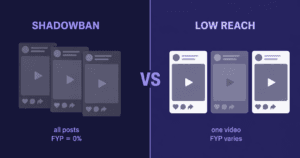
For a complete understanding of the algorithm’s scoring model that underlies all four of these pitfalls, see TikTok algorithm 2026 explained: how the FYP actually decides what gets shown. If your reach has dropped sharply and you suspect active suppression rather than gradual decline, run the diagnostic from the 2026 shadowban recovery guide first to rule out an active account-level flag before applying the pitfall recovery protocols above.
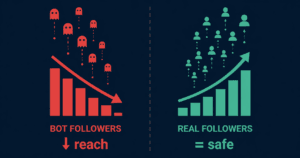
For accounts that have used engagement or follower services and are concerned about whether those services contributed to a reach decline, the detection mechanics and risk framework are covered in detail at how TikTok’s algorithm detects fake engagement. A full overview of all TikTok growth service options is available at the complete TikTok services overview on SMMNut.